


More news on this day
Representative Young Kim is pressing Secretary of State Marco Rubio to elevate the U.S. travel advisory for mainland China, arguing that a higher risk rating is needed after Washington warned of wrongful detentions and exit bans but stopped short of upgrading its official guidance.
Get the latest news straight to your inbox!
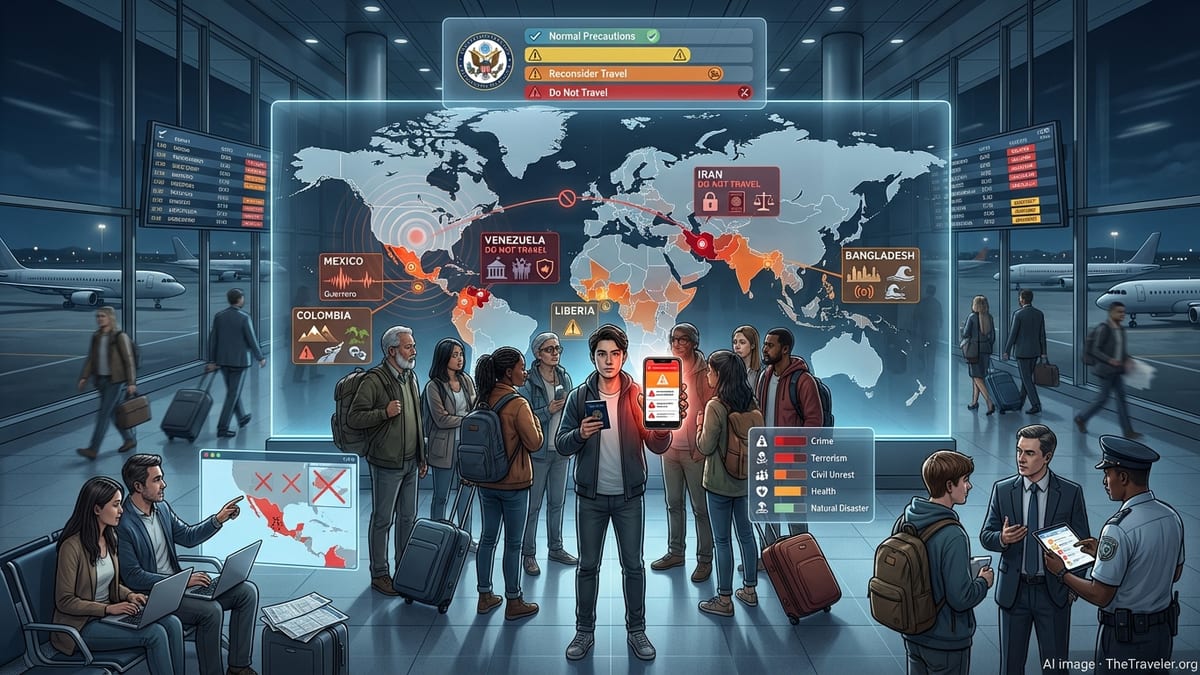
Call to Raise China’s Advisory to Level 3
In an October 29 letter, disclosed in a press release from her office, House Foreign Affairs East Asia and Pacific Subcommittee Chair Young Kim urged Secretary of State Marco Rubio to move the U.S. travel advisory for the People’s Republic of China from Level 2, “Exercise Increased Caution,” to Level 3, “Reconsider Travel.” Publicly available information on the letter indicates that Kim frames the current advisory as understating the nature of the threat faced by U.S. citizens.
The request follows the State Department’s October 19 update to its China advisory, which added a prominent warning that travelers face an increased risk of wrongful detention, arbitrary enforcement of local laws and the use of exit bans, while keeping the overall advisory at Level 2. Kim’s appeal contends that this combination sends a mixed signal, highlighting serious state-driven risks without reflecting them in the top-line risk category.
According to summaries of the letter, Kim argues that China should not share the same advisory tier as countries such as Italy, Germany or the United Kingdom, where identified risks are more often linked to localized security concerns or non-state actors. In her view, the pattern of detentions and exit bans in China represents a systemic, countrywide risk that justifies a formal request for Americans to reconsider travel.
The letter also points to specific cases of U.S. citizens, including Min Zin and Youlin Chen, as examples of what congressional materials describe as “hostage diplomacy.” Kim is pressing for these cases to be highlighted directly on the China advisory page to give potential travelers concrete illustrations of the dangers being cited.
What the Current China Travel Advisory Says
As of the October 19 update, the State Department lists mainland China at Level 2 on its four-tier advisory scale, with two risk indicators attached: “Wrongful Detention” and “Other.” Publicly available guidance explains that U.S. citizens may face arbitrary enforcement of local laws, exit bans imposed without a transparent legal process, and the risk of being detained in cases that Washington later assesses as wrongful.
The advisory points to broad national security, counterespionage and data security laws that give Chinese authorities extensive discretion to question or restrict foreign nationals. It notes that even routine business, research, academic and professional activities can draw scrutiny, and that individuals may be subject to questioning, searches of electronic devices or wider surveillance during their stay.
Several groups are identified as facing elevated exposure, including U.S. citizens of Chinese heritage, individuals involved in business disputes, and anyone with current or prior ties to U.S. law enforcement, the military, intelligence agencies or other parts of the federal government. Travelers on U.S. government-funded programs are similarly flagged as potentially vulnerable to exit bans or detention.
The advisory also highlights practical constraints that could affect travelers if something goes wrong, such as limited consular access in certain regions, especially the Tibet Autonomous Region, and the possibility of lengthy pre-trial detention. U.S. citizens are urged to enroll in the Smart Traveler Enrollment Program, ensure that family or employers hold copies of travel documents, and prepare communication plans in case contact is suddenly cut off.
How Level 2 and Level 3 Advisories Differ
The State Department’s global advisory system uses four levels, from Level 1 “Exercise Normal Precautions” to Level 4 “Do Not Travel.” According to public guidance, Levels 1 and 2 are typically reviewed at least every 12 months, while Levels 3 and 4 are reassessed at least every six months, reflecting a higher baseline risk.
Level 2, the category that currently applies to China, signals that travelers should “Exercise Increased Caution” in light of identified security or safety concerns. Many popular destinations fall into this tier, including some European and Latin American countries, where issues such as crime, civil unrest or health conditions warrant additional vigilance but not a broad recommendation against travel.
Level 3, by contrast, carries a clear instruction to “Reconsider Travel.” Destinations in this category are considered to present more serious risks, which may include widespread crime, persistent civil unrest, terrorism, or other conditions that could significantly affect personal safety and consular support. This level is typically reserved for countries where the overall situation is considered unstable or where Americans can face severe legal or security consequences.
Kim’s letter relies on this distinction to argue that China’s combination of state-driven wrongful detentions, far-reaching security laws and the use of exit bans places it closer to those higher-risk profiles. Public travel-risk tables published by the State Department show China currently grouped with a broad set of Level 2 countries, while several destinations with persistent violence or political instability are placed in Level 3 or Level 4.
Wrongful Detention Concerns and Named Cases
Concerns about China’s treatment of foreign nationals have intensified through 2026 as individual cases have drawn attention in both congressional hearings and independent reporting. Earlier this year, U.S. officials designated at least two U.S. citizens, Min Zin and Youlin Chen, as wrongfully detained under U.S. law, a classification that triggers enhanced diplomatic efforts and higher-level scrutiny.
Recent coverage indicates that these cases are central to Kim’s argument. The lawmaker’s letter calls for the State Department to identify the individuals by name on the China advisory page so that travelers can see real-world examples of the risks being described. Public accounts of these detentions describe long periods of limited information, restricted access to legal representation, and the possibility that political or diplomatic factors may influence the path to release.
The October 19 advisory update itself underscores the risk of exit bans and wrongful detention, warning travelers that they could be prevented from leaving China while local legal or political issues are pending. It notes that such measures may be imposed without clear explanation or timely judicial review, and that access to U.S. consular assistance may be delayed or constrained in practice even when formal notification requirements exist.
Travel-risk reporting in recent weeks has also highlighted what analysts describe as a broader trend in which states leverage foreign detainees in geopolitical disputes. In this context, debates in Washington over how to label and communicate risk in China are unfolding alongside separate discussions about other countries already subject to Level 3 or Level 4 advisories connected to wrongful detention and related concerns.
Implications for U.S. Travelers Planning Trips to China
For travelers considering trips to China, the latest developments add a new layer of complexity to risk planning. As of late October, the official advisory remains at Level 2, and there has been no public move to adopt the Level 3 designation requested by Kim. However, the combination of the new wrongful detention warning, continued congressional scrutiny and the potential for future changes suggests that conditions and guidance could evolve.
Publicly available travel information recommends that anyone contemplating nonessential travel to China review their personal risk profile carefully, particularly if they have Chinese heritage, business disputes in the country, or any current or former ties to the U.S. government or defense sector. Travelers are encouraged to ensure their passports and visas are fully in order, understand local registration requirements, and maintain up-to-date contact details with family or employers at home.
The advisory notes that U.S. citizens must generally enter China on a valid U.S. passport with an appropriate Chinese visa, that passports must be valid at least six months beyond arrival, and that entry and exit rules for currency and other items are strictly enforced. It reiterates that China does not recognize dual nationality in practice, a factor that can significantly limit U.S. consular assistance to dual citizens who enter on Chinese documents or hold Chinese identity papers.
While most visitors continue to report trips without serious incident, open-source travel guidance emphasizes that conditions can change with little notice and that legal processes may differ sharply from those in the United States. The debate sparked by Kim’s letter ensures that China’s risk rating will remain a live question in Washington, and travelers watching for any shift from Level 2 to Level 3 are likely to pay close attention to the State Department’s next round of updates.