


More news on this day
Ethiopian Airlines is moving closer to a landmark Boeing 777-8 Freighter commitment that would expand Africa’s largest cargo carrier into a more formidable global player, tying next-generation aircraft capacity to Addis Ababa’s fast-growing logistics hub and the airline’s long-term Vision 2035 strategy.
Get the latest news straight to your inbox!
From Memorandum to Potential Firm Order
Boeing and Ethiopian Airlines first signed a memorandum of understanding (MoU) for the 777-8 Freighter in March 2022, positioning the carrier among the early customers for the next-generation widebody cargo aircraft. Publicly available information shows that the MoU covered up to five 777-8F aircraft, intended to complement Ethiopian’s existing fleet of Boeing 777-200F jets and future converted freighters.
Recent industry coverage indicates that the airline is now edging closer to turning that preliminary agreement into a firm contract, roughly four years after the initial MoU. Reports describe the negotiations as part of a broader long-term fleet strategy in which Ethiopian continues to weigh aircraft performance, delivery timelines, and financing conditions, while also assessing competing options from Airbus.
The prospective 777-8F order would deepen a long-standing relationship between Ethiopian and Boeing in the cargo segment. Ethiopian was Africa’s first operator of the 777 Freighter and remains one of the type’s largest users on the continent, relying on the aircraft for high-volume trade lanes between Africa, Europe, the Middle East, Asia, and North America.
Data compiled in public fleet listings show that Ethiopian already operates ten 777-200F freighters and has additional cargo capacity coming through 777-300ERSF conversions later in the decade, underscoring how an eventual 777-8F order would sit at the top of a multi-layered widebody freight fleet.
Africa’s Cargo Powerhouse Builds Scale
Ethiopian Cargo & Logistics Services is widely described as the largest air cargo network operator in Africa, with a dedicated freighter fleet and a sizable belly-hold operation on passenger aircraft. The airline’s own fact sheets and cargo division materials indicate that it currently serves more than 60 dedicated cargo destinations, supported by over 130 passenger aircraft and a daily uplift of thousands of tons of freight across six continents.
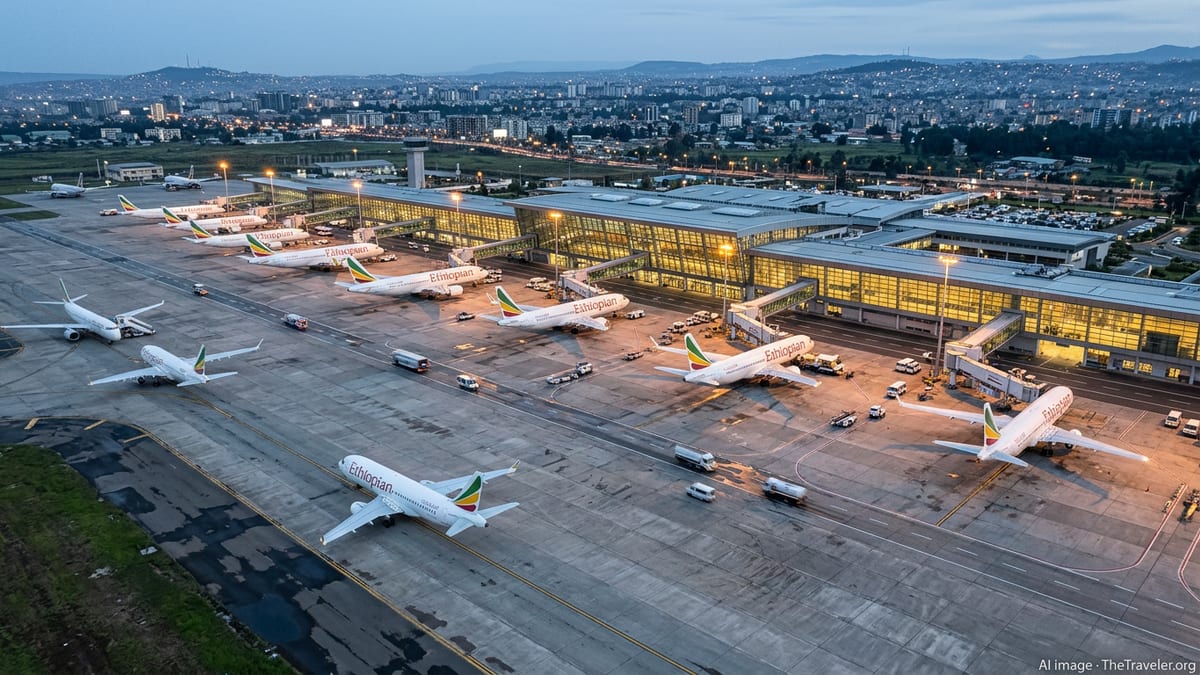
The carrier’s hub at Addis Ababa Bole International Airport anchors this growth. According to Ethiopian’s cargo division, the airline operates a cargo terminal complex capable of handling well over half a million tons annually, including specialized cold-chain facilities for perishable exports such as flowers, fruit, and pharmaceuticals that remain critical for African trade.
Analytical reports on African air freight highlight Ethiopian as the dominant player on the continent by both passenger and cargo volumes, with Addis Ababa now functioning as Africa’s largest air cargo hub. Industry analyses point to Ethiopian’s ability to connect secondary African cities with markets in Europe, Asia, and North America as a key driver of its competitive edge, especially in sectors like fresh produce and high-value manufacturing.
This scale has translated into consistent financial and network expansion. Trade and investment briefings on Ethiopia’s aviation sector note that Ethiopian Airlines has recorded average revenue growth of around 20 percent over the past decade, helped significantly by its cargo expansion. The airline is now executing its “Vision 2035” roadmap, which calls for more than tripling cargo volumes to around 3 million metric tons annually and substantially enlarging its fleet and global footprint.
Why the Boeing 777-8F Matters for Ethiopian
The 777-8 Freighter is Boeing’s forthcoming flagship cargo variant of the 777X family, designed to offer payload and range capabilities comparable to or better than the current 777F while targeting improved fuel burn and emissions. Public technical information suggests that the 777-8F will carry a payload approaching that of the 747-400F, but with a twin-engine efficiency profile, an attractive proposition for airlines scaling global operations.
For Ethiopian, the aircraft’s performance aligns with ambitions to deepen long-haul links between Africa, Asia, Europe, and North America. Cargo demand forecasts and African trade studies point to continued growth in sectors such as e-commerce, pharmaceuticals, and time-sensitive manufacturing, much of it moving along long-distance corridors that benefit from high-payload, fuel-efficient widebodies.
Industry backgrounders on Boeing’s African customers show that Ethiopian has already signaled its intent to modernize and upgauge its freighter fleet, pairing existing 777Fs with future 777-8Fs as older types phase out or are redeployed. The addition of the 777-8F would allow Ethiopian to consolidate capacity on key trunk routes while freeing other freighters for regional and secondary markets, reinforcing a hub-and-spoke cargo model centered on Addis Ababa.
At the same time, ongoing consideration of Airbus alternatives suggests that Ethiopian is using the competitive landscape to optimize commercial terms and technical fit. Reports indicate that the airline has evaluated the Airbus A350F alongside the 777-8F as part of its next-generation widebody freighter strategy, a sign of how pivotal this fleet decision is for its long-term cargo positioning.
New Routes Highlight Wider Global Ambitions
While fleet negotiations progress, Ethiopian continues to expand its cargo network. In late August 2026, the airline launched a direct freighter route linking Chengdu in western China with Addis Ababa, establishing a new corridor between one of China’s fastest-growing manufacturing regions and African markets. Coverage of the route launch notes that cargo arriving in Addis Ababa can be redistributed across the airline’s extensive African network, effectively turning the Chengdu connection into a broader China–Africa logistics bridge.
Specialist aviation outlets report that Addis Ababa already serves more than 30 cargo destinations within Africa alone, up sharply from a significantly smaller network just a few years ago. Additional freighter and belly-hold capacity from China, Europe, the Middle East, and the Americas supports this intra-African distribution model, making the Ethiopian hub a key relay point for goods moving between continents.
The airline is also investing heavily in infrastructure to support this growth. Publicly available information on Ethiopian’s cargo facilities shows a recently inaugurated e-commerce logistics warehouse at Bole International Airport, designed to handle mail, courier, and online retail flows with dedicated handling systems. The carrier has described this facility as part of its plan to position Addis Ababa as an e-commerce gateway for Africa, tapping into rising digital trade across the continent.
Together, new routes, expanded facilities, and prospective next-generation freighters illustrate a layered approach in which Ethiopian seeks not only to move more tonnage, but also to capture higher-yield, time-critical segments such as express parcels, pharmaceuticals, and specialty perishables. The 777-8F, if ordered and delivered on schedule, would be a central tool in sustaining this momentum on the airline’s longest and densest trade lanes.
Positioning Addis Ababa as a Global Logistics Hub
Ethiopian’s public strategy documents consistently frame cargo as a core pillar of the group’s long-term growth, not a secondary business line. Vision 2035 targets an extensive global network, a more than doubled fleet, and a leading position among the world’s top cargo airlines measured by traffic. The cargo division’s mission statements emphasize safe, reliable, and market-driven services that leverage a “SMART logistics hub” in Addis Ababa to link Africa with every major world region.
Regional aviation analyses describe how this strategy fits into a broader push to enhance air transport connectivity in Africa, where surface logistics constraints make air freight especially important for landlocked and infrastructure-poor markets. By building a dense network of cargo routes, Ethiopian is able to offer exporters and importers in smaller African economies a direct link into global supply chains, using Addis Ababa as the pivot point.
Securing next-generation freighters such as the 777-8F would help lock in that role as competition intensifies. Other African hubs, including Cairo and Nairobi, are also investing in cargo facilities and airline partnerships, while Gulf and European carriers continue to vie for Africa-related freight. Ethiopian’s move toward a 777-8F deal signals an intent to stay ahead of that curve by combining fleet modernization with network depth and specialized logistics infrastructure.
As negotiations progress, the outcome of Ethiopian’s freighter choices will be closely watched across the industry. For Boeing, a firm 777-8F order from Africa’s cargo heavyweight would reinforce the aircraft’s position in the global market. For Ethiopian, it would mark another step toward transforming Addis Ababa from a continental champion into a fully fledged global cargo hub.
Boeing and Ethiopian Airlines 777-8F MoU
Ethiopian Cargo & Logistics Services overview