


More news on this day
Travel between the United Arab Emirates and the United Kingdom faced fresh disruption after an Etihad Airways Airbus A380 service from Abu Dhabi to London Heathrow was forced to return to its departure airport following a reported onboard technical issue.
Get the latest news straight to your inbox!
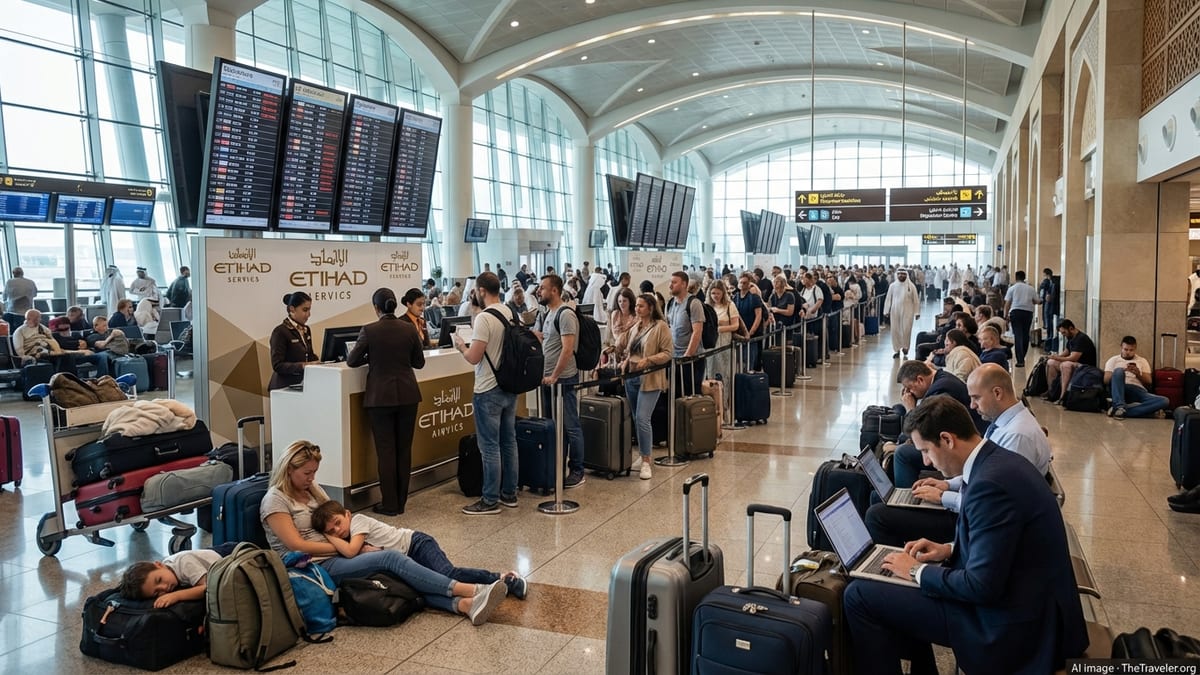
Midroute U-Turn Disrupts Flagship A380 Service
According to published coverage from aviation industry outlets, Etihad Airways flight EY061 departed Abu Dhabi’s Zayed International Airport on 20 May bound for London Heathrow before turning back to the UAE shortly after takeoff due to a technical problem on board. The aircraft involved was one of the carrier’s Airbus A380 superjumbos, a flagship type on the busy Abu Dhabi to London route.
Flight tracking data referenced in those reports indicates that the widebody jet climbed out of Abu Dhabi, entered its initial cruise sector and then began a turn that brought it back toward the Gulf. The aircraft subsequently landed at Zayed International Airport, where passengers disembarked and were reprocessed by ground teams.
No injuries were reported in connection with the incident, and publicly available information suggests the decision to return was precautionary while the technical issue was investigated. The episode nonetheless caused a chain reaction of delays and missed connections for travelers whose journeys linked the UK and wider global network through Etihad’s Abu Dhabi hub.
The affected rotation also constrained aircraft availability on a route that has been central to Etihad’s recovery strategy and the high-profile return of its A380 fleet on select long haul services.
Knock-on Effects for London-bound and Returning Passengers
Reports on the disruption note that the return of EY061 to Abu Dhabi led to a delay for the corresponding London to Abu Dhabi leg, EY062, as the aircraft and crew were no longer in position at Heathrow. Passengers booked on the outbound sector from the UK faced schedule changes, rebookings and in some cases missed onward connections through the UAE.
Travelers originating in Abu Dhabi were also affected. Many use the morning A380 departure to connect onward from London to other destinations in Europe and North America, relying on tight transfer windows. With the aircraft back on the ground in the UAE rather than continuing to the UK as planned, those itineraries required extensive re-accommodation.
Aviation analysts commenting in trade coverage highlight that disruptions on trunk routes such as Abu Dhabi to London can have outsized effects across an airline’s network because of the large number of connecting passengers. The A380’s high seating capacity further amplifies the impact, concentrating several hundred travelers on a single aircraft rotation.
For travelers already facing an unsettled period in international aviation, the combination of missed meetings, lost hotel nights and reshuffled itineraries underscores how a single in-flight technical issue can ripple across multiple markets in a matter of hours.
Technical Reliability Under Spotlight for Superjumbo Operations
While modern long haul aircraft are designed with multiple redundancies, any anomaly that could affect safety typically prompts a conservative response, including route diversions or returns to the departure airport. Aviation reports indicate that this latest incident fits into that standard operational pattern, with the crew opting to discontinue the London sector and have the aircraft inspected in Abu Dhabi.
The technical nature of the issue has not been detailed in open sources, but industry observers note that the Airbus A380, like other complex widebody types, requires intensive maintenance and monitoring as it accumulates flight hours. Etihad returned the type to commercial service on the London route as part of a broader post-crisis rebuilding of long haul capacity, making operational reliability a priority.
Published commentary suggests that the airline is unlikely to alter its wider A380 deployment strategy based on a single technical event, particularly given the aircraft’s role on other high-demand routes. However, the incident reinforces how quickly operational challenges can emerge even on well-established services linking major global hubs.
Safety regulators and industry bodies generally emphasize that precautionary returns such as this are a sign of rigorous safety protocols rather than systemic failure, though for travelers the immediate experience is one of disruption and uncertainty.
Growing Capacity Between Abu Dhabi and Europe Meets Volatile Conditions
The disruption comes as Etihad has been moving to substantially increase capacity between Abu Dhabi and key European gateways. In the days leading up to the incident, the airline announced plans to operate two daily Airbus A380 services plus a third daily Boeing 787 flight on the Abu Dhabi to Paris Charles de Gaulle route from July, in a bid to capture growing premium and connecting demand.
Industry reporting portrays this expansion as part of a broader strategy to restore and in some cases exceed pre-pandemic frequencies on high-yield routes, including London, Paris and other major European capitals. The A380 redeployment is central to that effort, offering premium cabins and large economy cabins that appeal to both business and leisure travelers.
At the same time, travelers in and out of the Gulf have been dealing with a fluid operating environment, with earlier episodes of regional airspace restrictions and weather-related disruption still fresh in memory. The latest London service complication illustrates how quickly localized technical issues can add to an already complex travel landscape for passengers moving between Europe, the Middle East and beyond.
For the United Kingdom market in particular, where London Heathrow acts as a crucial transfer point for traffic to North America and across Europe, any instability in long haul feeder services from the Gulf can have knock-on implications for tourism flows, business travel and diaspora journeys connecting through the UK.
What Travelers Between the UAE and UK Should Expect Next
For future passengers booked on Etihad services between Abu Dhabi and London, travel advisories issued through public channels encourage close monitoring of flight status before departure and allowing additional buffer time for connections. In the near term, operational recovery from the EY061 disruption is expected to involve aircraft swaps, schedule adjustments and continued re-accommodation for affected customers.
Analysts note that carriers frequently respond to such events by tightening maintenance checks on the affected fleet type and reviewing crew procedures, steps that may not be visible to travelers but can occasionally lead to further short term schedule changes. The objective is to restore confidence in the reliability of key trunk routes while maintaining strict adherence to safety protocols.
For now, the incident serves as a reminder that even as airlines rebuild networks and add capacity on in-demand city pairs like Abu Dhabi to London, individual flights remain vulnerable to unforeseen technical issues. Passengers planning trips between the United Arab Emirates and the United Kingdom may wish to factor in the potential for last minute disruption, particularly when planning tightly timed connections.
Despite the setback, publicly available schedules still show a robust program of A380 and other widebody services linking the two countries, reflecting enduring demand for travel between the Gulf and the UK and the strategic importance of the route for both tourism and commerce.