


More news on this day
Thousands of travelers heading into the Memorial Day weekend are facing disruptions after a sinkhole discovered near a main runway at New York’s LaGuardia Airport forced the closure of the strip and triggered widespread delays and cancellations.
Get the latest news straight to your inbox!
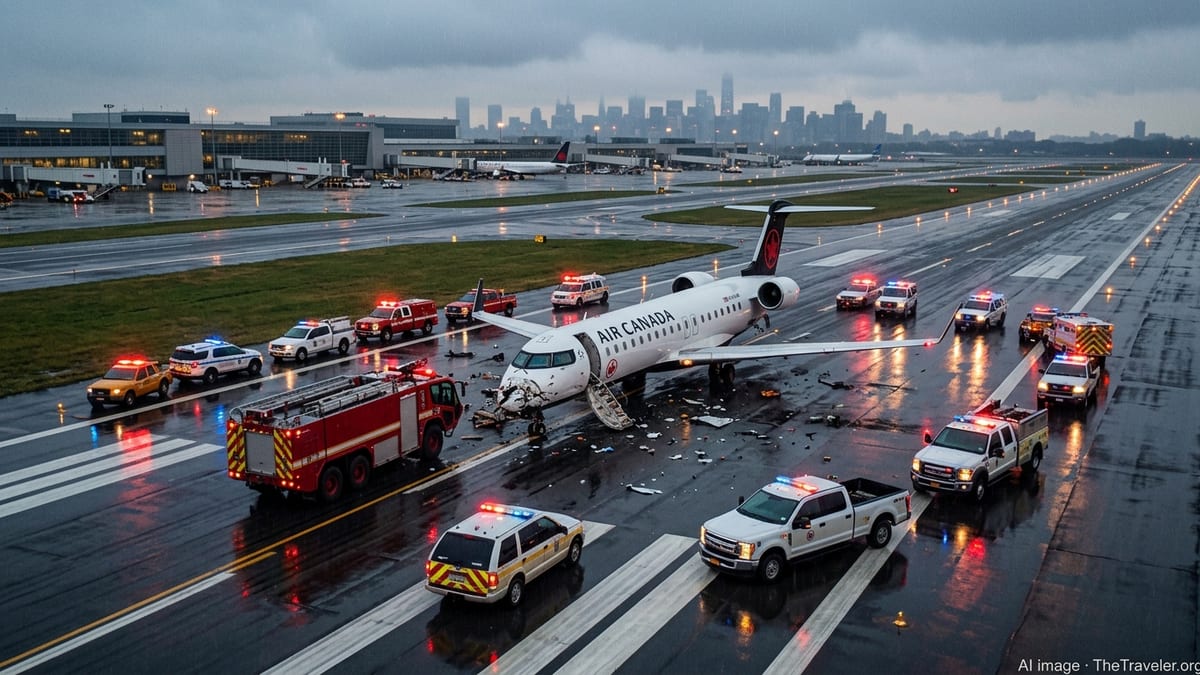
Runway 4/22 Shut After Routine Inspection Finds Sinkhole
The sinkhole was identified late Wednesday morning, May 20, during a standard inspection of LaGuardia’s airfield. Publicly available information from the Port Authority of New York and New Jersey indicates that the depression was found on a taxiway at the edge of Runway 4/22, one of the airport’s two primary runways. The affected runway was taken out of service immediately while crews moved in to stabilize the area.
Images shared by regional broadcasters show construction and engineering teams working around the damaged section of pavement near the Queens waterfront. Reports indicate that the sinkhole formed in a section of the airfield built on historic fill, a reminder of the underlying complexity of maintaining infrastructure on reclaimed shoreline.
According to multiple news outlets, the discovery prompted the Federal Aviation Administration to slow arrivals into LaGuardia, citing a combination of the runway issue and unsettled weather in the region. With only one main runway fully operational, the airport’s carefully choreographed arrival and departure schedule quickly backed up.
Published coverage describes the incident as a sudden but contained structural failure. There have been no reports of injuries or damage to aircraft, and the sinkhole was detected before any plane is known to have crossed the affected area.
Flight Cancellations, Long Delays Ripple Across the Network
Data compiled by flight-tracking services on Wednesday afternoon showed close to 200 flight cancellations and more than 150 delays into and out of LaGuardia after the runway closure, with average ground holds for inbound flights approaching 90 minutes. Those figures fluctuated through the evening as airlines rescheduled aircraft and crews.
The disruption quickly spread beyond New York. Reports from national outlets highlight knock-on delays at major hubs including Chicago, Atlanta and Dallas, where aircraft scheduled to operate LaGuardia routes were held out of position. Travelers reported missed connections and overnight rebookings as airlines worked to consolidate lightly loaded flights and preserve long-haul operations.
At LaGuardia itself, social media posts and local coverage describe crowded gate areas, long customer service lines and aircraft holding on taxiways awaiting clearance. Some passengers reported being notified of cancellations only after boarding had begun for flights bound to or from the airport.
Publicly available information from airport data dashboards shows that the impact fell unevenly across carriers and time periods. Morning departures on Thursday were expected to be constrained as airlines rebuilt schedules and repositioned planes, a situation complicated by forecasts calling for thunderstorms in the New York area heading into the holiday weekend.
Holiday Travel Crunch Heightened by Infrastructure Failure
The timing of the sinkhole could hardly be worse for travelers. Memorial Day weekend traditionally marks the start of the busy summer travel season in the United States, and federal transportation forecasts for 2026 had already projected record passenger volumes at New York airports. LaGuardia, which caters heavily to domestic business and leisure traffic, was expected to see some of its highest daily passenger counts of the year.
Travel industry analysts quoted in national and regional coverage note that even a short runway outage at a constrained airfield like LaGuardia can have outsized effects. With limited space for diversions and a tightly scheduled pattern of arrivals and departures, the loss of half of the airport’s runway capacity on the eve of a peak travel period leaves little margin to absorb additional disruptions such as thunderstorms or low visibility.
Published reports indicate that airlines serving LaGuardia are encouraging passengers to accept free rebookings to later flights or, in some cases, to nearby airports such as John F. Kennedy International or Newark Liberty International. Some carriers are also allowing customers to switch to alternative dates without change fees in an effort to spread demand away from the most affected periods.
Travel planners are advising passengers headed to or through LaGuardia in the coming days to monitor flight status frequently and to allow extra time at the airport. Early morning and late evening flights, which typically offer more options for same-day reaccommodation, are being highlighted as potentially more resilient choices while operations remain constrained.
Engineers Race to Stabilize Airfield and Reopen Runway
According to multiple reports citing Port Authority statements, specialized construction and engineering crews were dispatched within hours of the discovery to assess the sinkhole, determine its cause and begin repairs. The agency has not publicly detailed the precise dimensions of the void, but aerial images suggest a localized collapse limited to a section of taxiway pavement adjacent to the active runway.
Some outlets have reported projections that repairs could allow Runway 4/22 to reopen as early as the morning of Thursday, May 21, if no further complications emerge. That target may shift as crews evaluate subsurface conditions and decide whether more extensive excavation or reinforcement is needed to prevent a recurrence.
LaGuardia’s airfield has been the focus of intensive investment in recent years as part of a broader multibillion dollar modernization of the airport. Federal Aviation Administration documents on construction activity show that seasonal runway work and overnight maintenance closures have become a regular feature of operations, intended to extend pavement life and improve drainage.
Infrastructure specialists interviewed in previous reporting about similar incidents at other airports have emphasized that sinkholes and subsidence events, while rare, are a known risk where runways sit atop fill or complex underground utilities. In such environments, concentrated rainfall, aging drainage systems or shifting soils can undercut pavement and create voids that only become apparent during inspections or under heavy loads.
Renewed Scrutiny of Resilience at New York’s Airports
The LaGuardia sinkhole is the latest in a string of high profile disruptions at New York area airports, following winter weather ground stops, air traffic control staffing constraints and a runway collision earlier this year involving a regional jet and an emergency vehicle. Together, these incidents are prompting renewed public debate about the resilience of critical aviation infrastructure serving one of the world’s busiest air corridors.
Advocacy groups and transportation commentators are pointing to the sinkhole as evidence of the need for continued investment not only in terminals, but also in less visible systems such as drainage, soil stabilization and pavement monitoring. While LaGuardia’s new terminals have drawn praise for improved passenger experience, the airfield that supports them remains constrained by geography, age and historical development patterns.
Policy analysts writing in regional outlets suggest that Wednesday’s runway closure could also influence ongoing discussions about capacity management across the New York airspace system. Options range from adjustments to slot controls at LaGuardia to further incentives for airlines to shift some flying to secondary airports in the region, especially during peak holiday periods.
For now, attention remains focused on the pace of repairs and the speed with which airlines can restore something closer to normal operations. With Memorial Day weekend just ahead, the LaGuardia sinkhole has provided an unexpected stress test of the region’s aviation network and a stark reminder of how a small patch of failed pavement can disrupt travel plans for tens of thousands of people.