


More news on this day
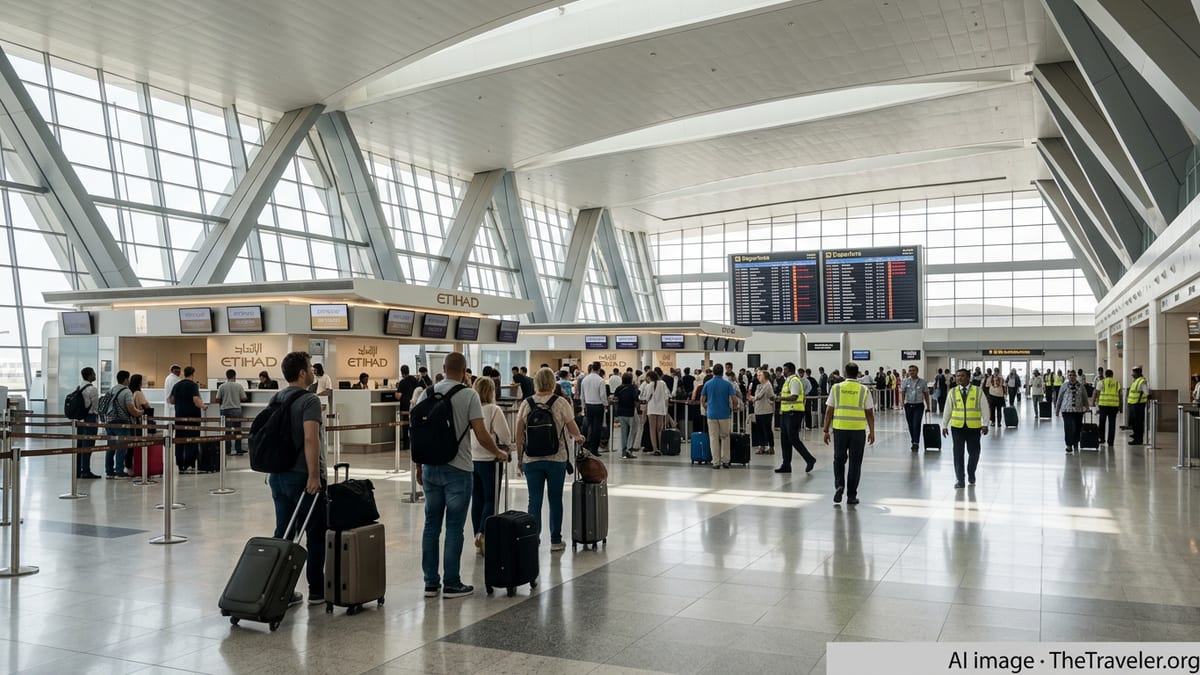
Etihad Airways is set to double its Abu Dhabi–Kabul service to twice daily from July 15, 2026, underscoring a sharp rise in passenger demand between the United Arab Emirates, Afghanistan and key onward markets.
Get the latest news straight to your inbox!
Rapid Capacity Increase On A Young Route
According to publicly available schedule information and recent airline announcements, Etihad’s Kabul route has ramped up at unusual speed. Kabul joined the carrier’s network in late 2025 with a limited-frequency operation before moving to a daily service on May 1, 2026, as demand strengthened on the corridor.
Reports indicate that from July 15, 2026, the Abu Dhabi–Kabul route will see a second daily rotation in each direction, taking the service from seven to fourteen weekly flights. Industry data providers tracking the market note that the move represents the second frequency increase in just a few months and places Kabul among the fastest-growing short-haul destinations in Etihad’s portfolio.
Travel trade coverage highlights that the additional flights are expected to be operated with narrowbody aircraft in a two-class configuration, significantly increasing the number of seats on offer while retaining a schedule tailored to short regional sectors. The rising capacity mirrors broader growth in Etihad’s regional network as the airline rebuilds and expands its post-pandemic footprint.
Observers point out that introducing twice-daily flights so soon after launch signals confidence in the long-term viability of the route, suggesting that the carrier sees sustained rather than purely seasonal demand between Abu Dhabi and Kabul.
Strong Demand Driven By Diaspora, Business And Transit Traffic
Regional aviation analysis attributes the surge in traffic between the UAE and Afghanistan to a mix of passenger segments. A sizable Afghan community in the Emirates is seen as a key driver, using Abu Dhabi as a gateway for visits home and family travel in both directions. Additional demand comes from business travelers, aid and development personnel, and workers linked to reconstruction and infrastructure projects.
Industry commentary further notes that Abu Dhabi’s position as a growing global hub is critical to the route’s performance. The Kabul service feeds into Etihad’s wider network, offering one-stop links from Afghanistan to destinations across the Gulf, the Indian subcontinent, Europe, North America and Australia. Travel market monitors report strong connecting flows to major European capitals and cities in Saudi Arabia and Turkey, as well as onward journeys to the United States and Canada.
Publicly available booking data suggest that the original limited-frequency schedule quickly reached high load factors, particularly around peak travel periods such as religious holidays and the northern summer. As a result, expanding to twice-daily operations is viewed by analysts as a way to relieve pressure on the most popular departure times while opening up more options for same-day connections.
The expanded schedule is also expected to improve resilience on the route, giving passengers more flexibility in case of disruption and allowing tighter banked connections over Abu Dhabi’s Zayed International Airport.
Strategic Move In A Competitive Regional Landscape
Etihad’s decision to grow its presence in Afghanistan comes as Gulf carriers continue to recalibrate their networks. Reports on airline strategy in the region describe a shift toward strengthening short and medium-haul markets that reliably feed long-haul services, especially to Europe and North America. Kabul, positioned within easy narrowbody range of Abu Dhabi, fits this profile.
By committing to twice-daily operations, Etihad places itself in a stronger position to capture share in a market where competing airlines also offer connections between Afghanistan and the wider world via their respective hubs. Aviation analysts note that schedule breadth and connection quality are key differentiators in such markets, meaning an additional daily flight can materially improve competitiveness.
The move also aligns with the airline’s broader capacity growth plans across 2026, which include frequency boosts and new destinations across the Middle East, South Asia and Europe. Publicly available fleet and schedule information shows that Etihad has been steadily adding frequencies on high-performing routes as aircraft become available, using targeted capacity growth rather than rapid, across-the-board expansion.
Travel sector observers suggest that a deeper presence in Afghanistan supports Abu Dhabi’s ambitions to reinforce its status as a regional aviation and commercial hub, connecting emerging markets with established global trade and tourism centers.
What Twice-Daily Flights Mean For Travelers
For passengers, the shift to two daily flights is expected to translate into more choice of departure times, improved convenience and potentially greater fare competition on the corridor. With morning and evening options likely on at least one side of the route, travelers can better tailor itineraries to business schedules, onward connections or family commitments.
Travel agents monitoring the change indicate that added capacity often results in a wider range of fare classes being available for longer, particularly on off-peak days. While overall pricing will still fluctuate with demand, greater seat availability can ease the sharp spikes commonly seen on constrained routes, especially around holidays and school breaks.
The expanded schedule may also appeal to time-sensitive travelers who rely on tight connections to reach onward long-haul flights. With two Kabul departures feeding into multiple connection banks in Abu Dhabi, passengers gain more buffer against delays and missed connections, a factor that can be particularly important for those traveling onward to North America or Europe.
From a practical perspective, more flight options can assist passengers who need to coordinate with ground transport or cross-border arrangements within Afghanistan, where internal travel times and conditions can vary significantly.
Implications For Afghanistan’s Reconnecting Aviation Market
Etihad’s capacity increase adds momentum to a gradual rebuilding of Afghanistan’s international air links. Published coverage of the country’s aviation landscape notes that the return and expansion of services by regional carriers provide important connections for trade, remittances and humanitarian work, even as the broader political and economic environment remains complex.
Analysts highlight that consistent, scheduled services to major Gulf hubs are particularly significant, as they plug Afghan travelers into extensive global networks without requiring direct long-haul flights from Kabul. In this context, a twice-daily link to Abu Dhabi represents a meaningful enhancement in connectivity for both passengers and cargo.
While aviation risk assessments continue to factor into airline decisions about operating to Afghanistan, the sustained growth of the Abu Dhabi–Kabul route is being watched closely by industry observers as a barometer of demand and stability. Further developments on the route, including possible upgauging of aircraft or schedule refinements, are likely to depend on how traffic responds once the second daily flight is in place from mid-July.
For now, the move underscores how a combination of diaspora travel, business links and hub connectivity is reshaping traffic flows between the UAE and Afghanistan, with Etihad’s expanded Kabul service emerging as one of the clearest examples of the current surge in regional travel demand.