


More news on this day
Europe’s peak summer travel season is colliding with a troubled rollout of new EU border checks, as airport leaders warn that mounting queues, missed flights and stressed terminals risk turning July and August into a test of the bloc’s biometric Entry/Exit System.
Get the latest news straight to your inbox!
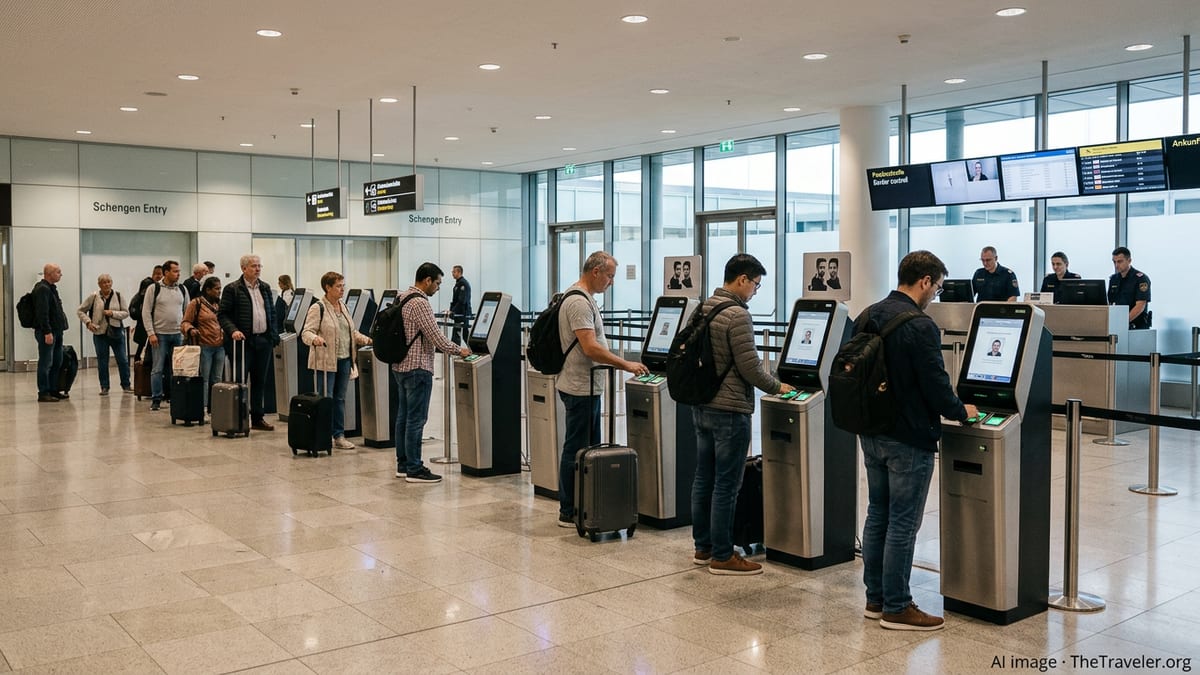
Airports Chief Sounds Alarm Over New EU Border Regime
Airport representatives across Europe are escalating warnings that the European Union’s new Entry/Exit System for non-EU travelers is placing unprecedented strain on border facilities just as summer demand surges. Publicly available information indicates that senior figures in the sector now describe the situation as reaching a “critical point,” with some calling current conditions “not bearable” for the peak months ahead.
The Entry/Exit System, fully activated across the Schengen area in April 2026, replaces manual passport stamping with digital registration of travelers’ biometric data, including fingerprints and facial images. While designed to improve security and streamline flows, early experience during the spring and early summer shows the opposite at many airports, with long queues and bottlenecks forming wherever enrollment stations and staff are in short supply.
Industry bodies representing airports and airlines have issued a joint appeal to EU institutions for immediate flexibility in how the rules are applied. According to published coverage, they argue that without urgent adjustments to accommodate peak volumes, the system could undermine Europe’s reputation as a seamless long-haul gateway and damage already fragile tourism and airline finances.
Biometric Entry/Exit System Struggles Under Peak Demand
Reports from major European hubs indicate that the first wave of mandatory biometric enrollments for non-EU passengers is significantly slowing the passport control process. Travelers entering the Schengen zone for the first time under the new rules must have their fingerprints and facial image captured before proceeding, an interaction that can take several minutes per person when equipment or staffing is stretched.
According to recent European press coverage, border queues have already stretched to two hours or more for non-EU citizens at some airports, with aviation organisations warning that waits of up to five hours are possible during peak traffic periods. These delays are rippling through the wider airport ecosystem, contributing to missed connections, delayed departures and last-minute gate changes as airlines hold flights for delayed passengers.
Although the system is intended to automate and standardise checks across all external Schengen borders, its impact is uneven. Airports that invested early in additional e-gates, enrollment booths and training have so far fared better, while those with less flexible infrastructure or staffing are finding their terminals quickly overwhelmed as summer traffic builds.
Joint Industry Plea for Flexibility and Temporary Suspension
Faced with mounting disruption, leading aviation associations representing European airports and airlines have coordinated their message to Brussels. According to open letters and public statements, they are urging the European Commission to grant member states the power to temporarily suspend or scale back Entry/Exit checks whenever passenger numbers exceed the operational capacity of border control facilities.
The groups argue that such targeted suspensions, particularly across July and August, are essential to stabilise operations while longer-term fixes are put in place. They also call for stronger guarantees around the reliability of the IT backbone that supports the database, warning that technical outages could instantly paralyse border flows at multiple airports at once.
Industry representatives further stress the need for higher staffing levels at airport border points and for rapid deployment of digital tools that would allow travellers to pre-register before arrival. Publicly available proposals include an EU-wide app enabling passengers to submit part of their data in advance, potentially reducing the time spent at enrollment kiosks and easing pressure on frontline staff.
Key Hotspots and Vulnerable Markets for Summer 2026
Not all airports are affected equally, and travel industry reporting highlights a number of holiday gateways as particular flashpoints. Mediterranean leisure hubs in Spain, Italy and Greece, which rely heavily on non-EU visitors from the United Kingdom and further afield, are flagged as especially vulnerable because they face sharp peaks in arrivals concentrated into a few daily banked flights.
Low-cost carriers operating dense summer schedules from the UK and Ireland into these airports have already warned of potential “queue chaos” if biometric bottlenecks are not resolved. Some budget airlines have publicly identified specific airports they consider underprepared, pointing to a mismatch between the volume of passengers scheduled and the number of functioning enrollment stations at border control.
Beyond the aviation sector, cross-Channel and cross-border ports are also bracing for strain as the Entry/Exit System is applied to ferry and coach passengers. Port operators in northern Europe have forecast repeated congestion episodes on busy summer weekends, noting that additional border processing time per traveller can quickly translate into tailbacks on local road networks.
What Summer Travellers Can Expect and How to Prepare
For travellers planning trips to Europe from July onward, the current environment means allowing significantly more time for border formalities than was typical before 2026. Public guidance from airports and airlines generally recommends arriving at departure airports earlier than usual, especially for morning peak flights to popular Mediterranean destinations and major hubs.
First-time visitors to the Schengen area under the new system are likely to face the longest registrations, as they must complete full biometric capture. Returning travellers who have already enrolled may move faster, but reports indicate that data inconsistencies and technical glitches are still causing some repeat enrollments, adding to frustration and delays.
Airports and carriers are stepping up communication through websites, social media and pre-departure emails to explain the new procedures and set expectations. However, sector leaders maintain that information campaigns alone cannot solve structural capacity gaps at border checkpoints and continue to press Brussels for regulatory flexibility over the critical summer months.
With July and August forecast to bring tens of millions more passengers through European airports than in the spring shoulder season, the coming weeks will test whether the EU’s biometric border vision can be reconciled with the realities of mass-market holiday travel. For now, aviation chiefs are clear in their public messaging: without swift action on staffing, technology and rule flexibility, the Entry/Exit System could define Europe’s 2026 summer getaway for all the wrong reasons.