


More news on this day
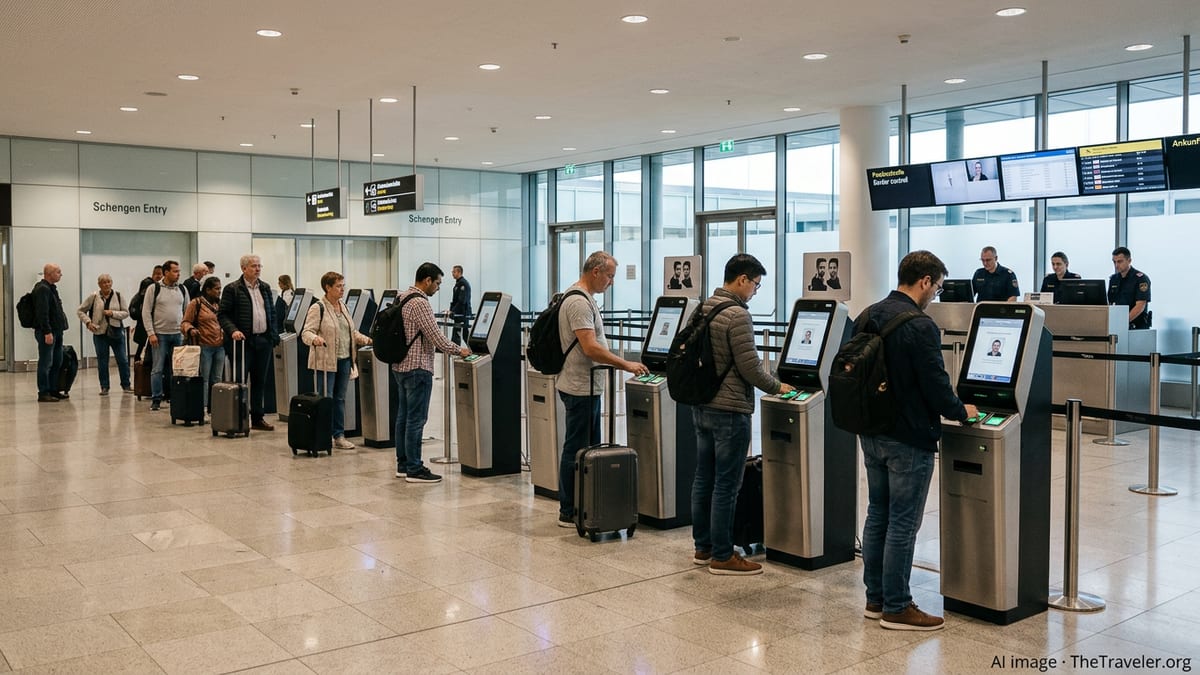
Travellers entering the Schengen area through busy airports and Channel ports are being told to brace for prolonged disruption, as Europe’s new biometric Entry/Exit System beds in and publicly reported estimates suggest queues may not fully stabilise for up to two years.
Get the latest news straight to your inbox!
Frontex warning highlights long road to “stable” operations
According to recent broadcast coverage in the United Kingdom, a senior figure at Frontex, the European Union’s border agency, has suggested that the new regime of fingerprinting and facial scans for most non-EU visitors could take around two years to reach a steady state. The remarks, made in the context of current congestion at air terminals and cross-Channel hubs, have sharpened concerns that the early turbulence will not be resolved in time for the coming peak holiday seasons.
Reports indicate that some EU countries are still struggling to integrate the Entry/Exit System, or EES, into existing border infrastructure and staffing models. While the underlying technology has been years in the making, practical challenges such as terminal layouts, equipment reliability and passenger handling procedures are now determining how quickly queues move in real-world conditions.
The two-year timeframe being discussed by European institutions and travel industry analysts would push any return to broadly predictable wait times towards 2028. That horizon reflects not only technical refinements to the IT system but also the need for repeated travellers to build up records in the database, which should eventually allow faster processing for those who have already been enrolled.
Publicly available information suggests that the European Commission and member states are under pressure to demonstrate visible improvements well before then, particularly at major gateways used by British, North American and other long-haul visitors who now require biometric registration on arrival.
Hours-long queues at airports and ports
Published coverage from several European outlets shows that the roll-out of EES has already produced significant bottlenecks at some of the continent’s busiest external borders. In April and May, airport associations and airlines described scenes of passengers queueing for two to three hours at passport control as the system went live in full for the first time during a busy travel period.
Accounts from travellers and aviation bodies point to a mix of factors driving the delays, including unfamiliarity with the new process, initial teething problems with fingerprint scanners, and a sharp increase in the time needed to process each first-time enrolment. In some locations, only a portion of the available border booths are equipped for biometric capture, further amplifying congestion.
Channel crossings have faced their own challenges. Specialist travel trackers and ferry operators report that ports handling vehicle and coach traffic have struggled to reconcile limited physical space with the need to conduct biometric checks before boarding or on arrival. Where these controls are carried out at juxtaposed borders on UK soil, such as at the Port of Dover or the Eurotunnel terminal in Kent, queuing traffic has periodically spilled back onto local road networks.
Despite the difficulties, some operators have reported more modest impacts, especially where advance planning has allowed for extra lanes, temporary check-in facilities or extended staffing at border points. These variations underline how much local implementation decisions influence passenger experience under the new regime.
Phased launch and emergency workarounds
European policy documents show that the Council of the EU and the European Parliament recently agreed to allow a progressive introduction of EES, giving member states more flexibility in how the system is deployed at different types of border. The revised framework permits a transition period during which border guards can operate the system with partial features and prioritise flow management over strict enforcement in certain circumstances.
This regulatory shift follows years of postponed start dates, as national authorities warned that infrastructure and software were not ready. A phased approach is now seen by many analysts as essential to avoid gridlock, particularly at land crossings and ferry ports with limited capacity to expand physically.
Some countries have also resorted to temporary workarounds to keep traffic moving. Travel media and regional outlets have reported that, in a few cases, border agencies have selectively relaxed biometric checks for specific nationalities or during peak weekends, relying instead on traditional passport inspection in order to prevent extreme queuing. These measures, while controversial in some quarters, reflect the tension between strict application of new rules and the need to maintain basic throughput.
Industry groups have urged national governments to communicate clearly with travellers about where and when full biometric enrolment will be required, warning that inconsistent practices can undermine passenger confidence and complicate airlines’ and tour operators’ planning.
Implications for UK travellers and peak holiday seasons
The warning that disruption could last up to two years has particular resonance in the United Kingdom, where outbound leisure travel to EU destinations remains strong. British media coverage in recent days has highlighted concerns that summer holidaymakers could face especially long waits at Mediterranean gateways and Channel crossings, even if they arrive at airports well in advance of departure.
Post-Brexit changes mean that UK citizens are treated as third-country nationals under Schengen rules and must therefore be registered in EES, alongside visitors from the United States, Canada, Australia and many other non-EU states. Analysts note that regular weekend flows to cities such as Paris, Amsterdam and Barcelona, combined with school holiday peaks, create pronounced spikes in demand at border checkpoints.
Travel firms are already adjusting their advice. Many airlines and tour operators are encouraging customers to allow additional time at departure airports serving Schengen destinations and to expect longer formalities on arrival, particularly for the first trip taken under the new system. Rail and ferry passengers are receiving similar guidance, especially on routes where border controls are conducted before boarding.
Insurance specialists and consumer advocates are also reminding travellers to check policy wording around missed departures. While carriers may sometimes provide rebooking assistance when border queues are unusually severe, entitlement to compensation is not guaranteed if flights and sailings depart on schedule.
Looking ahead to ETIAS and longer-term change
The entry into force of EES is only one part of a broader overhaul of the EU’s border architecture. Public information issued by European institutions indicates that the separate European Travel Information and Authorisation System, or ETIAS, is now expected to follow after EES has been fully embedded, with current timelines pointing to late 2026 or beyond for operational launch.
ETIAS will require many visa-exempt travellers, including most UK visitors, to obtain a paid travel authorisation online before departure, in a model often compared with the United States’ ESTA. Travel experts argue that, once both EES and ETIAS are running smoothly, the combination should allow for more automated risk assessments and a reduced need for intensive questioning at physical border points.
In the short term, however, the layering of new requirements is adding to uncertainty for passengers and operators. Airport and port planners must factor in not only the immediate impact of biometric checks but also the possibility that, as ETIAS goes live, additional verification steps will be introduced at check-in and boarding gates.
For now, the consensus emerging from European policy papers and aviation industry briefings is that disruption related to EES is likely to remain a feature of travel to the Schengen area for several peak seasons to come. While the system is designed to deliver faster, more secure crossings in the long run, the journey to that destination appears set to be measured in years rather than months.