


More news on this day
Post-Brexit travel rules for Britons entering Europe have been thrown back into flux after the European Union allowed nine countries to delay full implementation of new biometric border checks, following weeks of disrupted journeys and mounting pressure from the travel industry.
Get the latest news straight to your inbox!
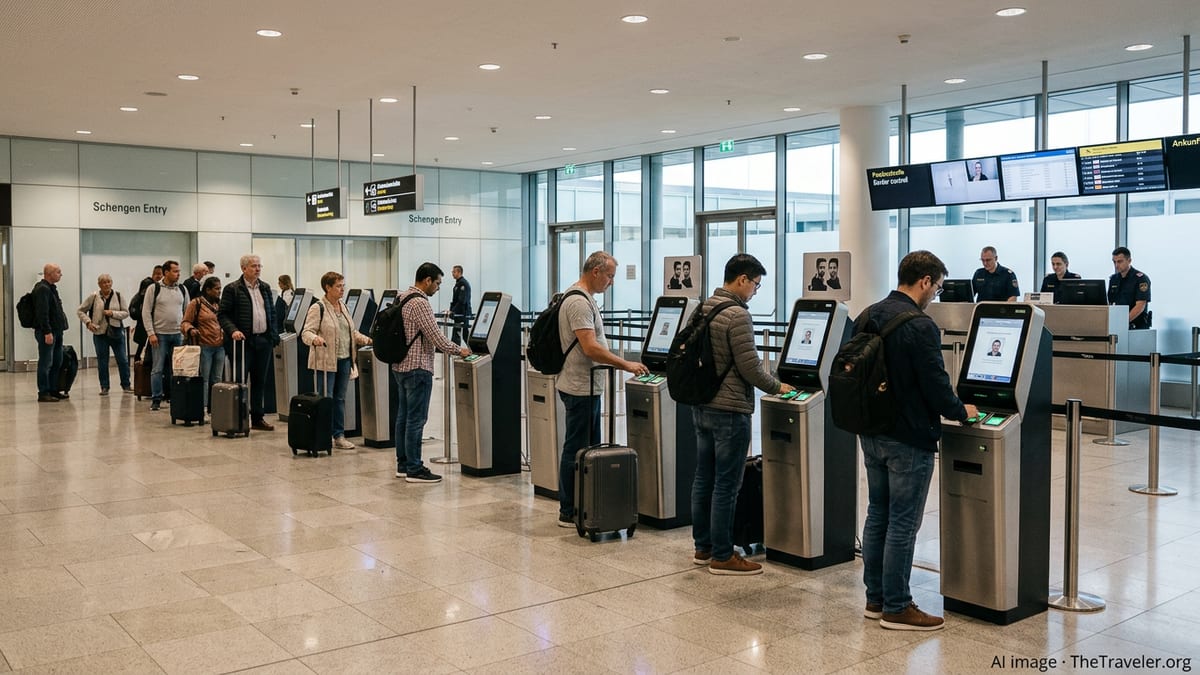
Fresh reprieve for key EU and Schengen gateways
According to recent reports, France, Belgium, the Netherlands, Germany, Greece, Malta, Portugal, Italy and Switzerland have been granted permission to pause or scale back use of the EU’s Entry/Exit System for many UK visitors. The move comes just months after the digital regime became fully operational at external Schengen borders and days after peak‑season queues exposed shortcomings in airport and ferry terminal preparations.
The Entry/Exit System is designed to replace passport stamping for most non-EU nationals with automated registration of fingerprints, facial images and travel history. British travellers, now treated as “third-country nationals” after Brexit, are among those required to enrol on their first trip to a participating country and then have their details verified at each subsequent crossing.
In practice, however, implementation has varied widely by country and by border point. The latest decision gives nine governments further flexibility to limit or suspend on-the-spot biometric capture where infrastructure is proving inadequate or where local authorities judge that full use of the system would unduly disrupt traffic flows at busy air, sea or land crossings.
The adjustment does not repeal the underlying EU rules but changes how rigorously they are enforced at some of the most heavily used entry points for UK tourists. Travellers are being warned that their experience may differ markedly from one country or airport to another, even on the same itinerary.
Queues, glitches and pressure from the travel industry
Published coverage over the summer highlighted long queues and missed connections at airports in Spain, Greece and Germany after the Entry/Exit System moved from pilot phase to daily use. Reports described airline advice for passengers to arrive up to three or even four hours before departure, with some holidaymakers claiming that lengthy border waits caused them to miss flights or pre-booked transfers.
Technical glitches also contributed to early disruption. Publicly available information indicates that systems at some border posts struggled to process fingerprint and facial scans at the advertised throughput, particularly when large numbers of passengers arrived at once from the UK and other non-EU countries. In some locations, manual passport checks and ad-hoc workarounds were reintroduced to clear backlogs.
Industry bodies have argued that such scenes risk undermining confidence in European trips at a time when international tourism is still rebuilding. Analysis published by global travel and tourism groups earlier this year suggested that sustained three to four hour waits at external Schengen borders could deter tens of millions of potential visitors over the coming seasons.
Against that backdrop, the decision to allow nine countries to delay strict enforcement of the new regime is being interpreted by observers as an attempt to balance security ambitions with the practical limits of airport and port infrastructure, and the political sensitivity of highly visible disruption for British holidaymakers.
What the delay means for British holidaymakers
For UK travellers, the immediate effect is not a return to pre-Brexit free movement but a partial softening of how the new rules are applied. Passports for short-stay visits will still be checked at the border, and the standard 90-days-in-180 allowance for stays in the Schengen area remains in force. However, in some of the nine countries, first-time biometric enrolment may be postponed, streamlined or applied only at certain crossings.
This mixed picture is likely to produce differing experiences across Europe. A British family flying into a major French hub could, for example, encounter shorter queues if initial fingerprinting is suspended in favour of simple passport scanning, while the same family might still face full biometric capture when entering another Schengen state that is pressing ahead with the system.
Officials in the UK have previously advised outbound passengers to allow extra time at ports where Entry/Exit registration is carried out before boarding, such as the Port of Dover, Eurotunnel in Folkestone and some international rail terminals. With nine countries now easing their approach, operators may adjust their guidance, but passengers are still being encouraged through public information campaigns to monitor airline and ferry advice closely.
Travel insurance considerations are also in focus. Insurers have indicated in earlier consumer guidance that policies may not cover missed departures caused by generic border queues, meaning travellers remain exposed if they fail to build in sufficient buffer time under the evolving system.
Patchwork implementation across Europe
The latest move underscores how uneven the rollout of post-Brexit border technology has become. While some EU and Schengen members have pressed ahead with full biometric checks, others have quietly relaxed requirements during peak periods, or targeted exemptions at specific nationalities such as British tourists to avoid bottlenecks.
Greece, for example, has already experimented with lighter-touch procedures at certain holiday islands during the summer months, according to local media accounts, while still collecting Entry/Exit data at main gateways. Earlier speculation that Portugal and Italy might follow suit prompted clarification from European institutions that any such decisions must remain within the common legal framework and be justified on grounds such as public order or capacity constraints.
The European Commission has maintained in its public statements that the Entry/Exit System is a central plank of the bloc’s wider migration and security reforms, intended to tighten oversight of short-stay visitors and reduce reliance on manual passport stamps that can be lost or misread. At the same time, recent Commission opinions on border management have acknowledged the need for “tailor-made solutions” in regions where traditional infrastructure cannot easily be expanded.
For British visitors, this means that even as some front-line checks are relaxed temporarily, their travel history is expected to be recorded more systematically over time. Once biometric data has been captured at any participating border, future crossings should in principle be faster, though early user reports suggest that performance still varies significantly by airport and time of day.
What travellers should do now
With rules shifting quickly, travel organisations are advising UK holidaymakers to pay closer attention to pre-departure information than they may have done before Brexit. Airlines and ferry operators have begun updating customer emails and app notifications to flag where Entry/Exit procedures are in force and how much extra time passengers should allow.
Experts on European mobility policy note that, despite the recent delay for nine countries, further adjustments are likely as governments gather data on flows and costs. Some states may reintroduce full biometric checks once new equipment and staffing are in place, while others may continue to pursue more flexible models that prioritise throughput for tourists during busy seasons.
For now, travellers are being urged in public guidance to ensure their passports meet EU validity rules, to keep proof of accommodation and return travel readily accessible, and to factor in the possibility of extended border checks when planning flight connections or transfers. The latest postponement may ease immediate congestion for many British holidaymakers, but it also confirms that post-Brexit border arrangements across Europe remain a work in progress.