


More news on this day
Europe’s new biometric Entry-Exit System, fully rolled out across Schengen external borders this spring, is generating hours-long queues and mounting concern in the travel industry as reports suggest disruption could persist for up to two years.
Get the latest news straight to your inbox!
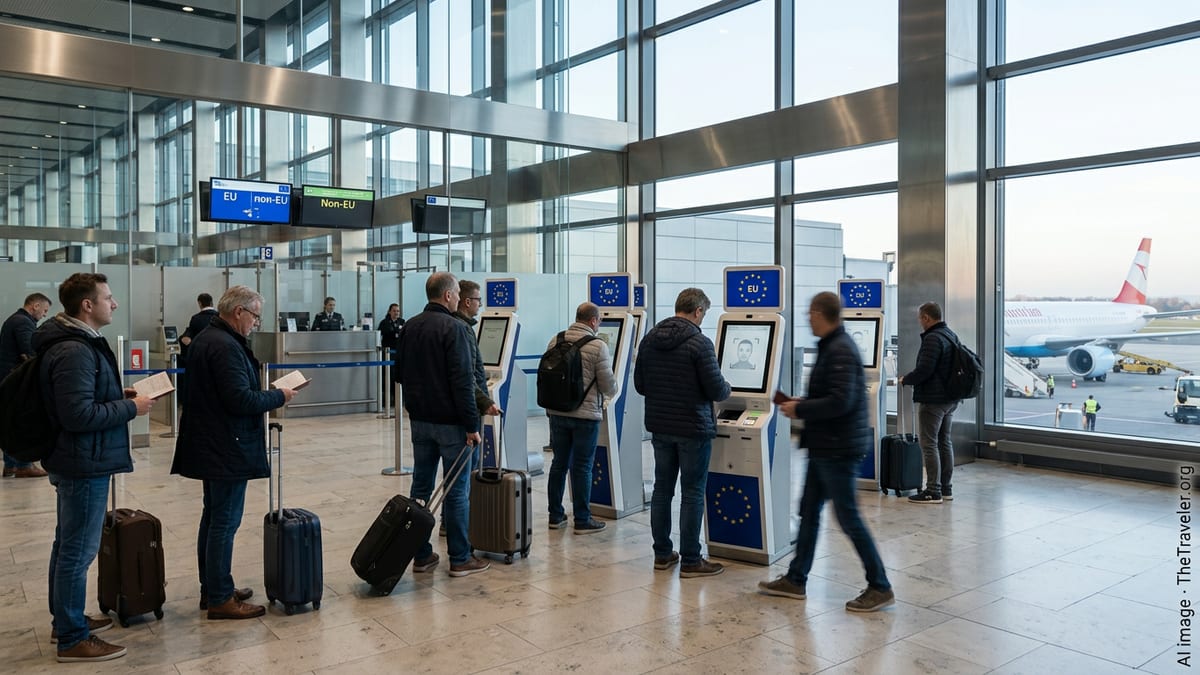
A Biometric Border Shake-Up Across Schengen
The European Union’s Entry-Exit System, a long-planned digital register of non-EU nationals entering and leaving the Schengen area, became fully operational in April 2026 after a phased deployment. The scheme replaces manual passport stamping with biometric registration, recording facial images and fingerprints alongside travel document data at every crossing.
Publicly available information from European institutions describes the system as a cornerstone of the bloc’s modernised border management architecture. It is designed to automatically track short-stay visits, identify overstays and feed data into future tools such as the European Travel Information and Authorisation System, which is scheduled to follow later in 2026.
In practice, the launch has meant that millions of travellers from the United Kingdom, the United States and other non-EU countries must now undergo one-off biometric enrolment on their first arrival since activation. Subsequent crossings are supposed to be faster, relying on the stored record, but the initial capture process has proved significantly slower than traditional stamping at many front-line checkpoints.
Airports, seaports and land crossings that handle large leisure flows, particularly between the UK and nearby Schengen countries, have been among the most exposed to early disruption. Transport operators and tourism bodies across Europe are now adjusting forecasts for the peak summer season in light of the new procedures.
Queues Stretch From Airports to Ferry Ports and Rail Terminals
Since the system’s full switchover in April, reports from major European gateways indicate queues of two to three hours at busy periods as border guards complete biometric enrolment for first-time EES users. Coverage from aviation and tourism outlets points to particularly acute delays at popular holiday hubs in Spain, Portugal and France, where large numbers of non-EU visitors arrive on short breaks.
Travel industry reports also highlight pressure at Channel ports and rail terminals linking the UK with France and Belgium. At locations where French controls are carried out on UK soil, such as the Port of Dover and London’s international rail hubs, congestion has at times spilled back into local road and passenger terminals as processing times increased.
Some member states appear to be using flexibilities built into the rules, temporarily scaling back EES checks at peak moments to prevent gridlock. However, media coverage suggests this is not applied uniformly, resulting in a patchwork experience for travellers, with some frontier posts flowing more smoothly than others.
Airlines and ferry operators are responding by advising passengers to arrive earlier and warning of possible missed connections. Industry groups have called for closer coordination between border agencies and carriers, arguing that inconsistent implementation is compounding bottlenecks created by the underlying technology shift.
Warnings That ‘Stabilisation’ Could Take Up to Two Years
In recent days, public remarks by senior figures at the EU’s border agency have intensified concern. According to widely reported comments at a travel industry event in early June, it could take up to two years for the system to “stabilise,” with border queues expected to remain a recurring problem while member states refine infrastructure, staffing and procedures.
Travel sector associations in the UK and across Europe have reacted with alarm to that timeframe. Statements compiled in trade and mainstream media coverage describe a one to two year bedding-in period as “very painful” for passengers and businesses that rely on predictable border flows, especially after several seasons of disruption during and after the pandemic.
Airline representatives cited by European and British outlets argue that such a prolonged horizon goes beyond what would normally be considered teething troubles for a new system. They are urging European institutions and national governments to accelerate investments in automated gates, pre-registration options and additional staffing to shorten the adjustment phase.
Consumer groups, meanwhile, are pressing for clearer communication. Travel commentators note that many non-EU visitors are still arriving at Schengen borders unaware of the need for biometric capture or the extra time this can entail, contributing to confusion in queues and at check-in desks.
Tourism and Transport Sectors Fear a Tough Summer
Tourism boards and trade bodies in Mediterranean destinations are increasingly factoring EES disruption into their summer outlooks. Reports from southern Europe indicate that airports serving Spain’s islands and coastal resorts have already experienced several episodes of extended queues, prompting concerns that visitor satisfaction scores could suffer if the pattern repeats through July and August.
Economic analyses published by travel and hospitality journals suggest that while most passengers eventually clear the border, prolonged waits risk secondary impacts. These range from missed onward connections and additional staffing costs for airlines and tour operators to potential reputational damage for destinations marketed as hassle-free short-break options.
In northern Europe, ports handling cross-Channel traffic are preparing for busy school holiday peaks with new contingency plans. Local media around major ferry and rail hubs have reported on traffic management measures, passenger flow redesigns and calls for travellers to build in significant buffer time when crossing between the UK and Schengen countries.
Some industry voices are cautioning against exaggeration, noting that early months of any large IT rollout often reveal weaknesses that can be fixed relatively quickly. However, with official expectations now pointing to a multi-year stabilisation, there is little confidence that queues will disappear entirely in the near term without further policy adjustments.
What Travellers Can Expect at EU Borders This Year
Based on current implementation, non-EU visitors arriving at Schengen’s external borders for the first time since April 2026 can generally expect a slower process than they were used to before the rollout. The initial registration typically involves fingerprinting, a facial image and verification of passport details in the new database, followed by standard entry checks.
Travel guidance from airlines, tour operators and consumer outlets now routinely advises passengers to allow extra time at departure points where Schengen border checks are conducted, including UK ports and airports with juxtaposed controls. Recommendations often include arriving earlier for flights and being prepared for lines that could extend well beyond the immediate passport control area at busy periods.
Once the first biometric enrolment is complete, subsequent crossings within the system’s retention period are expected to be faster, as border officers can retrieve the traveller’s record without repeating all checks. However, commentators note that the overall experience will still depend heavily on local staffing levels, the availability of automated kiosks and how consistently member states apply the rules intended to prevent excessive queues.
For now, the Entry-Exit System remains in a difficult transition phase, balancing its long-term goals of enhanced security and more efficient data-driven border management against the very visible, short-term reality of longer waits for millions of travellers heading into and out of Europe.