


More news on this day
The European Union is pressing ahead with its new biometric Entry/Exit System at Schengen borders despite weeks of disruption, with publicly available information indicating officials see no case for suspending the scheme even as airlines warn of mounting queues and missed flights.
Get the latest news straight to your inbox!
Brussels backs system amid mounting criticism
Recent public statements from EU institutions and coverage by European media indicate that the bloc remains committed to its Entry/Exit System, known as EES, describing it as a cornerstone of modernised border management rather than a temporary experiment. Reports on Tuesday from Brussels-based outlets described officials acknowledging that the rollout has been “not perfect,” but insisting that full suspension is neither needed nor legally feasible.
The stance comes after a series of appeals from airline and airport associations urging the European Commission and member states to pause or at least soften the system during the height of the 2026 holiday season. Industry groups have warned of long queues at border control, bottlenecks at busy hubs and an elevated risk of passengers missing flights when border processing times spike.
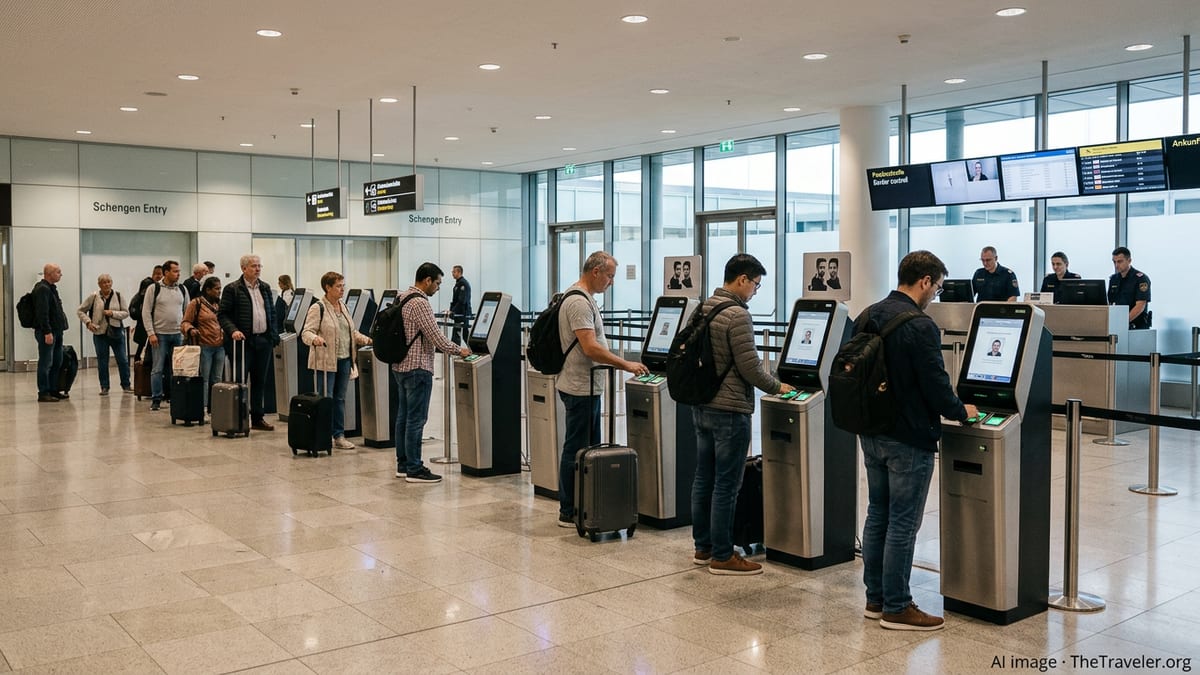
According to publicly available information, the EES has been fully operational at Schengen borders since April 2026, covering non-EU travellers arriving by air, land and sea. The system records biometric data and logs each entry and exit electronically, replacing traditional passport stamps. EU bodies have framed it as a long-delayed upgrade intended to tighten security and monitor overstays more precisely.
Despite the disruption, coverage from European outlets suggests there is little political appetite in Brussels to reverse course. Instead, the emphasis is on fine-tuning procedures, reinforcing national infrastructures and urging border authorities to use existing flexibility to keep queues under control.
Queues, missed flights and pressure from the air sector
Since the system moved into full operation, reports from major European airports describe scenes of passengers queueing for up to several hours at passport control, particularly at hubs handling large volumes of non-EU leisure travellers. Travel rights organisations and consumer platforms have compiled accounts of missed departures, tight connections lost at transfer airports and confusion over the new requirements.
Airline trade bodies have issued multiple public warnings that peak summer 2026 could see widespread saturation at border-control points unless additional measures are introduced. An open letter made public in recent days by leading airline and airport associations urged EU leaders to authorise more flexible use of manual checks, deploy extra staff and, if necessary, delay full biometric processing at the busiest locations.
Individual carriers have also raised the alarm. Coverage from European broadcasters and newspapers highlights low-cost airlines warning of “queue chaos” at key holiday gateways, arguing that travellers should not serve as test subjects for a system that is still encountering technical glitches. At some airports, reports indicate that faulty fingerprint scanners and poorly tested software have contributed to repeated enrolment attempts and extended processing times.
Travel-insurance analysts cited in recent consumer reporting note that most policies treat EES queueing as part of normal border procedures, meaning passengers who miss flights because of long biometric checks may struggle to obtain compensation. This has heightened concern among travellers planning tight same-day connections or onward journeys by train and cruise ship.
Security goals and data already collected
EU institutions continue to present the Entry/Exit System as a central response to long-standing security and migration-management concerns. By registering fingerprints, facial images and precise travel histories for non-EU nationals entering the Schengen area, the system is designed to identify overstays, detect document fraud and flag individuals considered security risks more effectively than manual inspection alone.
According to recent coverage based on Commission figures, tens of thousands of travellers have already been refused entry since the electronic border regime began phasing in, including several hundred individuals reportedly categorised as potential security threats. Supporters of the system argue that these statistics show the underlying rationale is sound, even if the first months of large-scale operation have exposed weaknesses in implementation.
The new database also underpins forthcoming policy changes. EES is intended to work in tandem with the European Travel Information and Authorisation System, or ETIAS, a pre-travel screening requirement for many visa-exempt visitors that is expected to launch in late 2026. Together, the two systems form a broader shift toward digitalised border controls that more closely resemble long-standing practices in countries such as the United States and Canada.
Critics within the travel industry, however, point out that the benefits are largely invisible to passengers standing in slow-moving lines. They argue that, while security gains may be real, the immediate experience for many tourists is one of uncertainty and disruption, particularly at airports and land crossings where infrastructure and staffing were already under strain.
Calls for flexibility as peak summer approaches
With the main European summer holiday period about to begin, the focus among airlines and airports has shifted from opposing EES outright to demanding greater operational flexibility. Trade groups are publicly calling for wider use of contingency measures that would allow border officers to reduce the number of biometric checks during peak hours, rely more heavily on automated gates where available and temporarily prioritise flow over full data capture when queues reach critical length.
Several industry letters and briefings reported in European media argue that such steps are essential to protecting Europe’s reputation as an easy and attractive destination. They warn that if queues of several hours become common at major tourist gateways, travellers may rethink future trips or choose destinations outside the Schengen zone. Concerns are especially strong at airports serving the United Kingdom and United States, where large numbers of leisure travellers now face biometric registration on arrival.
National authorities and airport operators have begun rolling out their own mitigation efforts, according to local press accounts. These include reconfiguring queuing areas, opening temporary passport-control positions and encouraging travellers to arrive earlier than usual. Some border agencies are experimenting with pre-registration kiosks and mobile applications to capture data before passengers reach the main control points, although such solutions are not yet widely available.
Despite these efforts, forecasts compiled by travel associations suggest that pressure will continue through at least September 2026, when peak-season traffic traditionally tapers off. Industry modelling cited in recent reports suggests that in worst-case scenarios, processing times for first-time EES registrations could still reach several hours at certain airports during busy weekends.
What travellers should expect in the coming months
For visitors from countries outside the EU and Schengen area, the Entry/Exit System now forms part of the standard arrival routine. Non-EU travellers can generally expect to provide fingerprints and a facial image the first time they enter the bloc under the new system, followed by biometric verification and an electronic passport check on subsequent trips. The process remains manual at many border posts, particularly where automated gates are limited.
Travel advisories and consumer guidance published in recent weeks consistently recommend that passengers build extra time into their journey plans. For air travel, this may mean arriving at the airport earlier than usual for both departure and transfer flights, avoiding tight connections and allowing additional time before boarding cruises or long-distance rail services that depart shortly after landing.
Passengers are also being encouraged by tour operators and consumer groups to familiarise themselves with EES basics before travelling, including which documents are required, how long they are permitted to stay within the Schengen zone and what happens if biometric capture fails. Clearer information at booking and check-in, they argue, could help reduce last-minute confusion at border control points.
With EU institutions signalling that the Entry/Exit System will remain in place and even expand through its linkage with future digital travel authorisations, most observers expect the coming months to be defined by incremental adjustments rather than sweeping policy reversals. For now, travellers face a period in which Europe’s ambition to modernise its borders coexists with the very traditional prospect of longer queues.