


More news on this day
Air travel across Europe faced another day of severe disruption on June 19, with more than 100 flights cancelled and over 1,700 delayed as weather, staffing shortages and recent strike action combined to snarl operations from London and Madrid to Amsterdam, Berlin and Copenhagen.
Get the latest news straight to your inbox!
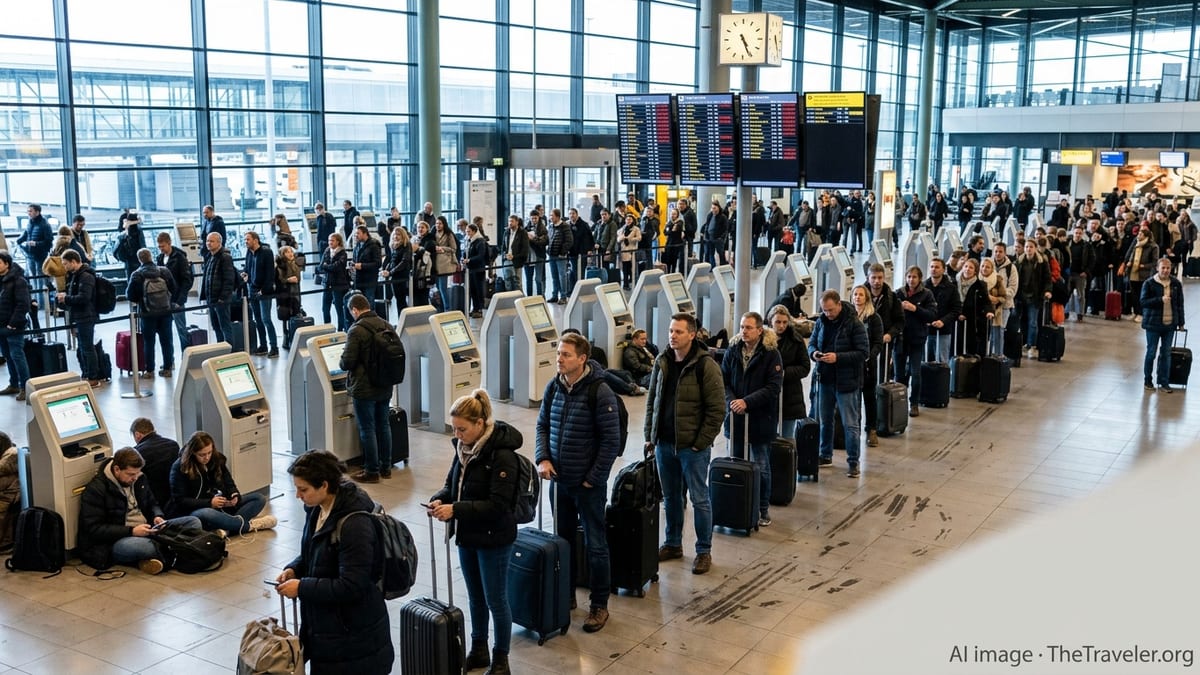
Wide Disruptions Across Key European Hubs
Data compiled from live flight tracking dashboards and regional aviation reports on June 19 indicate that at least 105 flights were cancelled and around 1,734 delayed across a broad swath of European airspace. The impact stretched across Spain, the United Kingdom, the Netherlands, Belgium, Denmark and Sweden, with knock-on effects felt throughout the wider network.
Major hubs including London, Madrid, Amsterdam, Berlin and Copenhagen reported clusters of late departures and arrivals as airlines worked to recover schedules already weakened by several weeks of operational strain. Publicly available figures for the European network show that in early June roughly 17 percent of flights were affected by air traffic flow management restrictions, highlighting how little resilience remains when additional local shocks occur.
Regional airports feeding into these hubs also contributed to the bottlenecks. Weather warnings in parts of the Netherlands and surrounding states, coupled with localized thunderstorms and low cloud in northern Europe, slowed departure rates and forced tighter spacing in busy terminal areas. The result was a cascade of late rotations that rippled across short and medium haul routes for the rest of the day.
Spain, UK and Netherlands Bear the Brunt
Spain and the United Kingdom again emerged as some of the worst affected countries for delay minutes per flight, in line with recent network performance briefings that point to capacity and staffing constraints in high-growth markets. Madrid, Barcelona and key holiday gateways along the Spanish coast experienced rolling delays as morning weather and volume-related restrictions pushed rotations back into the afternoon peak.
In the UK, the London system faced a familiar mix of congestion and tight staffing margins. Live departure boards at major London airports showed a steady tally of late-running services on intra-European routes, particularly to northern European cities already struggling with their own weather and capacity pressures. British carriers operating from regional airports such as Birmingham also reported cancellations and late departures, compounding onward connection problems.
In the Netherlands, Amsterdam Schiphol continued to feel the effects of recent disruptions that saw KLM and partner airlines suspend or curtail a number of services earlier in June. Publicly available coverage of those events described multiple cancellations and delays on long haul and European sectors, and the resulting aircraft and crew dislocation has not fully unwound. For passengers transiting Schiphol on June 19, even relatively minor additional delays elsewhere in the network translated into missed connections and forced rebookings.
Belgium, Denmark and Sweden See Knock-On Effects
Belgium’s airspace and airports entered June on the back of an abrupt stoppage of traffic earlier in the month, when a walkout by air traffic control staff temporarily halted nearly all flights through key Belgian airports and below a certain cruising altitude. Aviation forums and regional news outlets reported hundreds of cancellations in that single afternoon, and airlines have been working through the operational after-effects ever since.
Although Belgian airspace was open on June 19, network data and passenger accounts suggest that schedules remained finely balanced. Any additional spacing measures or minor staffing constraints at control centers can quickly translate into ground holds and minor rerouting, which in turn slow operations in neighboring states such as the Netherlands and western Germany.
Further north, Denmark and Sweden encountered their own localized weather and capacity headwinds. Copenhagen and Stockholm saw waves of late-running flights, particularly on short-haul links to Germany, the UK and southern Europe. With aircraft cycling rapidly between Nordic capitals and continental hubs, even short delays on the first rotations of the day propagated through to evening services.
Major Carriers Struggle to Stabilize Schedules
The latest bout of disruption once again tested the resilience of Europe’s leading airlines. KLM, British Airways, regional Lufthansa Group carriers such as Air Dolomiti, and low cost operators including easyJet all appeared among the lists of cancelled or heavily delayed services across major tracking platforms on June 19.
KLM has already been under pressure in 2026, with publicly available information highlighting a comparatively high number of cancellations this year as it manages higher fuel costs, capacity limits at Amsterdam Schiphol and operational challenges on some long haul sectors. Even when the number of outright cancellations is modest, the resulting aircraft and crew rotations leave the airline more exposed when sudden weather or airspace constraints arise.
British Airways and other UK based airlines have faced similar difficulties. High passenger demand into popular Mediterranean and northern European leisure destinations, combined with tight staffing at airports and control centers, has limited their ability to absorb disruptions. For low cost carriers such as easyJet, which rely on fast turnarounds and high aircraft utilization, lost minutes on a single rotation can accumulate over the day, ultimately forcing cancellations when curfews and crew duty limits are reached.
Smaller regional and hybrid carriers, including Air Dolomiti, have also been caught up in the wider turbulence. Operating dense schedules with limited spare capacity, they can struggle to recover quickly when flights into large hubs are delayed by congestion or weather, leaving passengers in secondary cities with fewer alternative same day options.
Weather, Strikes and Structural Strain Converge
While the headline numbers for June 19 are significant on their own, they are part of a broader pattern of strain that has been building across European aviation since late spring. Network overviews for early June show that average air traffic flow management delay per flight has ticked higher than last year, with en route and airport capacity issues increasingly concentrated in countries such as Spain and Greece.
In parallel, targeted industrial action has periodically taken key pieces of infrastructure offline, as illustrated by the shutdown of Belgian airspace earlier in the month and recent strike announcements at major airlines and ground handling firms. Each stoppage generates backlogs of displaced aircraft and crews that can take days to clear, particularly at slot constrained airports.
Adverse weather has added another layer of complexity. Severe thunderstorms, heavy rain and hail warnings across parts of the Low Countries and central Europe in late May and early June resulted in precautionary ground stops and reduced arrival rates at several airports. Even when conditions improve, the resulting queues of aircraft and revised flight plans create additional workload for air traffic controllers and airline operations centers.
Aviation analysts note that these pressures are unfolding against a backdrop of strong demand for summer travel and limited spare capacity in both fleets and workforces. The combination means that what would once have been manageable single day events now more easily trigger widespread cancellations and rolling delays, as reflected in the more than 1,800 disrupted flights recorded across Europe’s skies on June 19.