


More news on this day
Greece’s skies are becoming a critical pressure point for European aviation as conflict-related diversions, record tourism demand and longstanding capacity constraints combine to trigger mounting flight delays across the Mediterranean corridor.
Get the latest news straight to your inbox!
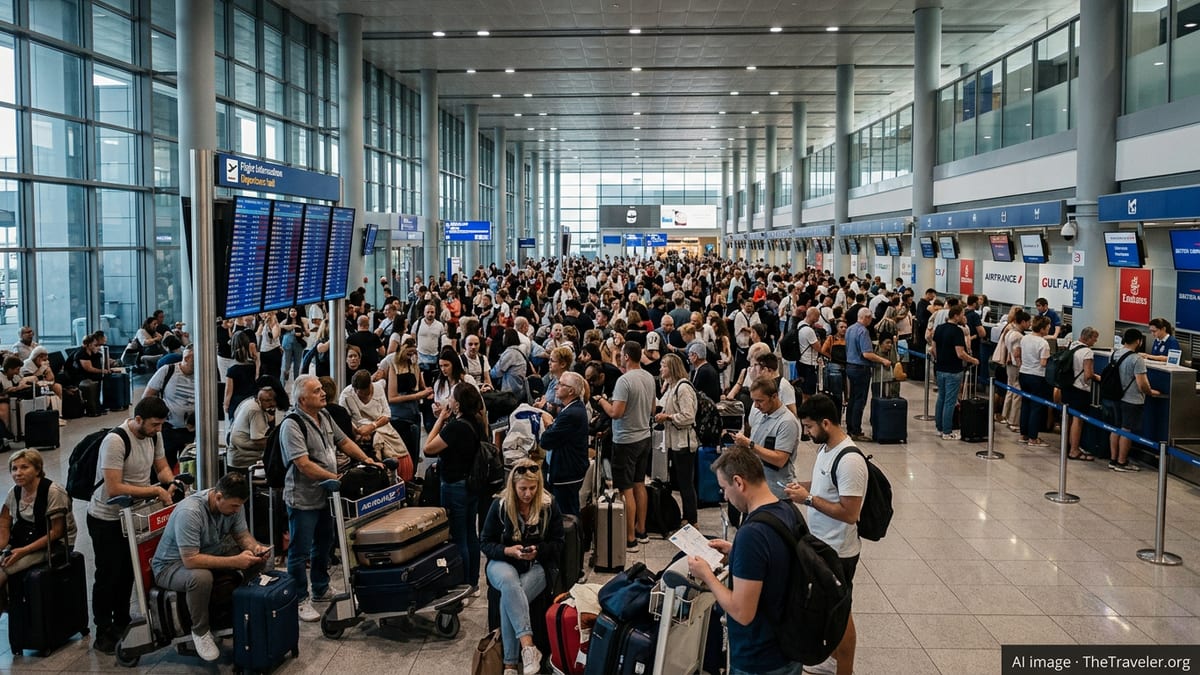
A Perfect Storm Over the Eastern Mediterranean
Published operational data for Europe’s air traffic network shows that traffic in the southeast axis, including Greece, has surged well beyond pre‑pandemic levels at the same time that large portions of airspace to the east and north remain constrained. With parts of Russian and Ukrainian airspace still effectively closed and Middle East routings regularly disrupted by regional tensions, long‑haul and regional carriers are funnelling more flights through Greek, Cypriot and Balkan corridors.
Eurocontrol’s network performance figures for recent summers highlight how this shift has concentrated pressure on states along the southeast axis, with Greece handling traffic increases of around 20 percent compared with 2019 while still operating within legacy infrastructure and staffing levels. As flows from northern and western Europe to the eastern Mediterranean, the Gulf and North Africa are recalibrated, Greek airspace has become a key gateway, particularly for services that can no longer use traditional corridors over the Black Sea region or certain Middle Eastern flight information regions.
The result is that Greece, once a peripheral player in the European network, now sits at the crossroads of several high‑density flows: intra‑EU leisure traffic into its islands, hub‑to‑hub links between major European airports and Gulf or Levantine hubs, and an increasing number of cargo and repositioning flights that also depend on the same upper airspace sectors. Network managers report that when these flows peak simultaneously, Greek control sectors quickly reach their declared capacity, forcing the imposition of ground delays far beyond the country’s borders.
Summer Tourism Boom Collides With Structural Constraints
At ground level, Greece’s tourism revival has been dramatic. Passenger totals at Athens and major island airports have set repeated records, with international arrivals pushing well above 2019 levels during the peak months. Airlines have responded by scheduling denser waves of departures and arrivals to match hotel and cruise turnover patterns, leading to intense morning and evening peaks at Athens International Airport and the main island gateways.
Eurocontrol planning documents and seasonal performance reviews have for several years flagged chronic capacity limitations at multiple Greek island airports, many of which have short runways, limited stands and constrained terminal space. Even as private operators have invested in upgrades at some regional gateways, the combination of infrastructure limits and rapid demand growth has kept airport‑related air traffic flow management delays elevated compared with many western and northern European hubs.
At Athens, network overviews indicate that declared arrival and departure rates are frequently outpaced by schedule demand in high season, prompting the European network manager to regulate traffic through slot allocations that hold aircraft at origin to prevent runway and terminal congestion. When convective weather, strong meltemi winds or local disruptions are added to the mix, these structural constraints can lead to significant knock‑on delays for flights across the continent.
Greek air traffic control capacity is another pressure point. Industry analyses and European performance assessments have repeatedly cited staffing shortages and slow modernization of systems as factors limiting the number of aircraft that can safely be handled in key sectors. This means that even when airports could theoretically handle more movements, the en‑route network above them cannot always be scaled up to match surging summer demand.
Middle East Diversions Push More Traffic Through Greek Skies
The ongoing volatility in Middle Eastern airspace has further reshaped traffic flows in ways that amplify Greece’s newfound role as a bottleneck. Periodic closures or restrictions affecting the skies over parts of Israel, Iraq and surrounding regions, as well as tactical risk assessments that prompt airlines to avoid certain flight information regions, have prompted carriers to shift Europe–Gulf and Europe–South Asia routes to more northerly or westerly tracks.
Publicly available network briefings and airline schedule data suggest that a growing share of these rerouted services now route via the eastern Mediterranean, adding to congestion over the Aegean and Ionian Seas. Flights that once transited more directly through Middle Eastern airspace may now pass closer to Greek and Cypriot sectors, particularly when operators seek to balance safety considerations, fuel efficiency and available overflight permissions.
This shift interacts with Europe’s broader airspace constraints. With capacity still reduced in parts of eastern Europe and Russia effectively off‑limits to most western carriers, there are fewer alternative corridors available when Middle East tensions spike. As a result, Greek sectors are often used as a safety valve during regional flare‑ups, carrying additional rerouted flights on top of already dense summer schedules.
Network management reports describe how even short‑lived airspace restrictions in the Middle East can ripple quickly into the European system, generating holding patterns, level capping and departure delays in countries hundreds of kilometres away. When such episodes coincide with Greek holiday peaks, the system can tip from manageable congestion into widespread knock‑on delays across the Mediterranean basin.
Recent System Failure Highlights Infrastructure Risks
The vulnerabilities created by this concentration of traffic were starkly illustrated earlier this year when a technical failure in Greek air traffic control systems forced the temporary shutdown of the country’s airspace. According to press coverage at the time, pilots were unable to communicate with controllers in key area control centres for several hours, leading to the diversion or delay of hundreds of flights and the effective emptying of Greek airspace until backup procedures were in place.
Reports on the incident linked the disruption to outdated communication and navigation infrastructure, as well as long‑standing resourcing disputes between controllers and state authorities. The episode drew renewed attention to earlier European Commission actions targeting Greece over delayed implementation of modern performance‑based navigation procedures at its airports, which are intended to improve both safety and efficiency.
While network data suggests that such complete outages are rare, the scale of the knock‑on impact underscored how central Greece has become to the smooth functioning of Europe’s aviation system. Flights between northern Europe and destinations across the eastern Mediterranean, Middle East and even parts of Africa were forced into lengthy diversions via Italy, the Balkans or central Europe, further congesting neighbouring airspaces and straining airline operations.
Industry analysts note that as long as Greek systems and staffing remain under strain, there is limited resilience in the network when major incidents do occur. Even after normal operations resumed, many carriers were still recovering aircraft and crew rotations for days, illustrating how a single failure at what has become a critical junction can disrupt schedules across multiple regions.
Network Managers Race to Contain Delays Ahead of Peak Season
European network planners are responding to these dynamics with a series of tactical and structural measures aimed at containing delays as the next peak summer season approaches. Eurocontrol’s rolling Network Operations Plans and seasonal updates place particular emphasis on the southeast axis, including Greece, outlining capacity enhancements, revised sector configurations and closer coordination with airlines to smooth peak loads.
Measures include encouraging more disciplined adherence to filed flight plans, which helps flow managers sequence traffic more predictably through constrained sectors, and promoting the use of alternative routings at off‑peak times to spread demand. Airport‑focused initiatives at Athens and other busy Mediterranean hubs seek to align declared capacities more closely with realistic operational performance, in order to reduce the gap between schedules and what can actually be delivered on the day.
However, strategic documents also acknowledge that infrastructure upgrades and controller training pipelines take time, especially in states facing fiscal constraints and complex procurement processes. Given how quickly traffic has rebounded and then exceeded pre‑pandemic levels, there is a recognition that the system is relying heavily on short‑term measures to manage what are, in many cases, long‑term structural issues.
For travellers, the practical implication is that Greece is likely to remain a weather vane for wider Mediterranean aviation performance this summer. When conditions are favourable and traffic is spread evenly, delays may be modest. But when intense tourism demand collides with regional airspace disruptions or local technical problems, the bottlenecks over and around Greece can swiftly translate into missed connections and late arrivals for passengers across Europe and beyond.