

More news on this day
Air travel across Europe is facing fresh disruption today, with publicly available data indicating at least 1,854 flights delayed and 41 cancelled, straining operations at major hubs in Italy, France, Germany, Spain, Portugal, Ireland and beyond and affecting passengers booked on Lufthansa, KLM, ITA Airways, Ryanair and other carriers.
Get the latest news straight to your inbox!
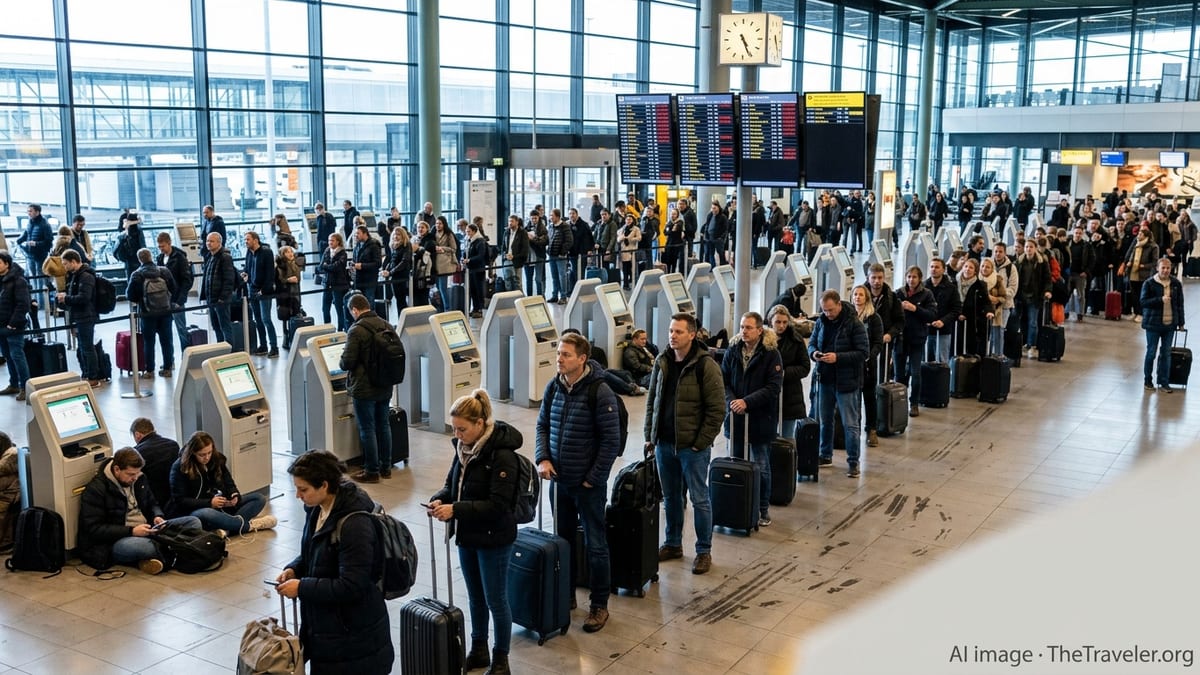
Major European Hubs Struggle With Fresh Wave of Disruptions
Tracking platforms that compile operational data from airports and airlines show that traffic across the European network has been hit by a broad wave of delays today, concentrated at large hubs in Rome, Amsterdam and Lisbon alongside further disruption at airports in France, Germany, Spain and Ireland. While the majority of scheduled flights are still operating, the latest figures point to 1,854 delayed services and at least 41 outright cancellations, a level high enough to ripple through connecting banks of flights.
Rome Fiumicino, Amsterdam Schiphol and Lisbon Portela, already among Europe’s most delay-prone airports in recent seasons, are again featuring prominently in today’s disruption picture. Historical analysis from flight-statistics providers has consistently ranked Lisbon and Amsterdam near the top of European delay tables, with Rome also recording above-average arrival delay minutes, and today’s operational snapshot indicates that pattern is continuing as congestion builds during peak hours.
In addition to the headline figures, live dashboards show mounting knock-on effects as late-arriving aircraft struggle to be turned around in time for their next legs. Even where cancellations remain limited compared with overall traffic, the clustering of delays at key nodes in the network increases the risk of missed connections for transfer passengers, particularly on multi-leg itineraries routed through Amsterdam, Frankfurt, Rome or Madrid.
The latest situation follows a series of months in which Europe’s air traffic system has been operating close to capacity on busy days. Analyses published by Eurocontrol and independent analytics firms through 2024 and early 2025 have highlighted growing sensitivity to weather, air traffic control flow restrictions and local staffing shortages, leaving little margin when several of these factors coincide on a single day.
Flag Carriers And Low-Cost Airlines Among Those Affected
Today’s figures indicate that the disruption is spread across both traditional network airlines and low-cost carriers. Reports from flight-status aggregators show that services operated by Lufthansa, KLM and ITA Airways, as well as by Ryanair and other budget airlines, are among those delayed or cancelled, particularly on routes connecting major European capitals and holiday destinations.
Lufthansa’s hubs in Germany, notably Frankfurt and Munich, are experiencing a combination of late inbound arrivals and departure flow restrictions, which are feeding into delays on onward flights to Italy, Spain and Portugal. KLM’s Amsterdam base is similarly under pressure, with tightly scheduled short-haul rotations to cities such as Rome, Paris, Dublin and regional German airports vulnerable to small schedule upsets that quickly expand across the day.
Italy’s ITA Airways and Ireland-based Ryanair, both significant operators at Rome Fiumicino, Amsterdam and Lisbon, are also visible in today’s disruption data. Ryanair continues to rank among Europe’s busiest carriers by daily flights, which amplifies the network impact when even a small share of its schedule runs late. National and regional carriers in France, Spain and Portugal are likewise seeing scattered delays that reflect broader constraints on airspace and airport throughput.
Publicly available flight-status tools do not typically assign responsibility for each individual delay in real time, but previous reporting on similar disruption days in Europe has shown that a mixture of airline-related issues, airport congestion and air traffic control flow regulations generally lie behind the patterns now emerging.
Operational Pressures: Weather, ATC Flow Controls And Capacity Limits
While precise causes for each affected flight vary, today’s disruption fits within a wider trend of mounting operational pressures across the European air transport system. Eurocontrol’s recent delay analyses for 2024 and early 2025 highlight how air traffic control capacity constraints, sector congestion and adverse weather remain among the leading contributors to all-causes delay, especially at large hubs and in busy cross-border airspace corridors.
Lisbon and Amsterdam have been repeatedly singled out in statistical reviews for high average delay minutes per flight, with analysts pointing to a mix of airspace structure, airport capacity limits and sensitivity to strong winds and low visibility. Rome, Frankfurt, Paris and Madrid all appear regularly in rankings of Europe’s most delayed airports, reflecting their role as dense connection banks where even short disruptions can propagate rapidly through the network.
On days like today, when several busy regions experience weather changes or flow restrictions at similar times, the network impact can quickly escalate. Airlines often respond by introducing short ground holds, swapping aircraft between routes or consolidating lightly booked flights, practices that can help maintain overall resilience but add to the perception of instability for those passengers who see their departure times repeatedly revised.
Industry research published over the past year also underscores how reactionary delays have become a dominant feature of the European system. Once an early-morning rotation runs late, subsequent legs often inherit and amplify that delay, particularly on short-haul aircraft that are scheduled to operate multiple sectors in a single day across different countries.
Passenger Experience: Missed Connections And Consumer Rights
For travellers, today’s figures translate into longer queues at check in and security, crowded departure lounges and increased risk of missed onward connections. Passengers transiting through large hubs such as Amsterdam and Frankfurt are especially exposed, as minimum connection times can quickly be breached when an inbound leg from Italy, Spain or Ireland is held on the ground due to airspace congestion or late aircraft arrival.
Travel rights organisations note that many of today’s disruptions fall under Europe’s established passenger-protection framework. Under Regulation EC 261/2004, eligible travellers whose flights are significantly delayed or cancelled for reasons judged to be within an airline’s control may be entitled to care, rerouting and, in some cases, financial compensation. However, where disruption is primarily attributed to severe weather or air traffic control restrictions, cash compensation may not apply, even though carriers are still expected to provide reasonable assistance.
Advisories from consumer groups and travel agencies consistently recommend that passengers affected by days of widespread delays keep detailed records of their bookings, boarding passes and any associated expenses. These organisations also stress the importance of checking itineraries frequently through airline apps and airport information screens, as rebookings or gate changes can occur at short notice when operations are under strain.
In recent months, case studies highlighted by advocacy platforms have shown that claims processes can be complex and time consuming, particularly when journeys involve multiple airlines on a single ticket or when responsibility for a delay is contested between airport operators, carriers and air navigation service providers.
What Travellers Should Watch For As Disruption Continues
With operational data indicating hundreds of delayed flights still working their way through today’s schedule, further knock-on disruption into the late evening period remains possible. Passengers departing from or connecting through Rome, Amsterdam, Lisbon and other major European hubs are being encouraged by travel advisers to arrive at the airport earlier than usual, remain flexible with onward plans and monitor departure boards closely.
Analysts who track European air traffic trends note that days of elevated disruption increasingly occur even outside traditional peak holiday periods, as airlines operate fuller schedules and airports handle traffic levels close to or above pre-pandemic volumes. This leaves the system more exposed when localised storms, staffing gaps or technical issues affect one or more key nodes.
For those yet to travel, publicly available flight-tracking services and airline status tools offer the clearest real-time view of whether a specific service is running on time, heavily delayed or cancelled. Travel planners suggest that passengers with critical same-day connections consider routing options with longer layovers or, where feasible, direct flights that avoid tight transfers at repeatedly congested hubs.
While today’s tally of 1,854 delays and 41 cancellations represents only a fraction of Europe’s total daily traffic, the concentration at major airports and on popular routes amplifies the disruption felt by travellers. With capacity pressures and airspace constraints expected to remain features of the European network, both airlines and passengers may need to build greater buffers into schedules and itineraries to absorb similar shocks in the months ahead.