


More news on this day
Hundreds of passengers across northern Europe faced long queues, missed connections and last minute schedule changes this weekend as widespread delays and cancellations rippled through airports in Denmark, Finland, France and neighboring countries, disrupting services for carriers including KLM, Ryanair and easyJet on routes through Copenhagen, Paris and other major hubs.
Get the latest news straight to your inbox!
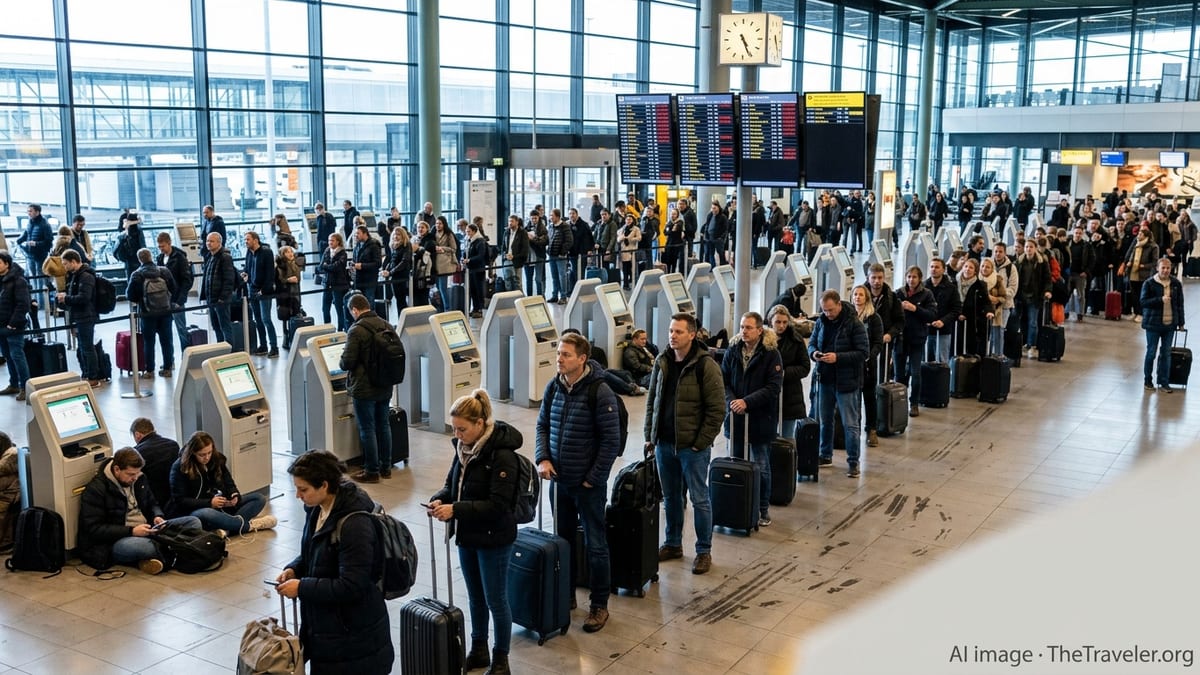
Delays Mount Across Northern European Hubs
Preliminary operational data from airport and flight-tracking dashboards indicate that more than 1,400 flights across Europe encountered significant disruption within a 24 hour window, with roughly 1,424 departures and arrivals delayed and at least 61 services cancelled outright. The heaviest operational strain has been reported at key transfer hubs such as Copenhagen and Paris Charles de Gaulle, with secondary impacts at airports in Finland, the Netherlands, Germany and the United Kingdom.
Short haul and regional services bore the brunt of the knock on effects, with late arriving aircraft from one airport feeding into fresh delays on subsequent rotations. Flight status portals for routes between Copenhagen and Paris, for example, showed clusters of departures operating behind schedule as carriers worked through congestion in the wider network.
While long haul operations have generally remained more stable, irregular aircraft and crew rotations created by the disruption are expected to filter into transatlantic and Asian schedules over the course of the weekend, particularly for airlines that rely on tight connection banks in northern Europe.
Publicly available statistics from recent Eurocontrol network briefings underscore how even modest constraints quickly multiply at peak times, with thousands of flights on a typical summer day already operating close to capacity in European airspace.
Finland, Denmark and France Among Most Affected States
Reports from aviation and travel outlets point to a concentration of delays in and around Finland, Denmark and France, where a combination of air traffic flow restrictions, technical issues and staffing constraints has periodically slowed traffic throughout the early summer period. Network performance summaries highlight France as a persistent hotspot for en route delays linked to capacity and transition work in its air traffic management systems, while northern European states have contended with their own local bottlenecks.
At Copenhagen Airport, one of Scandinavia’s busiest hubs, earlier episodes of disruption this month illustrated how quickly local operational challenges can cascade into a much broader traffic problem. When departure rates are throttled for even a few hours because of congestion, equipment checks or limited runway capacity, aircraft and crews end up out of position across dozens of destinations.
In Finland, Helsinki’s role as a transfer point between Europe and Asia means that delays on feeder flights can jeopardize onward connections to long haul services. In France, high traffic volumes into Paris and ongoing capacity work in regional control centers have increased the sensitivity of the system to external shocks such as weather or upstream congestion.
These national level constraints are playing out against a backdrop of steadily rising traffic volumes as European carriers ramp up for the main summer holiday season, leaving limited slack in the system to absorb problems once they emerge.
Low Cost and Network Carriers Feel the Impact
Operational data and schedule monitoring suggest that the latest wave of disruption has cut across airline business models, affecting both large network groups and low cost operators. Ryanair and easyJet, two of Europe’s biggest budget carriers, have reported previous bouts of delays and selective cancellations this year as congestion and air traffic control measures forced adjustments to tightly timed turnarounds.
KLM and partner carriers within its broader airline group have also been exposed, particularly on short haul flights feeding into or out of major hubs such as Amsterdam, Copenhagen and Paris. When departure slots are restricted by air traffic flow management, airlines often prioritize long haul or strategically important routes, leaving some intra European services to operate late or be cancelled.
Industry analysis notes that high utilisation, single fleet type operators can be especially vulnerable to disruption because a single delayed aircraft can affect a large portion of the day’s schedule. Legacy carriers, meanwhile, must balance complex network structures, connecting banks and crew rosters, which can make it difficult to recover quickly once irregular operations take hold.
Several travel advisories circulating on consumer rights and aviation tracking platforms have urged passengers not to assume that only one or two brands will be impacted, warning that shared ground handlers, common airspace constraints and codeshare arrangements can spread disruption across multiple airlines at the same airport.
Knock On Effects in Copenhagen, Paris and Beyond
Copenhagen and Paris have emerged as focal points for the latest operational challenges, but the impact is being felt across a web of destinations stretching from southern Europe to the Nordic region. Passengers connecting through Copenhagen report missed onward flights to cities across the continent after initial delays from other European gateways left too little buffer time between arrivals and departures.
Paris Charles de Gaulle and Orly have simultaneously handled dense summer schedules, with traffic patterns influenced by diversions and reroutings around recent airspace constraints elsewhere on the continent. Irregular arrivals from northern Europe have in turn created congestion at boarding gates and transfer security points, lengthening minimum connection times and increasing the risk of missed flights for travelers on tight itineraries.
Regional airports are not immune. When a hub suffers disruption, smaller fields at the edges of major networks can find themselves temporarily cut off as airlines consolidate flights, swap aircraft types or focus scarce capacity on routes with higher passenger volumes. This can leave travelers at secondary destinations facing longer waits for rebooking or being rerouted through entirely different hubs.
Travel commentators note that such patterns mirror previous summers in Europe, where scattered bottlenecks at a handful of large airports effectively set the tempo for punctuality across the wider continent.
What Passengers Can Expect in the Coming Days
Given current traffic levels and recent Eurocontrol network briefings showing a generally tight operating environment, aviation analysts expect continued pockets of disruption in the short term, even if the present spike in delays and cancellations eases. Airlines are likely to maintain schedule adjustments and occasional pre emptive cancellations to protect the remainder of their operations.
Consumer advocates and travel law specialists point out that under European passenger protection rules, travelers affected by long delays or cancellations on flights departing from EU or EEA airports may be entitled to meals, accommodation and, in many cases, financial compensation, depending on the cause of the disruption and the length of the delay.
Passengers are being encouraged by travel organisations and online advisory sites to monitor flight status closely on the day of departure, allow extra time for connections and consider avoiding very tight layovers through the most congested hubs. Rebooking options can be more flexible when disruptions are identified early, before alternative services also fill up.
With demand for summer travel expected to remain strong, the latest wave of operational issues in Finland, Denmark, France and neighboring states highlights the degree to which European air travel still operates on a narrow margin, where relatively small technical or staffing constraints can quickly translate into thousands of delayed passengers across the continent.