


More news on this day
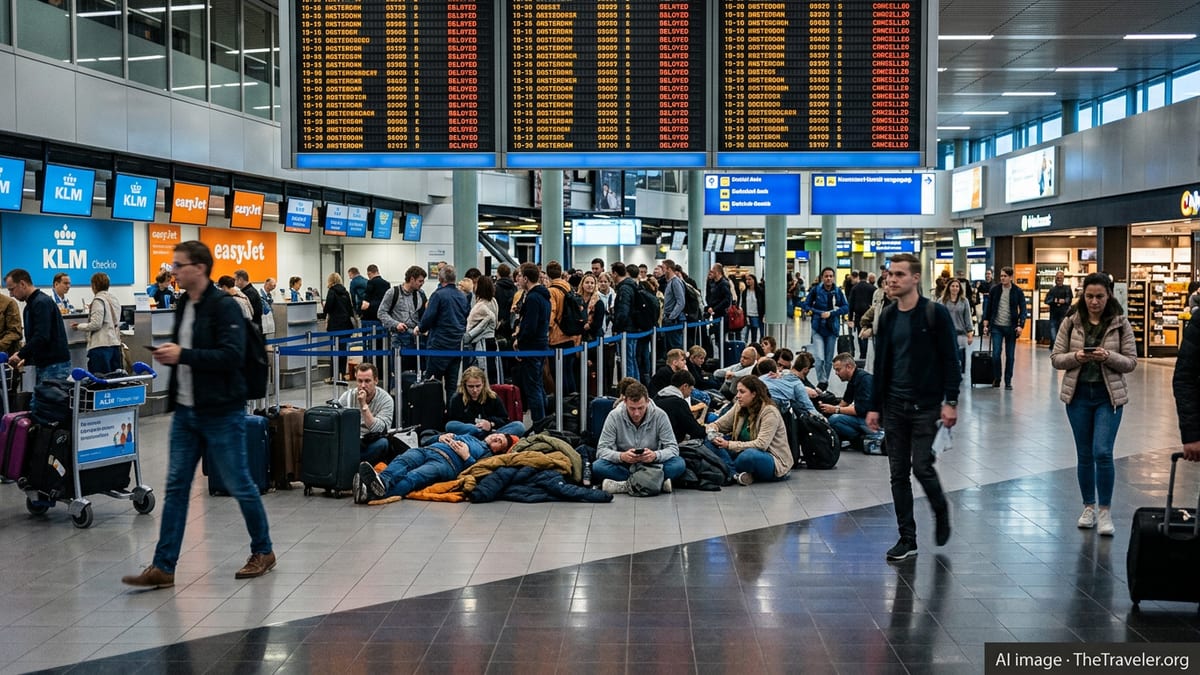
European air travel is facing a fresh day of disruption after 2,141 flight delays and 113 cancellations were recorded across 12 major airports on 3 September 2026, disrupting operations in nine countries and affecting tens of thousands of passengers at the tail end of the peak summer season.
Get the latest news straight to your inbox!
Network-Wide Disruptions Concentrated in 12 Key Hubs
Publicly available disruption tallies for 3 September 2026 indicate that delays and cancellations were concentrated at a dozen of Europe’s busiest hubs across Austria, Spain, Denmark, Italy, Germany, the United Kingdom, Norway, Sweden and the Netherlands. Reports from travel-industry outlets describe the event as a Europe-wide aviation crisis as the combination of late-running flights and outright cancellations rippled across the daily schedule.
Coverage compiled from monitoring platforms shows that Rome Fiumicino and Amsterdam Schiphol were among the worst affected for delays, while Berlin Brandenburg recorded one of the highest cancellation ratios relative to its scheduled flights. Other airports identified as heavily impacted include London Gatwick, London Heathrow, Frankfurt and Copenhagen, alongside additional hubs in Scandinavia and Iberia.
Travel news reports in Spanish and English note that the tally of 2,141 delays and 113 cancellations was drawn from live operational boards and aggregated across nine national markets. Although the disruption is not on the scale of previous strike-driven shutdowns, the clustering of problems at major transfer hubs amplified missed connections and onward delays across the network.
The incident comes as European traffic volumes remain close to or slightly above 2025 levels, with Eurocontrol’s latest weekly briefings highlighting sustained daily traffic in excess of 36,000 flights and elevated delay minutes linked to weather and air traffic flow restrictions.
Operational Strains: Weather, Flow Management and Crew Positioning
Analysis of recent Eurocontrol network briefings for late August and early September 2026 points to a confluence of factors behind the worsening punctuality picture in Europe. Severe convective weather across parts of the continent in late August generated more than 200,000 minutes of en route delay on a single day and pushed average air traffic flow management delay per flight up by more than 20 percent week on week.
Reports from travel-industry outlets on the 3 September disruption describe a similar pattern of capacity constraints, with strict flow regulations in already busy airspace and intermittent ground holds at several airports. These restrictions limited the number of aircraft that could safely depart or arrive each hour, forcing carriers to absorb delays or cancel rotations when knock-on effects became unmanageable.
Operational commentary also highlights crew and aircraft positioning challenges. After a summer of high utilization, tight turnaround schedules left little slack to recover from earlier disruptions, while crew duty-time limits constrained the ability to simply extend working hours. When inbound aircraft arrived late from another part of the network, subsequent departures from hub airports could not always be re-crewed in time.
Recent all-causes delay analyses published by Eurocontrol show that airline-related issues, including late inbound aircraft and reactionary delays, remain a leading component of average delay minutes per flight, alongside capacity-driven air traffic control constraints. This structural fragility has made the network more sensitive to any single day of adverse conditions.
Airlines and Airports Most Affected
According to disruption tallies compiled from airport boards and summarized by travel news outlets, a handful of large carriers accounted for a significant share of the 2,141 delayed flights and 113 cancellations registered across Europe on 3 September. Low cost and network airlines including easyJet, KLM, ITA Airways, British Airways, SAS and Lufthansa were frequently cited among those experiencing the highest number of late departures and cancellations.
On the airport side, Rome Fiumicino was reported as having the greatest number of delayed flights among the 12 major hubs, underlining its role as a critical Mediterranean gateway during late-summer holiday traffic. Amsterdam Schiphol, which has faced recurrent capacity and staffing pressures since the pandemic, again appeared near the top of the disruption rankings for both delays and cancellations.
Berlin Brandenburg, Frankfurt, London Gatwick and London Heathrow each recorded substantial disruption, reflecting their positions as key nodes in intra-European and long haul networks. In Northern Europe, Copenhagen and major Scandinavian hubs saw elevated levels of delay, while airports in Spain and Austria contributed additional disrupted flights to the overall tally.
While the 113 cancellations represented only a fraction of the thousands of flights scheduled across Europe that day, cancellations tend to have disproportionate impacts, especially for passengers on the last frequency of the day or on routes with limited alternatives. The clustering of those cancellations at hubs with already heavy delay burdens added to gate congestion, aircraft substitution challenges and missed onward connections.
Passenger Impact and Rights in the EU Framework
The operational crisis has had an immediate impact on passengers across Europe and beyond, with missed connections, overnight stays and significant schedule changes reported by traveler forums and social media posts. With airports stretched and queues at service desks growing quickly, travel advisory outlets emphasize the importance of using airline apps, websites and call centers to rebook rather than waiting in line at the terminal.
Consumer information services tracking European disruption point travelers to the long-standing EU passenger rights framework, often referred to as EU Regulation 261/2004. Under this regime, passengers departing from or arriving into EU and associated countries on qualifying flights may be entitled to care, re-routing and, in some circumstances, financial compensation when cancellations or long delays are not caused by extraordinary circumstances such as severe weather or airspace closures.
Legal analyses of recent cases stress that entitlement depends on the precise cause of the disruption, the length of delay at arrival and the distance of the flight. For example, a short haul intra-EU service arriving more than three hours late due to airline operational problems may trigger compensation, while a similar delay directly attributable to severe storms or mandatory air traffic control flow restrictions may not.
Travel organizations advise passengers affected by the 3 September disruption to retain boarding passes, booking confirmations and any receipts for essential expenses such as meals or accommodation. These documents support later claims once airlines have completed their initial handling of operational recovery. Online claim portals and national enforcement bodies provide additional guidance for travelers uncertain about their rights.
What the Crisis Signals for the Rest of 2026
The scale of the 3 September 2026 disruption has drawn attention because it arrives at a time when European aviation was expected to be stabilizing after several summers of staffing shortages, industrial action and rapid demand recovery. Forecasts for 2026 from industry consultancies published earlier in the year warned, however, that structural constraints in air traffic management, infrastructure capacity and labor availability could continue to produce reliability issues even as passenger numbers normalized.
Eurocontrol’s rolling European Aviation Overview and summer traffic briefings for 2026 depict a network operating near historical traffic peaks, with daily flight counts consistently above 36,000 and limited spare capacity at certain bottleneck sectors. The agency’s data on all-causes delay show that while average delay per flight has moderated compared with the sharp spikes seen during strike episodes, it remains above pre-pandemic baselines and is highly sensitive to weather and capacity shocks.
Analysts note that the clustering of 2,141 delays and 113 cancellations at only 12 major airports underscores how concentrated Europe’s aviation system has become. A relatively small set of hubs now handle a large share of connecting traffic, which increases efficiency in normal conditions but magnifies the impact when those hubs experience operational stress.
With Eurocontrol projecting sustained high traffic through September and updated route and airspace restrictions entering into force for the current AIRAC cycle, network managers, airlines and airports face pressure to improve resilience for the remainder of the summer and into the autumn schedule. Observers will be watching closely to see whether the early September disruption proves to be an isolated spike or a sign of recurring strain in Europe’s aviation infrastructure.
Travel and Tour World: Vuelos cancelados en toda Europa
Nomad Lawyer: European Aviation Crisis 2026
Eurocontrol Flash Briefing 2026 Week 35