


More news on this day
A fresh bout of disruption across the European aviation network has left thousands of passengers facing missed connections and overnight waits, after 1,603 flight delays and 49 cancellations were recorded in a single day across key hubs in Amsterdam, Paris and London.
Get the latest news straight to your inbox!
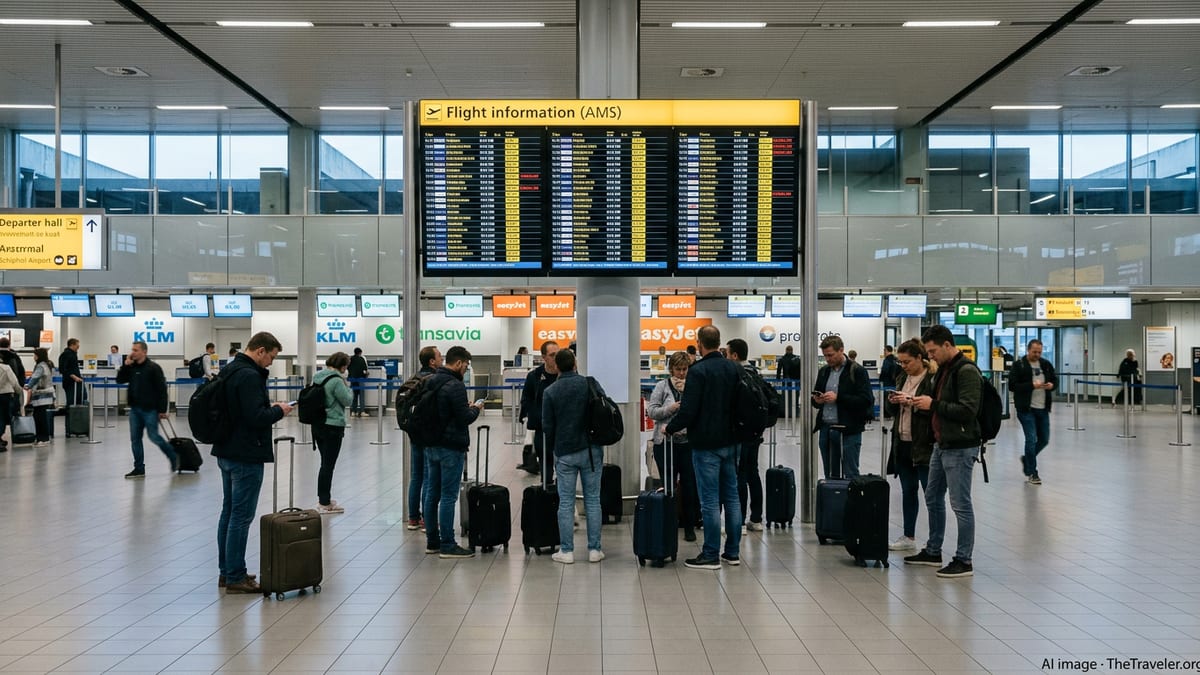
Network Pressure Peaks at Amsterdam, Paris and London
Publicly available air traffic data and disruption trackers indicate that the latest operational crunch has centered on Amsterdam Schiphol, Paris Charles de Gaulle and the main London airports, including Heathrow and Gatwick. Together, these hubs form a dense triangle of short haul and long haul services that connect Europe with North America, the Middle East and Asia. When problems build at all three on the same day, knock on effects are quickly felt across the continent.
The 1,603 delays and 49 cancellations reported across the European network align with a pattern of high summer stress, with aircraft and crews scheduled close to maximum utilization. Industry reports for summer 2026 already pointed to rising traffic volumes compared with last year, while also warning that limited slack in the system could magnify any local disruption into a wider network issue.
According to published coverage, congestion at London airports and Amsterdam has been especially acute on peak travel days, with delay statistics showing that even modest schedule slippages cascade into missed departure slots and gate shortages. Paris Charles de Gaulle is heavily exposed to the same dynamics, as it functions both as a major origin and transfer point and as a key link in transatlantic and Africa bound services.
While the exact balance of causes varies by airport and airline, the aggregate numbers from this latest episode underscore that Europe’s busiest hubs remain vulnerable when multiple operational constraints arrive at once, whether related to capacity limits, staffing bottlenecks, weather or airspace restrictions.
Structural Strain in the European Aviation Network
Network level analyses from Eurocontrol and other aviation bodies suggest that summer 2026 traffic is trending above last year, yet capacity in the skies and on the ground has not expanded at the same pace. Even before the latest disruption, European monitoring reports had highlighted a gradual rise in average delay minutes per flight and pointed to key hub airports as persistent pressure points.
Amsterdam Schiphol, Paris Charles de Gaulle and London Heathrow consistently rank among Europe’s busiest airports by daily movements. With each handling well over a thousand flights per day in peak months, relatively small deviations from plan can reverberate through their tightly coordinated arrival and departure waves. When several hubs concurrently struggle to absorb those deviations, flights operating between them often bear the brunt, contributing to network wide totals such as the 1,603 delays now reported.
Operational planning documents show that congestion can be further complicated by air traffic flow management regulations, which attempt to smooth peaks by holding flights on the ground or rerouting them through less crowded airspace. These measures can reduce overload on particular sectors but they also add minutes to flight times, feeding back into delay statistics recorded at destination airports.
Infrastructure constraints are another factor. Runway capacity, terminal expansion projects and noise related curfews at major European airports limit how many additional flights can be handled during the busiest hours. As airlines continue to rebuild and expand schedules to meet demand, they are increasingly competing for the same constrained slots, leaving little room for recovery when irregular operations strike.
Passenger Impact and Emerging Travel Patterns
For travelers passing through Amsterdam, Paris and London during the latest disruption, the headline statistics translate into missed connections, unplanned overnight stays and extended queues at rebooking and customer service desks. Short haul passengers within Europe have been particularly exposed, because these flights often operate as feeders into long haul departures and are more easily delayed by network congestion.
Consumer advocacy groups and compensation specialists have reported heightened contact volumes from passengers whose flights were affected by the recent spike in delays and cancellations. Publicly accessible guidance from such organizations notes that whether travelers are entitled to compensation can depend on the specific cause of each disruption, including whether the airline could reasonably have prevented or mitigated the problem.
Booking data and travel advice pieces indicate that some passengers are already adjusting their behavior in response to repeated operational issues at Europe’s busiest hubs. Trends include selecting first departures of the day to reduce the risk of knock on delays, choosing longer connection times on itineraries that route via Amsterdam, Paris or London, or, where possible, favoring direct flights that bypass congested hubs entirely.
There are also signs that rail and long distance coach services are benefiting from travelers seeking alternatives for medium range journeys, especially on well served corridors such as London to Paris and Amsterdam to Paris, where high speed rail can offer a predictable city center to city center journey when air travel reliability is in question.
How Airlines and Airports Are Responding
In response to recurring strains across the European aviation network, airlines and airport operators have been refining contingency plans and attempting to create more resilience in schedules. Public information released by airlines over recent months points to measures such as modest capacity trimming on the most congested days, the strategic deployment of spare aircraft and crew, and closer coordination with ground handling providers to accelerate turnaround times.
At airport level, operators in Amsterdam, Paris and London have been rolling out incremental changes aimed at smoothing passenger flows and improving punctuality. These range from more dynamic gate allocation and enhanced staffing at security checkpoints to investments in better queue management and passenger information systems, which can reduce knock on disruptions caused by late arriving travelers at the gate.
Network managers and regulators are also playing a role through initiatives designed to optimize airspace usage and improve cross border coordination. Published technical briefings refer to collaborative decision making processes between airlines, airports and air traffic control, which aim to anticipate bottlenecks earlier in the day and adjust flight plans or departure times before delays become unmanageable.
Despite these efforts, the latest figures of 1,603 delays and 49 cancellations across the European network highlight how fragile the balance remains during peak season. For now, both industry stakeholders and travelers are being reminded that even incremental disruptions at a cluster of major hubs can rapidly translate into continent wide travel headaches.
What Travelers Can Do Ahead of Peak Summer
With the main summer holiday period still unfolding, prospective travelers through Amsterdam, Paris and London are being encouraged by travel advisors and consumer organizations to build more flexibility into their plans. That includes allowing ample time for transfers, avoiding tight self planned connections between separate tickets and preparing for the possibility of schedule changes in the days before departure.
Published guidance commonly recommends that passengers monitor their flights closely via airline apps or departure boards, keep all travel documents and receipts in case disruption leads to claims, and familiarize themselves with applicable passenger rights before arriving at the airport. This can help people make faster decisions when delays or cancellations occur, including whether to request rebooking, refunds or accommodation support.
Some industry analyses further suggest that travelers consider the broader network context when selecting routes. On days when several major hubs are forecast to be busy, choosing flights that connect through less congested airports, even if they involve a short detour, may reduce exposure to the kind of cascading disruption that has produced the latest 1,603 delays and 49 cancellations across the European system.
For many passengers, however, Amsterdam, Paris and London will remain unavoidable gateways due to their extensive route networks. For those travelers, a combination of early planning, schedule flexibility and realistic expectations about potential delays may be the most practical way to navigate a European aviation network that continues to operate close to its limits.