


More news on this day
Overnight rail is rapidly reshaping how travelers move between Europe’s major cities, with new sleeper routes turning once-routine hops between capitals into multi-city journeys that compete directly with short-haul flights.
Get the latest news straight to your inbox!
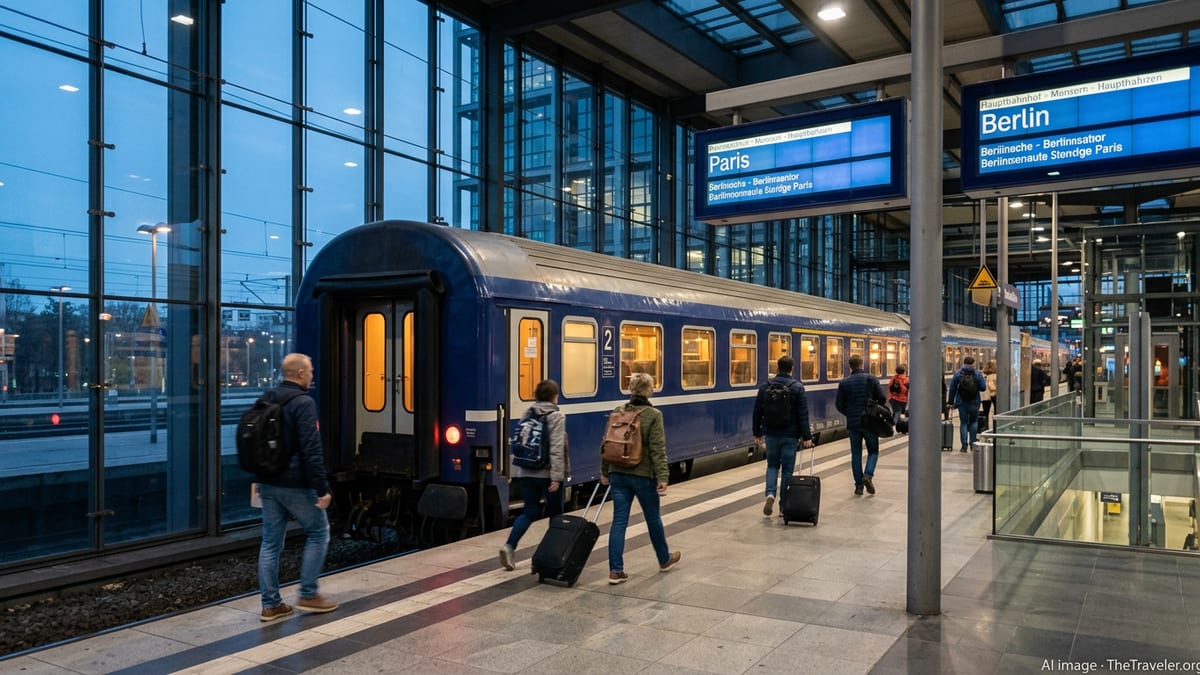
New Night Routes Link Capitals While Travelers Sleep
A new generation of sleeper operators and services is stitching together Europe’s city map in ways that were largely abandoned a decade ago. Belgian-Dutch cooperative European Sleeper has become one of the most visible players, launching its first “Good Night Train” between Brussels, Amsterdam and Berlin in May 2023, then extending the route on to Dresden and Prague in March 2024. Publicly available timetables show the train now links four capitals on a single overnight run, departing in the evening and arriving the following morning.
In March 2026, European Sleeper added a second flagship link between Paris and Berlin via Brussels and Hamburg, creating another overnight spine between two of Europe’s busiest air corridors. According to the company’s own published information, both services are marketed toward travelers who want to replace short flights with a night on the rails, using couchettes and classic sleeping cars rather than luxury rolling stock.
State-backed operators are expanding in parallel. Austria’s ÖBB has turned its Nightjet network into the backbone of many cross-border night links, operating services that connect Amsterdam and Brussels with Vienna, Zurich and Italian cities, and jointly developing new services with partners in Germany, Switzerland and France. According to route maps and schedules released by ÖBB and partner railways, Nightjet’s Paris–Berlin service, launched in late 2023, now offers another overnight option on one of Europe’s busiest intercity axes.
In northern Europe, Swedish operator SJ has extended its SJ Euronight service from Stockholm and Malmö through Denmark and Germany to Berlin, with the German section running on an open-access basis. Public timetable history shows the service being lengthened inside Germany in 2023, reinforcing Berlin’s position as an overnight rail hub that now connects directly to Scandinavia, the Low Countries, Central Europe and the Alps.
Twin-City City-Breaks Replace One-Destination Weekends
As more overnight links come online, travel media and rail specialists describe a noticeable shift in how leisure travelers plan European trips. Coverage by rail-focused guides and mainstream travel outlets highlights itineraries that pair cities such as Brussels and Prague, Paris and Berlin, or Amsterdam and Vienna in a single long weekend, using sleeper trains as moving hotels.
Reports on the European Sleeper Brussels–Amsterdam–Berlin–Prague route emphasize how the schedule enables travelers to board after dinner in one cultural capital and wake up near the historic center of another. Similar patterns are emerging on Nightjet routes from the Low Countries to the Alps and northern Italy, where passengers can leave Brussels or Amsterdam in the evening and step off in cities like Innsbruck, Venice or Milan the next morning for a short break without daytime travel lost.
Travel commentary also points to an emerging form of “twin-city” tourism, in which visitors combine two very different destinations in one trip. A weekend might begin with museums and politics in Brussels, then shift to riverside cafes in Prague, or pair Berlin’s nightlife with Parisian galleries, connected by an overnight compartment rather than an early flight. Published reviews from passengers suggest that the ability to experience the transition between regions at a slower pace is part of the attraction, even where overall journey times exceed those of air travel.
National statistics and government briefings on international rail underscore the trend at system level. Dutch transport policy documents, for example, note that the number of international trains running in and out of the Netherlands rose between 2024 and 2025 and flag night trains to Vienna, Innsbruck, Zurich, Basel and Prague as key components of cross-border connectivity. While these figures cover all international rail, they frame overnight services as a growing share of long-distance demand.
Sleeper Trains Compete Head-On With Short-Haul Flights
Published data from the European Commission and national rail operators indicate that rail passenger volumes across the EU recovered strongly after the pandemic, supported by both high-speed daytime services and night trains. At the same time, aviation statistics show that many of the new or revived sleeper routes overlap with short-haul flight corridors that are central to Europe’s low-cost airline network, particularly between France, Germany, the Benelux countries, Austria and Italy.
Industry analyses and route-by-route comparisons in specialist rail publications emphasize that, when the overnight aspect is factored in, sleeper trains can match or beat flights on total door-to-door time. An evening departure from Brussels, for example, can allow a full working day or day of sightseeing before boarding, followed by a full day at the destination after arrival in Berlin or Prague. For many travelers, this effectively replaces a flight plus two hotel nights with a train ticket that bundles transport and accommodation.
Price comparisons reported in consumer travel media suggest that basic couchette fares on routes such as Brussels–Berlin–Prague or Amsterdam–Vienna can be competitive with economy airfares, especially once baggage fees and airport transfers are included. While private sleeper compartments and new-generation “mini cabins” tend to cost more, they are frequently compared in coverage to mid-range hotel rooms in city centers, making them attractive for couples and small groups.
Environmental concerns also shape demand. Policy documents from EU institutions position night trains as a practical tool for reducing emissions on journeys between 500 and 1,500 kilometers, where rail’s carbon footprint per passenger is typically far lower than that of aircraft. Campaigning organizations and some national governments have promoted shifting from air to rail on these corridors, and night services provide a visible alternative that fits into climate-conscious travel planning.
Operational Challenges Temper the Overnight Renaissance
Behind the scenes, the surge in interest has exposed structural hurdles. Analyses by European rail research groups and industry observers point to aging sleeper rolling stock, fragmented timetabling across national networks and complex track-access charges as key constraints on expansion. Several accounts of new night services mention that operators often rely on refurbished carriages rather than new-built trains, which limits capacity and comfort upgrades.
Reports on European Sleeper’s development illustrate these pressures. Public presentations by the cooperative note that its Brussels–Amsterdam–Berlin–Prague service runs on open-access paths through several countries, requiring coordination with multiple infrastructure managers and incumbent operators. Documents relating to its 2025 timetable highlight uncertainty about maintaining a direct Brussels–Prague route because of capacity issues on parts of the German network, underlining how fragile some long cross-border paths remain.
Nightjet’s expansion has faced its own capacity crunch. New Nightjet trainsets with modern compartments are being phased in on key routes, but industry commentary notes that introduction has been slower than initially projected and that some older cars stay in use longer than planned. At the same time, planned routes such as a Zurich–Barcelona night train have experienced delays or remain under review, illustrating that even large state-backed operators must balance ambition with infrastructure and fleet constraints.
Passenger accounts published in forums and travel reviews show that demand at times outstrips supply, with popular holiday-period dates on night trains selling out weeks in advance. Complaints about fully booked sleepers, early-morning arrivals and occasional reliability issues surface alongside positive reports of comfortable journeys and memorable scenery. These mixed experiences suggest that while Europe’s night train renaissance is tangible, it is still a work in progress rather than a completed transformation.
What Comes Next for Europe’s Night Train Map
Looking ahead, official strategies and operator announcements point to further growth in overnight cross-border rail. The European Commission’s transport plans highlight night trains as part of a wider goal to shift long-distance passenger traffic from road and air to rail, particularly along core corridors linking Paris, Brussels, Amsterdam, Berlin, Vienna and major hubs in Italy and Spain. Maps accompanying these plans show existing night services as precursors to future higher-capacity routes.
European Sleeper, for its part, has announced additional services that build on the twin-city logic. Press material outlines a seasonal night train to the Alps and Venice and a future Brussels and Amsterdam to Milan service, further expanding the network of overnight links that turn city pairs into easy combinations for extended weekends or multi-stop itineraries. These additions align with a wider pattern in which night trains increasingly target leisure travelers who value the journey as part of the trip, not only its end point.
Other operators and governments are following similar paths. Transport policy statements from countries such as the Netherlands present increased international rail capacity as a strategic objective through the 2030s, while national rail companies in Germany, France, Austria and the Nordic countries continue to adjust timetables and rolling stock to accommodate demand for overnight travel. Observers note that coordination between these actors will be decisive for transforming isolated night services into a coherent, reliable network.
For travelers, the immediate impact is already visible. City pairs once linked primarily by budget airlines now appear side by side in sleeper timetables, making it easier to imagine a weekend split between Berlin and Paris, Brussels and Prague, or Amsterdam and the Tyrolean Alps. As more overnight trains roll out and infrastructure gradually adapts, the trend toward twin-city itineraries suggests that Europe’s renewed fascination with sleeping on the move is likely to endure.
https://www.europeansleeper.eu/press
https://www.nsinternational.com/en/trains/nighttrain/european-sleeper
https://www.government.nl/themes/transport/public-transport/international-rail-services