


More news on this day
Europe’s aviation network is entering the height of the 2026 summer season under severe strain, as extreme weather and long-standing airspace constraints combine to trigger widespread delays, cancellations and missed connections across the continent.
Get the latest news straight to your inbox!
Storms, Heat and Turbulent Skies Hit Summer Schedules
Powerful thunderstorms, heatwaves and rapidly changing weather patterns have become a defining feature of this year’s peak travel period, repeatedly disrupting traffic flows at major European hubs. Recent analysis and consumer data show that bouts of convective storms in April and May already forced airlines to cancel or delay well over a thousand flights at airports including Munich, Amsterdam, Barcelona, Frankfurt and Vienna, with knock-on effects rippling for days through aircraft rotations and crew schedules.
Weather-driven shocks have continued into early July as parts of France, Italy, Germany, Spain and Portugal contend with heatwave conditions, with temperatures pushing towards 40 degrees Celsius in several regions. Operational updates and local media coverage indicate that high temperatures are prompting temporary runway capacity reductions, more restrictive aircraft performance limits and tighter spacing between departures and arrivals, all of which reduce the number of flights that can be handled in peak hours.
Industry studies highlight that weather-related air traffic flow management delays in Europe have been trending higher for more than a decade, as more intense storms and heat events intersect with already busy airspace. While individual episodes of disruption are not unusual in summer, the frequency and severity of recent events are putting additional pressure on a network that is simultaneously dealing with capacity constraints, staffing challenges and new regulatory requirements at borders.
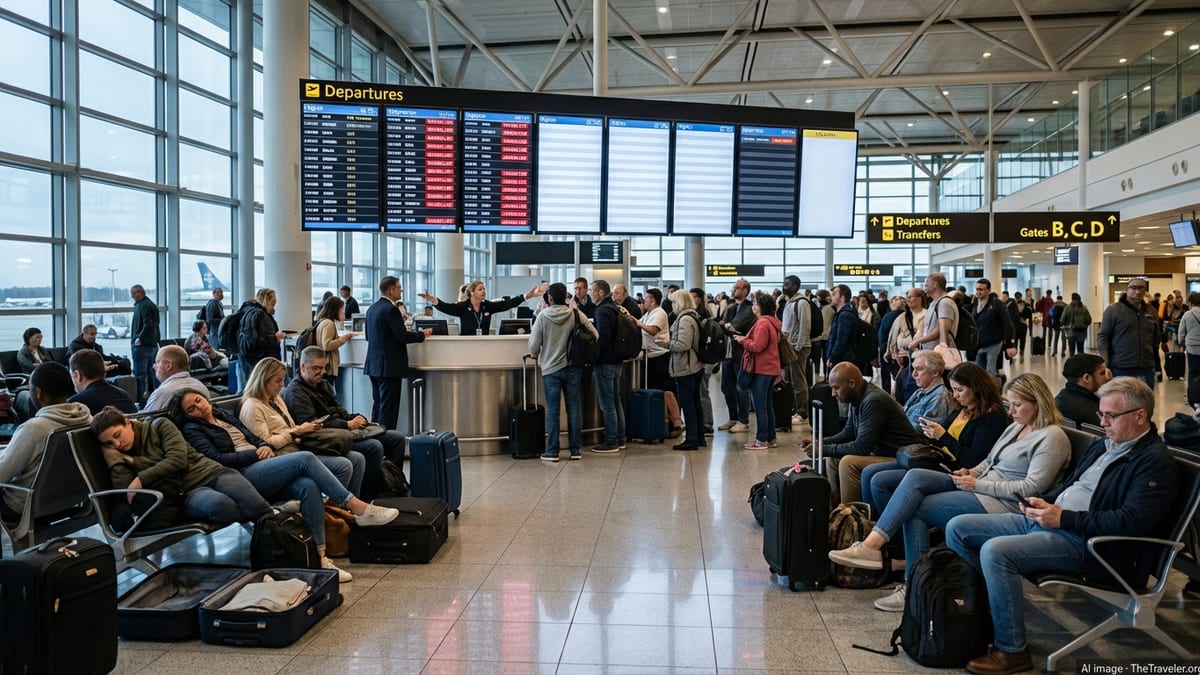
For travelers, the immediate impact is visible in crowded departure halls, long queues at rebooking desks and rising numbers of missed connections. Travel compensation and flight-tracking platforms report that several recent storm systems alone affected tens of thousands of passengers, underscoring how sensitive the current system is to even short bursts of extreme weather.
Airspace Squeeze Magnifies Delays Across the Network
Europe’s skies are also contending with a structural airspace squeeze that is magnifying the operational impact of each storm or heatwave. Over recent years, a combination of military activity, geopolitical restrictions and technical constraints has limited the number of optimal routes available, forcing aircraft onto longer or more crowded paths. Network performance reviews from European aviation bodies show that France, Germany and parts of south-eastern Europe regularly emerge as delay “hot spots,” with traffic funneled through a finite number of high-altitude corridors.
In several key control centers, including those covering French and Spanish airspace, capacity and staffing issues have been identified as major contributors to en-route delays. Flash briefings from European air traffic management sources for spring and early summer 2026 point to recurring bottlenecks in sectors such as Reims, Marseille, Brest, Barcelona and Athens, particularly during periods of high demand. Even when overall flight volumes remain close to or slightly above 2019 levels, localized constraints can quickly cascade into extended holding patterns, airborne rerouting and departure restrictions on the ground.
Compounding factors have added extra complexity this year. The ongoing security crisis in the Middle East has diverted many Europe–Asia flights away from Iranian and Iraqi airspace, concentrating long-haul traffic over south-eastern Europe and parts of the eastern Mediterranean. Network planning documents show that this has shifted traffic flows away from countries such as Bulgaria, Hungary, Romania and Türkiye and into alternative corridors via Greece, Cyprus and the western Balkans, concentrating demand on sectors that already face capacity challenges during the summer peak.
Airline groups and industry associations argue that without a significant acceleration in airspace modernization and investment in air traffic control staffing, Europe will struggle to meet future demand without persistent disruption. Analytical reports from global airline organizations estimate that structural air traffic control delays in the region have affected hundreds of millions of passengers over the past decade, with summer peaks in July and August consistently stretching available capacity.
Ground Operations Strain Under Border and Terminal Pressures
Even when aircraft are ready to depart, bottlenecks on the ground are increasingly determining whether flights leave on time. The phased rollout of the European Union’s new Entry/Exit System for non-EU nationals is emerging as a major pressure point at many international terminals. Airports Council International Europe, Airlines for Europe and the International Air Transport Association recently issued a joint public letter warning of a “systemic” risk of delays and missed flights linked to biometric registration checks that must be completed at border control.
According to recent coverage by European and national outlets, some airports have already reported waiting times of up to five hours at peak periods, with passengers queuing for fingerprinting and facial scans. The trade bodies have urged the European Commission to grant member states greater flexibility to suspend or scale back the system whenever passenger volumes exceed the operational capacity of border facilities, at least for July and August, to prevent further disruption.
The issue has been highlighted by individual airlines as well. One major low-cost carrier has publicly listed a series of airports where it says new border checks are already causing “major disruption,” with missed departures and tight connection windows proving particularly vulnerable. Airports in Germany and other Schengen states have warned that without temporary relief, peak summer weekends could see scenes of severe congestion in terminals even when flight schedules themselves remain relatively stable.
Beyond border controls, European airport coordination platforms are flagging terminal capacity as a broader concern. Operational notices shared with aviation stakeholders ahead of the main holiday season warn that, at many hubs, new processes introduced for security and border management, combined with strong passenger growth, are likely to generate longer queues at several touchpoints. This adds another layer of risk on days when weather or airspace constraints are already forcing airlines to compress operations into narrower time windows.
Data Shows Delays Concentrated in a Handful of Hot Spots
Despite the complexity of the current disruption, available data from European aviation monitoring bodies paints a relatively consistent picture of where the pressure is most acute. Recent network overviews indicate that a relatively small number of control centers and major hubs account for a large share of total en-route and airport delays, particularly in France, Spain, Germany and Greece.
In one week of the 2026 spring shoulder season, reports show that around three-quarters of all en-route air traffic flow management delays in the monitored area were attributed to air traffic control capacity and staffing issues, with France and Spain generating roughly half of that total. Weather and thunderstorm activity accounted for much of the remainder, often coinciding with already constrained sectors and amplifying the effect on punctuality.
While 2026 network-wide delay performance has, at times, been better than in 2024, experts caution that overall averages can obscure the experience of travelers on the worst-affected routes. Flights transiting busy cross-border corridors or connecting through heavily constrained hubs are significantly more likely to experience extended delays than services operating in less saturated parts of the network, particularly during evening peaks or following an earlier weather episode.
Independent analyses from passenger-rights platforms mirror this picture, identifying recurring clusters of disruption on days when storms or extreme heat intersect with airports that already face staffing or capacity limitations. As airlines operate more tightly timed schedules to maximize aircraft utilization, the room to recover from even short operational shocks has decreased, raising the likelihood of cancellations or missed connections when something goes wrong.
Travelers Face Tough Choices as Summer Peaks
For passengers planning trips in July and August, the convergence of extreme weather, constrained airspace and ground bottlenecks translates into a more uncertain travel experience. Consumer advocates and industry analysts recommend allowing extra time for connections within Europe, especially when itineraries involve tight transfer windows at major hubs affected by airspace or border constraints.
Some European governments and transport planners are also using the current disruption to renew calls for more investment in high-speed rail and alternative transport modes on shorter routes, arguing that shifting a portion of intra-European journeys to rail could help free up scarce airspace and airport capacity for long-haul and essential services. However, rail networks in several countries are themselves operating near capacity in peak periods, limiting the extent to which they can immediately absorb additional demand.
Airlines, airports and air navigation service providers are emphasizing that they are coordinating daily through European network management structures to adjust capacity, reroute flows and mitigate the worst effects of storms and congestion. Recent briefings from those bodies indicate that updated weather-based operating procedures and contingency plans have already saved hundreds of thousands of minutes of delay across the network this year, even as overall pressures have grown.
Nonetheless, the combination of more volatile weather and a tight, fragmented airspace structure suggests that Europe’s skies are likely to remain fragile throughout summer 2026. Travelers are being encouraged by carriers and consumer groups to monitor flight information closely, register for airline alerts, and consider flexible booking options where possible, as the aviation system navigates one of its most challenging summer peaks in recent years.