


More news on this day
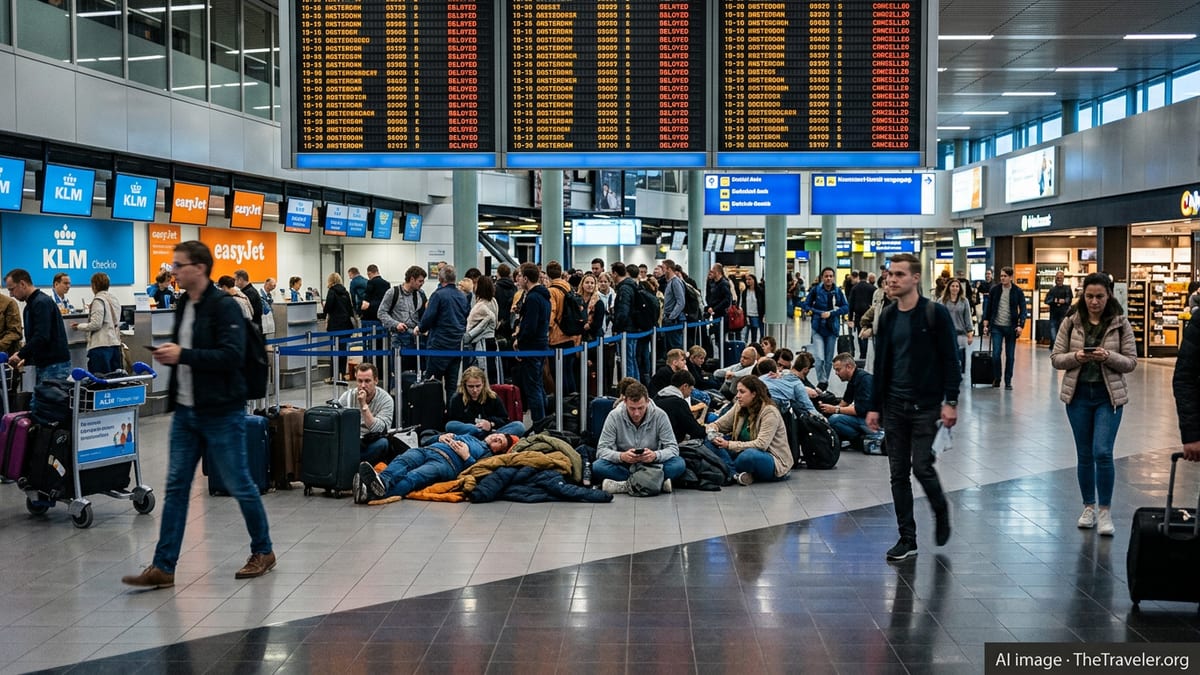
Air travel across the Netherlands faced fresh disruption as Amsterdam Airport Schiphol registered 329 delayed flights and 13 cancellations in a single day, affecting operations for KLM, Vueling, easyJet and several other airlines and leaving thousands of passengers facing missed connections and long queues.
Get the latest news straight to your inbox!
Widespread Delays Concentrated at Amsterdam Schiphol
Operational data for Friday, 3 July 2026, shows Schiphol once again at the center of flight disruption in the Netherlands, with hundreds of services pushed back from their scheduled departure or arrival times. Publicly available tracking information indicates that 329 flights were delayed and 13 were canceled at Amsterdam, figures that quickly rippled through the wider Dutch aviation network.
The picture at regional airports such as Rotterdam The Hague Airport and Eindhoven Airport appeared less severe, but delays at the country’s main hub still translated into missed onward connections and aircraft rotations across the Netherlands and beyond. Amsterdam Schiphol typically handles more than a thousand flights a day during peak summer periods, so even a relatively small share of cancellations can affect a large number of travelers.
Reports indicate that congestion at security and border-control points, together with tight runway scheduling and knock-on effects from earlier disruptions in Europe, played a role in Friday’s operational challenges. In recent months, Schiphol has undergone a series of staffing and contractor changes in its security operations, and observers note that each round of adjustments has increased the risk of bottlenecks when traffic surges.
Several Dutch-language aviation outlets and travel trackers noted that while the absolute number of cancellations remained modest compared with severe winter-weather episodes earlier this year, the high volume of delays made Friday one of the more difficult days of the early summer season for Schiphol-based travelers.
KLM Feels the Strain of Hub Disruptions
KLM, the largest airline operating at Schiphol and the Dutch flag carrier, experienced a significant share of Friday’s disruption. Because a large portion of the airline’s European and long-haul network is structured around tight connecting waves through Amsterdam, even minor schedule shifts can cascade into missed onward flights, extended layovers and last-minute rebookings.
Publicly available information from KLM’s disruption and travel-alert pages shows that the carrier has already spent the past several months adjusting schedules in response to multiple pressures, including higher fuel costs, constrained runway capacity and earlier winter-weather events that forced large numbers of cancellations. Friday’s operational issues therefore came on top of an already demanding period for the airline’s planning and customer-service teams.
Industry coverage in recent weeks has highlighted how KLM has trimmed European flying in some months, cancelling dozens of return services to and from Schiphol to reduce strain on the operation. On busy travel days, this means that remaining flights are often heavily booked, leaving limited spare capacity when irregular operations occur and making same-day rebooking more challenging for affected passengers.
Travel forums and consumer-rights discussions have also reflected increased frustration among some KLM customers over long wait times for assistance, questions about eligibility for compensation and uncertainty about whether delays are attributed to weather, airport constraints or internal airline decisions. Friday’s wave of delays is likely to add to that debate, particularly for travelers whose total arrival delay exceeds key European Union compensation thresholds.
Low-Cost Carriers Vueling and easyJet Also Impacted
Vueling and easyJet, both important carriers at Schiphol for short-haul leisure and city-break traffic, were not spared by Friday’s disruption. Flight-status boards showed a series of late departures and arrivals on popular routes such as Amsterdam to Barcelona, Alicante and London, with some services delayed long enough to affect passengers’ onward ground transportation and hotel plans.
Recent industry reporting has contrasted how different carriers have approached schedule planning in 2026. Vueling has continued to adjust capacity on key Mediterranean routes in response to demand and operational constraints at major European hubs. EasyJet, meanwhile, has repeatedly signaled that it aims to maintain a full program despite pressures ranging from fuel prices to airspace restrictions, though actual day-of-operation performance still depends on conditions at airports such as Schiphol.
Friday’s pattern at Amsterdam illustrates that even airlines that advertise robust schedules can be significantly affected when a hub airport experiences systemic issues. Aircraft and crew working multiple daily rotations through Amsterdam quickly accumulate delays when early-morning departures are held at the gate or required to wait for a slot, leading to knock-on effects for later flights in the sequence.
For passengers, the result was similar regardless of airline: longer-than-planned waiting times in terminals, shifting boarding times on departure boards and uncertainty about whether tight connections would be held or rebooked. Travelers on Vueling and easyJet services reported on social media that they had been advised to monitor airline apps closely and to allow more time for transfers through Schiphol.
Underlying Causes: Capacity Limits, Staffing and Weather Legacy
The latest disruptions come after a difficult first half of 2026 for Dutch aviation. Earlier in the year, severe cold snaps and snowfall across the Netherlands led to days of widespread cancellations at Schiphol, where hundreds of flights were grounded to keep runway and apron operations safe. That series of events left airlines with large backlogs of stranded passengers and baggage, and drew criticism from some travelers who questioned why operations at one of Europe’s major hubs proved so vulnerable.
Separate from the weather-related issues, published analyses point to structural factors at Schiphol that continue to complicate recovery. These include limits on the number of aircraft movements permitted at the airport, ongoing work to balance noise and environmental constraints with passenger demand, and the time needed to train and integrate new security and ground-handling staff. When traffic peaks at the start of the summer holiday period, those constraints can quickly translate into queues and delays.
Airlines such as KLM, Vueling and easyJet must also navigate a broader European context in which air traffic control capacity, regional weather systems and geopolitical tensions can all affect the punctuality of flights to and from Amsterdam. In recent months, airlines using Schiphol have rerouted some long-haul services around sensitive airspace and adjusted frequencies to destinations where local conditions or fuel prices made operations more challenging.
Aviation analysts note that, taken together, these factors mean that even relatively modest disruptions can have outsized impacts on complex hub-and-spoke networks. Friday’s 329 delays and 13 cancellations at Schiphol are therefore viewed by some observers less as an isolated incident and more as another indication of how fine the operational margins remain as the industry moves through a busy summer season.
What Passengers Can Expect in the Coming Days
With the Dutch school holidays ramping up and Schiphol expecting more than 12 million passengers over the wider summer period, travel experts anticipate further pressure on peak days, particularly Fridays and Sundays. While there is no immediate indication of another large-scale cancellation program, publicly available forecasts suggest that airlines and airport operators are preparing for heavy passenger flows and tight turnaround windows.
Consumer organizations in the Netherlands continue to advise passengers to arrive at Schiphol well in advance of departure, to complete online check-in whenever possible and to keep a close eye on airline notifications for any last-minute gate or schedule changes. Travelers with tight connections through Amsterdam are being encouraged to build in additional buffer time where their itineraries allow.
Under European passenger-rights rules, travelers whose flights are canceled or significantly delayed may be entitled to rebooking, refunds or financial compensation, depending on the cause and length of the disruption. Legal specialists emphasize that the exact entitlement often depends on whether the airline can demonstrate that circumstances were outside its control, a point that has been at the center of recent disputes relating to earlier Schiphol disruptions.
For now, Friday’s wave of delays and cancellations serves as a reminder that travel across the Netherlands remains vulnerable to operational shocks at its main hub. Passengers flying with KLM, Vueling, easyJet and other carriers through Amsterdam in the coming days are being urged by travel advisers to check flight status frequently and to plan for the possibility of longer-than-expected journeys.