


More news on this day
Flight operations at Chicago O’Hare International Airport were sharply curtailed on Sunday, August 30, 2026, after a Federal Aviation Administration ground stop halted many inbound departures and pushed delays into the triple digits at one of the United States’ busiest hubs.
Get the latest news straight to your inbox!
Ground Stop Freezes Arrivals as Storms Sweep Chicago
Publicly available FAA traffic management advisories show a ground stop in effect for Chicago O’Hare on Sunday morning, August 30, 2026, as strong thunderstorms crossed northern Illinois and the Chicago metropolitan area. The ground stop applied to flights destined for O’Hare from multiple regions and was categorized as a collaborative decision-making initiative, a framework used to manage capacity when adverse conditions limit safe arrival rates.
Coverage from aviation-focused outlets indicates that the thunderstorms moved quickly through the region, prompting restrictions on both arrivals and departures while air traffic controllers worked reduced arrival flows into the congested airspace around O’Hare. In practice, the stop meant many flights were held on the ground at their origin airports, while inbound traffic already en route experienced extended holding or diversions as capacity tightened.
Historical FAA operations data for O’Hare show that such ground stops are not unusual during periods of convective weather, but Sunday’s event stood out for the scale of its impact. Official advisory summaries from recent months illustrate how even short-lived interruptions at O’Hare can cascade into lengthy delays nationwide once arrival rates are cut and departure queues build on the ground.
Triple-Digit Delays Ripple Across the Network
According to FAA delay summaries for the August 30 ground stop, maximum delays at O’Hare climbed above the 100-minute mark, with average delays also elevated as thunderstorms and traffic management initiatives overlapped. These figures placed O’Hare among the most heavily disrupted airports in the national airspace system for the day, with some flights waiting hours for departure clearance or for gates to become available after landing.
The FAA’s public Operations and Status pages, which aggregate delay statistics by airport, underscore how quickly conditions deteriorated once the ground stop took hold. The number of affected flights moved into the thousands, while peak individual delays pushed past two hours for some itineraries, especially those involving connections through the Midwest hub. Travelers reported missed connections, rolling rebookings, and aircraft holding both on taxiways and at origin airports while release times were adjusted.
These delays added to a broader pattern of operational strain at O’Hare during the Summer 2026 travel season. Historical advisories from May and July show previous days when maximum delays also reached triple digits during severe weather and construction-related capacity reductions, suggesting that Sunday’s disruption is part of a recurring challenge for the airport’s tightly scheduled operation.
Existing Capacity Strains and Construction Add Pressure
Federal Register notices and FAA scheduling documents for Summer 2026 describe O’Hare as operating near or above its sustainable capacity for much of the season. Transportation Department and FAA analyses determined that planned schedules, layered on top of long-term airfield and terminal construction, were likely to produce significant congestion and delay without intervention.
In response, regulators moved earlier this year to limit scheduled operations at O’Hare to a level closer to the airport’s demonstrated manageable capacity, citing the need to preserve safety and reduce the risk of large-scale disruptions. The notices highlight that disruptions at O’Hare often propagate quickly through the national network, due to the airport’s role as a connecting hub for multiple major carriers.
Local and traveler accounts posted in recent weeks describe frequent arrival and departure delays linked to runway and taxiway work, as well as tight gate availability. When layered with a sudden capacity constraint such as Sunday’s thunderstorms, these structural pressures can leave little margin to absorb irregular operations, resulting in long queues for arrival slots and departure releases once a ground stop takes effect.
What Travelers Experienced on the Ground
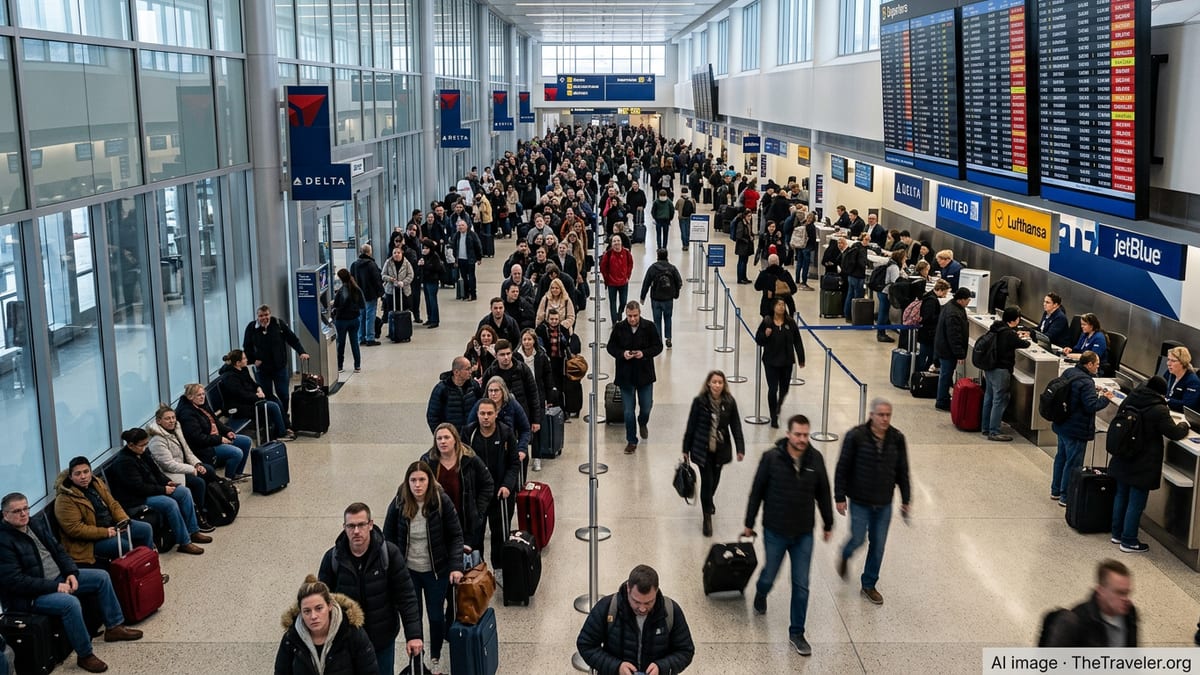
Reports from passengers using Chicago O’Hare and connecting airports on August 30 describe crowded concourses, long customer service lines, and repeated schedule changes as airlines worked through the backlog. Some travelers documented extended tarmac waits before takeoff, while others noted that flights destined for O’Hare were held at origin airports for hours pending updated release times from air traffic control.
Local discussions on public forums in August have also described a pattern of extended ground delays at O’Hare on stormy days, with some flights waiting for gates after landing as arriving aircraft outpaced available parking positions. These anecdotal accounts align with FAA data showing recurring days of high average delays at the airport during the peak summer period.
Despite the disruption, the ground stop does not signal a complete shutdown of the airport. Operations data and traveler reports indicate that limited arrivals and departures continued when conditions allowed, with the most stringent restrictions focused on managing inbound flows into the storm-affected airspace. As the weather moved out of the region and arrival rates increased, the FAA gradually relaxed restrictions, and airlines began working through the accumulated queues.
Guidance for Flyers in the Days Ahead
Travelers scheduled to pass through Chicago in the coming days are being encouraged by airlines and travel advisories to monitor flight status closely and allow extra time for connections. The FAA’s real-time airport status portal and the city’s FlyChicago site provide up-to-date information on delays and cancellations, while carrier apps and notifications offer the most specific guidance on boarding times, rebooking options, and gate assignments.
Given the combination of active summer weather, ongoing construction at O’Hare, and a still-busy schedule environment, aviation planners expect intermittent use of traffic management initiatives such as ground delay programs and ground stops when conditions deteriorate. Public notices from the FAA emphasize that these tools are designed to maintain safety and manage demand when the airfield or surrounding airspace cannot support normal traffic levels.
For passengers, the experience of Sunday’s ground stop is likely to reinforce the importance of flexible itineraries during peak travel periods, particularly when connecting through major hubs. Travel experts generally recommend longer connection windows, early-day departures where possible, and prompt engagement with airline support channels if delays begin to accumulate.
FAA Operations and Delay Information
Chicago Department of Aviation Flight Information
Federal Aviation Administration Newsroom
Travel and Tour News coverage of August 30 O’Hare ground stop