


More news on this day
Efforts to bring back commercial supersonic travel in the United States are accelerating, with new federal noise proposals promising “boomless” flight even as airlines and air traffic managers warn of mounting pressure on already congested routes.
Get the latest news straight to your inbox!
New Noise Standards Aim to End the Era of Sonic Booms
Publicly available federal documents indicate that the Federal Aviation Administration has released a notice of proposed rulemaking that would, for the first time, set comprehensive noise-based certification standards for civil supersonic aircraft. The proposal would update long-standing rules that effectively barred routine supersonic operations over land by tying approval not to speed alone but to how much sound reaches people on the ground.
The draft framework builds on earlier work to streamline special flight authorizations for experimental supersonic tests and follows high-profile demonstrations by manufacturers using techniques such as so-called “Mach cutoff” or “low-boom” cruise. Those flight profiles are designed to keep the shockwave high enough in the atmosphere that it reaches communities below as a muted thump rather than the disruptive crack that contributed to the retirement of Concorde.
Under the proposal, new supersonic aircraft would be folded into the existing Part 36 noise certification architecture that now governs subsonic jets, but with separate standards tailored to high-Mach operations. That includes landing and takeoff limits around major airports and, critically, an en route standard for sonic boom that would determine where and how fast aircraft may fly across the continental United States.
Industry groups have generally welcomed a clear certification path, arguing that without predictable noise rules, investors are reluctant to commit to new passenger designs. At the same time, analysis in the federal docket underscores that the standard will influence not only the design of engines and airframes but also how flights are routed through an already complex national airspace system.
Routing Supersonic Jets Through a Crowded Sky
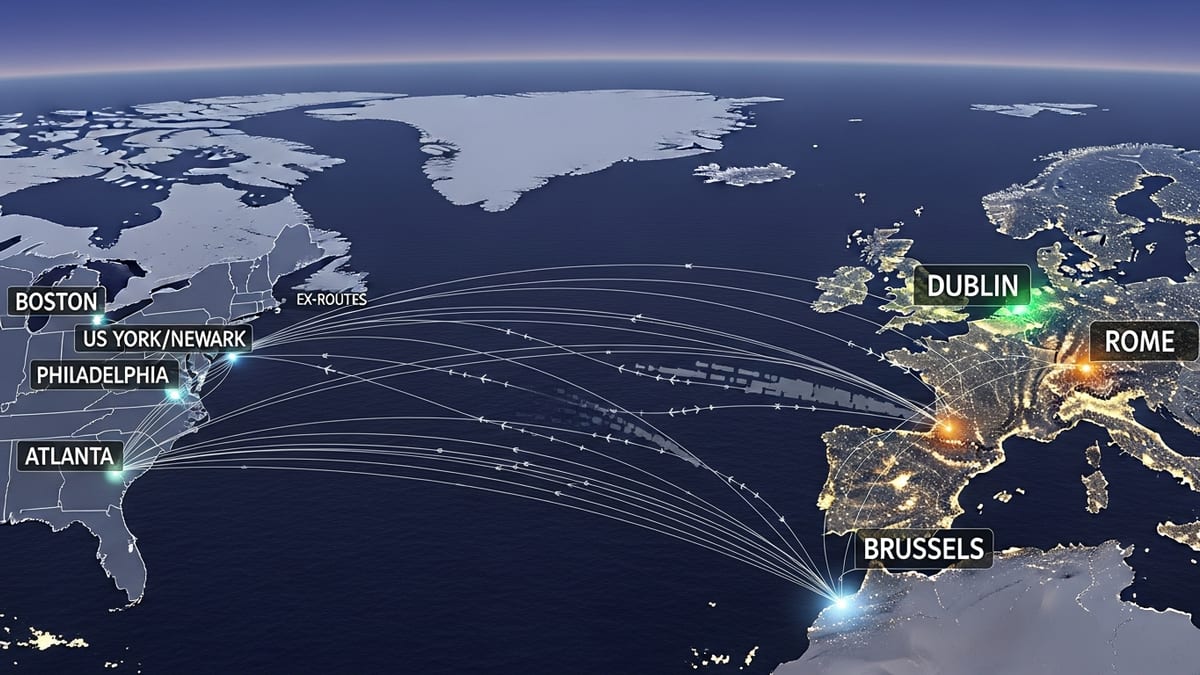
While the proposed noise limits focus on what communities hear, their practical effect is to define corridors where supersonic speeds are acceptable and areas where aircraft would have to slow to subsonic cruise. That creates a new layer of routing constraints on top of weather, military airspace, and environmental restrictions that already shape daily operations for airlines and air traffic controllers.
The FAA’s own planning documents for the National Airspace System show that even subsonic traffic routinely triggers delays when storms, congestion, or temporary airspace closures compress available capacity. Studies of delay propagation in the system have found that small disruptions can ripple across hubs as flights miss slots and controllers resort to holding patterns and reroutes to maintain safety and separation.
Adding high-speed supersonic corridors, which may need wider lateral spacing and more conservative separation standards until real-world data accumulates, could intensify those pressures. In practice, controllers may have to carve out time-and-altitude windows for supersonic crossings that can limit flexibility for other traffic, especially at the critical interfaces between cruise, descent, and terminal airspace.
Publicly released test-flight environmental assessments for experimental supersonic aircraft already hint at this challenge. Documents for recent trials over the Mojave Desert show that even relatively small, tightly controlled missions required careful scheduling to deconflict with commercial flows and to keep noise footprints away from populated areas. Scaling that approach to daily scheduled services across multiple regions would demand significantly more coordination.
New Traffic Management Technology Targets Delay Risks
U.S. airspace planners are trying to match the pace of supersonic rulemaking with a parallel modernization of traffic management tools. Recent FAA announcements describe the rollout of artificial intelligence supported systems that analyze airline schedules, weather patterns, airport capacity, and sector loading to predict congestion and recommend reroutes before delays materialize.
One flagship effort, described in federal briefings as part of the agency’s broader modernization strategy, uses advanced software to manage airspace, routes, and trajectories more strategically. By modeling how traffic flows evolve hours in advance, the system is intended to help controllers and airlines adjust departure times and trajectories so that choke points do not form over busy corridors or around major hubs.
According to publicly available descriptions, these tools are expected to evolve to handle more complex aircraft mixes, including advanced air mobility vehicles and, eventually, supersonic transports subject to specialized noise and altitude constraints. In theory, integrating noise-sensitive routing requirements into pre-departure planning could allow the system to place supersonic flights in optimal lanes that minimize both community impact and downstream delays.
Experts who study delay propagation note that predictive rerouting and better use of high-altitude airspace have historically delivered some of the largest efficiency gains in the National Airspace System. However, they also caution in published research that improvements often depend on reliable data sharing and staffing levels within air traffic facilities, both of which have been persistent challenges in recent years.
Global Standards and Community Response Shape U.S. Policy
The FAA’s move on supersonic noise does not occur in isolation. The International Civil Aviation Organization has been working for years on technical guidance for sonic boom measurement and acceptable human response levels, in part informed by low-boom flight tests involving NASA and industry partners. Those efforts are aimed at establishing a globally recognized standard so that future supersonic aircraft can operate internationally under consistent rules.
Historical experience still weighs heavily on the debate. The Oklahoma City sonic boom tests of the 1960s, which generated thousands of complaints and led to legal challenges, remain a cautionary example in many policy analyses. Community opposition to noise has since driven curfews, runway-use restrictions, and in some cases limits on airport expansion, underscoring how quickly local reaction can reshape national aviation plans.
Against that backdrop, current U.S. proposals emphasize that any return of supersonic passenger service must be compatible with modern expectations for environmental protection and quality of life. Environmental reviews associated with experimental supersonic programs already examine cumulative noise exposure, wildlife impacts, and climate considerations alongside safety and performance.
Industry proponents argue in public forums that new materials, engine designs, and flight control technologies will make the next generation of supersonic aircraft quieter and more efficient than their predecessors. Still, the outcome of the FAA’s rulemaking, and how it meshes with international standards, will largely determine whether carriers see a viable business case for launching routes that must navigate both strict noise contours and the realities of a congested global air traffic network.
Balancing Speed, Capacity and Reliability for Travelers
For passengers, the most visible impact of supersonic rulemaking may not arrive until well after the first new aircraft are certified. In the nearer term, travel experiences will continue to be shaped by how effectively the FAA and airlines can manage today’s mix of traffic while preparing for tomorrow’s high-speed entrants.
Recent agency decisions on airport scheduling and capacity management highlight the tension between offering more flights and preserving reliability. Publicly released guidance on peak-period scheduling at major hubs stresses that over-scheduling can quickly erode on-time performance when even modest disruptions occur, requiring last-minute reroutes and airborne holding that increase fuel burn and emissions.
Analysts following the supersonic debate note that similar trade-offs will apply once quiet supersonic aircraft join the fleet. A transcontinental route sold on the promise of cutting block times dramatically could still deliver a disappointing experience if airspace constraints force repeated slowdowns, vectoring, or diversions to protect noise-sensitive communities and accommodate mixed traffic flows.
How the FAA’s new noise standards integrate with routing tools now under development will therefore be central to the next era of high-speed travel. If predictive technologies and carefully designed corridors can unlock both speed and reliability, supersonic service may become a premium but practical option on select routes. If not, the risk is that complex routing and persistent delays could blunt the advantages of flying faster than sound, even as the industry invests heavily in bringing those aircraft to market.