


More news on this day
Rail passengers across central England face severe disruption after a fatal collision between two London-bound trains near Bedford led to widespread cancellations, diversions and an extended shutdown of services linking London St Pancras with key East Midlands cities.
Get the latest news straight to your inbox!
Driver Killed and Dozens Seriously Injured Near Bedford
Publicly available information indicates that two East Midlands Railway passenger services collided south of Bedford on the afternoon of Friday 19 June, on the busy Midland Main Line that connects London with the East Midlands. Both trains were travelling toward London St Pancras when one struck the rear of the other on the approach to Bedford, in an area used by intercity and commuter services.
Coverage from multiple news outlets reports that the driver of the rear train died in the crash and that dozens of passengers on board the two services sustained serious injuries. Initial tallies from emergency responders cited in media reports point to close to 90 people hurt, with a significant number described as seriously or critically injured, including some airlifted to major trauma centers.
Images shared by passengers and local media show a line of damaged carriages still upright on the tracks, with the leading cab of one train bearing extensive impact damage. Passengers can be seen evacuated onto the trackside, many wrapped in foil blankets, as ambulances, fire crews and specialist rescue teams work along the embankment.
Rail safety investigators have begun examining the circumstances of the collision, including reports that one train had come to a halt on the line before being struck from behind. Early commentary in rail industry circles highlights the role of trackside signaling and train protection systems on this section of the Midland Main Line, though formal findings are expected to take months.
London St Pancras Cut Off From East Midlands Cities
The crash has had an immediate and far-reaching impact on rail connectivity between London and central England. Service updates from rail operators and National Rail show that all lines between London St Pancras and Bedford were closed following the collision, effectively cutting off one of the capital’s major intercity gateways from destinations to the north.
East Midlands Railway services between London St Pancras and key cities including Nottingham, Derby and Leicester were initially suspended for the remainder of Friday, with operators later extending warnings of continued disruption into the weekend. Trains that would normally link St Pancras with Sheffield, Nottingham, Derby and other East Midlands hubs were either cancelled outright or turned short at stations north of the incident site.
Thameslink commuter services, which share the route as far as Bedford, have also been heavily affected. Published disruption maps show that stopping services between central London and Bedford were unable to run through the crash area, forcing a combination of cancellations, emergency timetables and limited shuttles on sections of line that remained available.
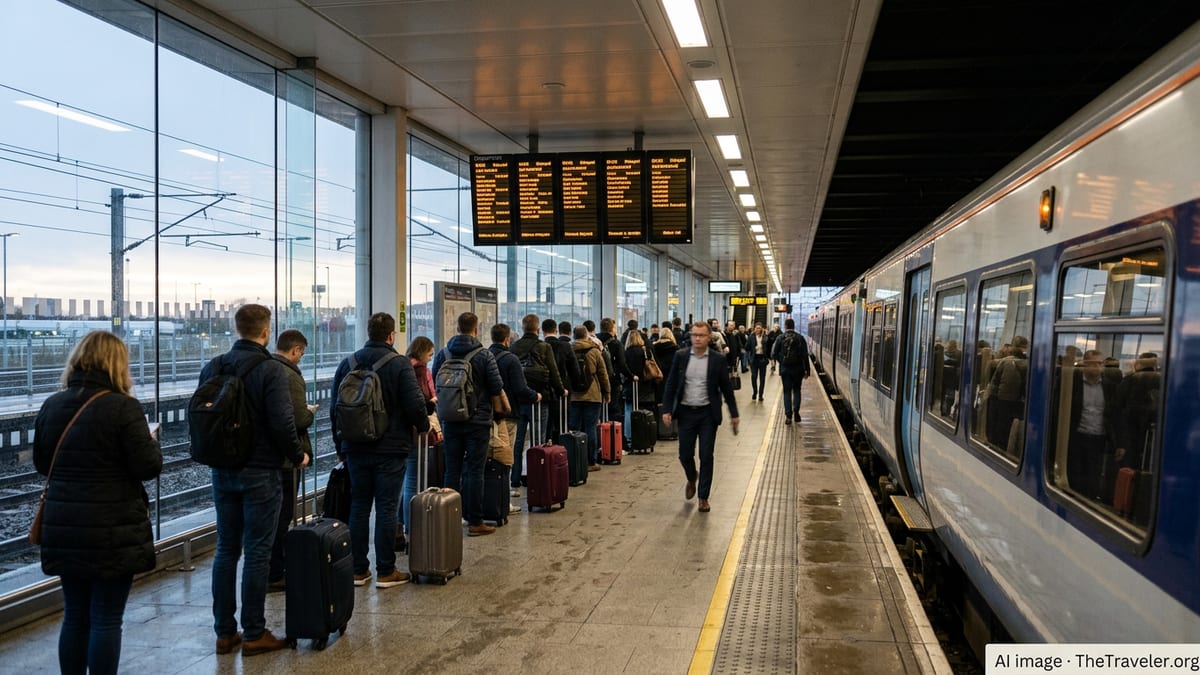
For many passengers, the shutdown arrived at the worst possible time, hitting the Friday evening peak when commuters and leisure travelers typically crowd the Midland Main Line. Social media posts from stranded passengers describe long queues at London St Pancras, Leicester and Nottingham, with staff working to redirect people to alternative routes or arrange overnight accommodation where onward travel was not possible.
Severe Travel Warning and Network-Wide Knock-On Disruption
In the hours after the collision, National Rail and train operators issued severe travel warnings urging passengers not to attempt journeys on routes that normally run between London St Pancras, Bedford, Leicester, Nottingham and Derby unless absolutely essential. Journey planners have flagged “do not travel” advice across large parts of the East Midlands network as replacement options remain limited and journey times uncertain.
With the Midland Main Line blocked in both directions near Bedford, rail planners have scrambled to use diversionary routes where possible. Some long-distance services have been redirected via alternative lines, adding substantial time to journeys and reducing overall capacity, as sections not designed for intensive intercity traffic become temporary main arteries.
The disruption has also spilled over onto neighboring rail corridors as passengers seek other ways to reach London or cross-country destinations. Reports from other London termini, including Euston and King’s Cross, describe increased demand from travelers switching to West Coast or East Coast Main Line services, pushing already-busy Friday timetables close to saturation.
Travel advice circulated on Friday night and Saturday morning points to a patchwork of solutions involving a mixture of partial rail services, bus replacement links and ticket acceptance on other operators. Even so, journey times between London and the East Midlands remain heavily extended, with some passengers warned to expect delays of several hours or to postpone travel entirely.
Extended Closure for Investigation and Infrastructure Repairs
Rail infrastructure managers have indicated that the section of line south of Bedford is likely to remain closed for an extended period while investigators work at the scene and damaged rolling stock is removed. The collision has not only affected the trains themselves but has also raised concerns about possible damage to track, signaling equipment and overhead power lines on this electrified route.
According to published rail incident procedures, specialist teams must document the crash site in detail before recovery work can begin, in order to preserve crucial evidence about train positions, braking distances and signaling status at the time of impact. This process, combined with the technical complexity of re-railing or removing damaged carriages, routinely keeps key lines shut for many hours or even days after a serious accident.
Once the trains are removed, engineers will undertake inspections and any necessary repairs to track, ballast, masts and electrical systems. Only when the infrastructure has been certified safe can test trains run through the affected area, followed by a gradual reintroduction of passenger services under speed restrictions. Operators are warning that, even after the route is technically reopened, timetables are likely to remain disrupted for some time as rolling stock and crew are repositioned.
For travelers, this means that disruption to journeys between London, Bedford and the wider East Midlands region is likely to persist well beyond the initial shock of the collision. Those planning trips over the coming days are being urged by publicly available travel bulletins to check live information before setting out and to consider alternative routes where feasible.
Impact on Passengers and Future Rail Safety Scrutiny
Beyond the immediate operational challenges, the Bedford collision has raised difficult questions about passenger safety on one of Britain’s busiest main lines. Britain’s railways have recorded relatively few fatal multi-train collisions in recent decades, and early analysis in specialist rail forums notes that events of this kind are now rare compared with the late twentieth century.
Nevertheless, the severity of this crash and the number of people injured are expected to trigger intense scrutiny of how such a rear-end collision could occur on a modern, signal-controlled railway. The Rail Accident Investigation Branch is anticipated to focus on signaling conditions, train protection systems and any technical issues with the braking or control equipment on the trains involved, as well as the operational context on a heavily used corridor into London.
Passenger accounts shared publicly describe a chaotic and frightening experience, with individuals thrown from their seats by the force of the impact and then facing a long wait for evacuation from darkened carriages. Hospitals across the region have been treating a spectrum of injuries, from fractures and head trauma to shock and minor cuts, with local health services asking residents to reserve emergency departments for the most serious cases.
For regular users of the Midland Main Line, the incident is likely to have a lasting psychological as well as practical impact. Many commuters travel daily between cities such as Nottingham, Leicester, Derby and London, relying on high-speed services that have long been marketed as a safe and efficient alternative to road travel. As services gradually resume, rail travelers will be looking not only for reliable timetables but also for clear communication about safety improvements and lessons learned from one of the UK’s most serious rail accidents in years.