


More news on this day
A collision between two London-bound passenger trains near Bedford in central England has left one person dead and dozens injured, disrupting a major rail artery and triggering a comprehensive safety investigation into one of the United Kingdom’s worst rail incidents in recent years.
Get the latest news straight to your inbox!
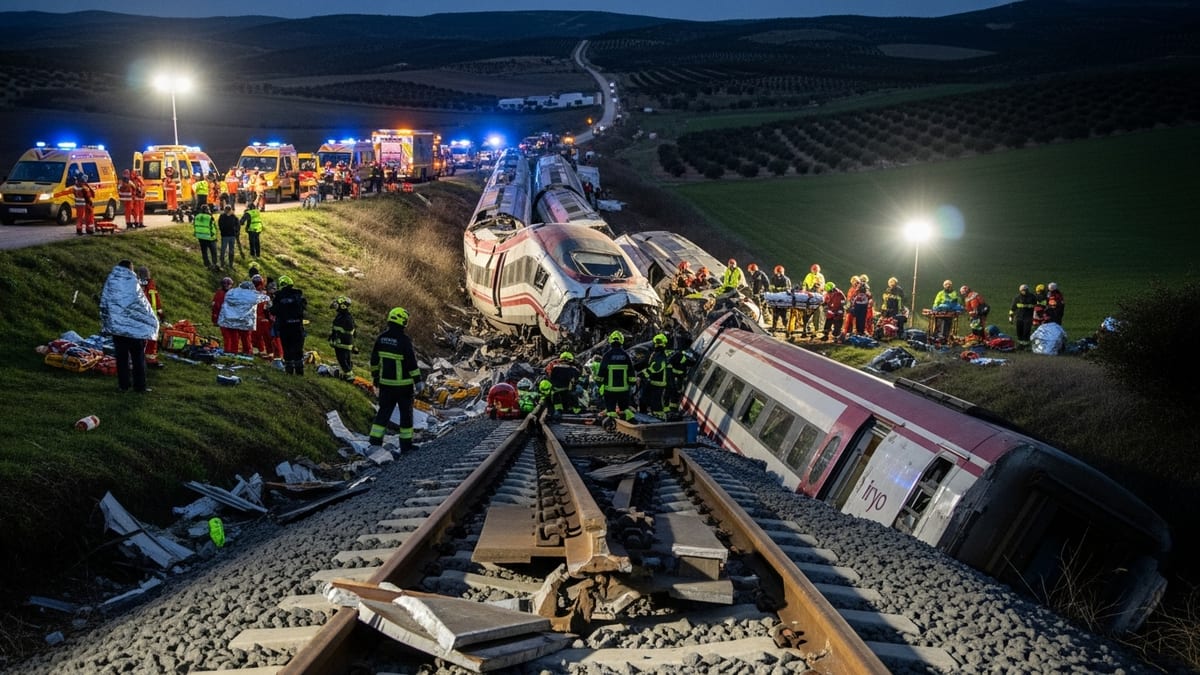
Crash near Bedford on busy London corridor
Publicly available information indicates that the crash occurred on the afternoon of Friday 19 June 2026 on the Midland Main Line just south of Bedford, a major commuter hub around 50 miles north of London. Two southbound services heading for London St Pancras were involved, both operated by East Midlands Railway on one of the country’s busiest intercity and commuter corridors.
Reports suggest that one train travelling from Corby collided with the rear of another service from Nottingham that was ahead of it on the same line. Rail tracking data cited in media coverage places the impact at around the evening peak, when trains on the route are typically crowded with commuters, long-distance travellers and airport passengers.
Images and video from the scene show at least one train partially derailed but upright beside the tracks, with several carriages visibly crumpled at the point of impact. Passengers can be seen standing on adjacent roads and embankments while emergency vehicles line a service road parallel to the line.
The collision led to the immediate shutdown of all lines through the area, causing extensive disruption to services linking London with the East Midlands and northern England. Replacement buses and diversions via alternative routes were arranged, but late-evening and overnight travel remained heavily affected.
Casualties and hospitalisations mount after peak-hour impact
Initial casualty figures compiled from official statements and national media reports indicate that one person, understood to be the driver of the rear train, was killed in the collision. Dozens of passengers suffered injuries ranging from minor cuts and bruises to severe trauma.
British Transport Police and health authorities cited in published coverage have spoken of more than 80 people receiving hospital treatment, with around 20 to 30 patients classed as seriously injured and several reported in critical condition. Estimates from multiple outlets refer to a total injury toll approaching 90 people when minor injuries are included.
Witness accounts gathered by broadcasters and newspapers describe a sudden, violent jolt that sent passengers flying forward inside carriages. Some travellers reported seeing fellow passengers with suspected broken bones, head wounds and leg injuries, while others described walking through coaches where only a handful of people appeared unhurt.
Nearby hospitals in Bedfordshire and neighbouring counties activated major-incident protocols, with extra staff called in and additional trauma capacity made available. Reports indicate that air ambulance crews were dispatched to the scene alongside standard ambulance, fire and police units, reflecting early concerns that the casualty numbers could have been even higher.
Emergency response and ongoing disruption for travellers
The crash prompted an immediate large-scale emergency response, with regional and national agencies coordinating efforts on the ground and at control centres. Publicly available information shows that a major incident was formally declared soon after the first calls, prioritising access for rescue vehicles and specialist teams.
Passengers were evacuated from the damaged trains along the track and via adjacent roads, with temporary triage points set up near the scene. Photographs published by multiple outlets show travellers wrapped in foil blankets, some with visible bandages, as medical teams assessed injuries and arranged onward transport to hospitals.
For rail users, the impact on travel has been significant. Services on the key Bedford to London section were initially suspended in both directions, with operators issuing “do not travel” advice for parts of the route. Network managers warned that repairs, rolling stock recovery and forensic site examination would continue into the weekend, creating knock-on disruption for intercity and regional services.
Passengers attempting to travel between London, the East Midlands and northern destinations have been advised through operator updates and national media to check journey planners carefully, expect reduced timetables, and allow extra time while alternative routes and bus connections are in place.
Investigators look at possible signalling and spacing factors
The Rail Accident Investigation Branch has launched an inquiry into the circumstances of the collision, supported by specialist units from British Transport Police. Early attention is focused on understanding why two trains running in the same direction on a modern, signal-protected main line came into contact with such force.
Rail commentators and former railway professionals quoted in coverage have highlighted several potential areas of interest, including adherence to signalling aspects, the functioning of train protection systems, and the spacing and braking performance of the services involved. At this early stage, no definitive cause has been identified and investigators are expected to spend days at the site collecting data from onboard systems, trackside equipment and signal-box records.
Specialists are also likely to study the pattern of damage to the carriages to gauge how train design and crashworthiness features performed. While the human toll has been severe, some analysts have noted that the upright position of the trains and the absence of extensive carriage telescoping suggest that modern safety standards and operating rules limited the scale of destruction that has been seen in older rail disasters.
Investigators typically issue an initial bulletin within days of such an incident, followed by an interim report and detailed final findings at a later date. Those findings often carry recommendations for infrastructure upgrades, operational changes or further training, which rail industry bodies and the government may be pressed to implement.
Serious crash raises questions over rail safety record
The Bedford collision stands out sharply against the backdrop of the United Kingdom’s strong long-term passenger rail safety record. Statistical summaries published in recent years show that multi-train collisions causing passenger fatalities have been extremely rare, with only isolated incidents recorded over several decades.
Recent years have seen occasional serious accidents, such as the collision between two passenger trains in Wales in 2024 and several high-profile near misses, but the overall number of passenger deaths in train crashes has remained low compared with road transport and with railway systems in many other countries. This history has shaped public expectations that serious rail crashes are exceptional events.
The latest collision has therefore provoked widespread debate about whether existing safeguards are sufficient as passenger numbers grow and more intensive timetables run over constrained infrastructure. Commentators in national and international media have raised questions on topics such as investment in signalling technology, the resilience of safety systems under disruption, and staffing and training levels for both drivers and control-room personnel.
For travellers, the incident is a stark reminder that even in a network with an excellent safety record, complex systems can fail in rare but devastating ways. As the investigation progresses, many regular rail users will be watching closely for clear explanations, transparent communication and concrete measures intended to reduce the risk of similar events on Britain’s busy main lines.