


The FIFA Women’s World Cup 2027 will bring a month of elite football and festival energy to Brazil from 24 June to 25 July, with 64 matches played across eight host cities and both the opening match and final at Rio de Janeiro’s Maracanã. For traveling fans, it is a rare chance to combine world-class sport with some of South America’s most compelling urban and natural landscapes. This guide focuses on the confirmed host cities, how to move between them, realistic price ranges, and the kind of advance planning that will make the difference between a stressful scramble and a smooth, once-in-a-lifetime trip.
Get the latest updates straight to your inbox!
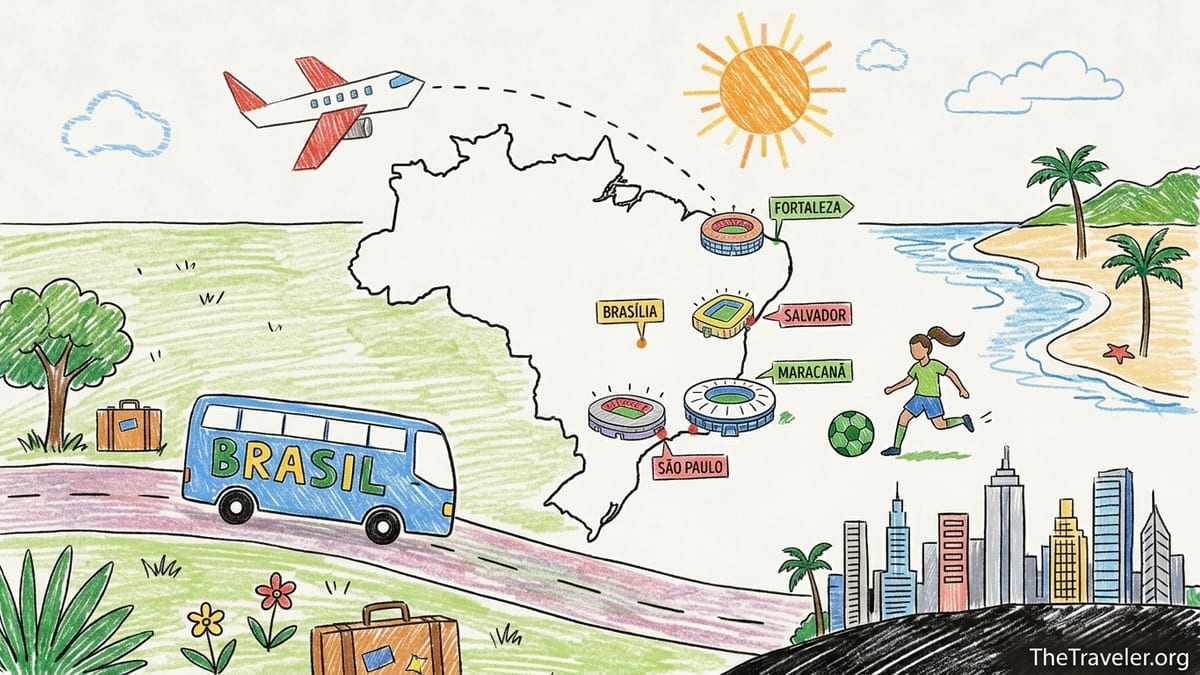
Key Facts and Brazil’s Eight Host Cities
FIFA has confirmed that the 2027 Women’s World Cup will be staged entirely in Brazil, the first time the tournament is held in South America. The competition window runs from 24 June to 25 July 2027, with 64 matches spread across eight host cities. Both the opening match and the final are scheduled for Rio de Janeiro’s iconic Maracanã Stadium, a key detail for fans trying to decide where to base themselves if they aim to attend the headline fixtures.
The eight confirmed host cities are Rio de Janeiro, São Paulo, Brasília, Belo Horizonte, Salvador, Recife, Fortaleza and Belém. Each city will use an existing large-capacity stadium that already handles domestic league matches or past mega-events such as the 2014 FIFA World Cup or the 2016 Olympic Games. That means established transport links, hotel districts and fan zones are likely to anchor the tournament experience in each location.
Although the detailed match-by-match schedule is still being fine-tuned, the distribution framework released by FIFA and Brazilian authorities shows that group-stage games will be spread widely so that each host city sees multiple matchdays. Knockout fixtures will concentrate more heavily in Rio de Janeiro and São Paulo, with at least one quarter-final and a semi-final in each of those hubs. Fans hoping to see several different teams can realistically pick one or two base cities and add targeted side trips rather than chasing the tournament across all eight locations.
The sheer size of Brazil, however, means that distances between host cities can be significant. Flying time from Belém in the Amazon gateway region to Porto Alegre in Brazil’s far south would normally be around five hours with a connection, and even mid-range jumps such as Rio to Fortaleza involve around three hours in the air. Understanding these scales early will help you build an itinerary that matches your budget, vacation time and appetite for long travel days.
Getting Between Host Cities: Flights, Trains and Buses
For most World Cup travelers, domestic flights will be the backbone of any multi-city itinerary. Brazil’s main airlines, including LATAM, Gol and Azul, already operate dense networks linking Rio and São Paulo with the other host cities such as Salvador, Recife and Fortaleza. In 2026, sample return fares on busy routes like São Paulo to Rio have often ranged around 360 to 400 Brazilian reais when booked well in advance, while longer hops such as Salvador to Recife can show average one-way prices in the 300 to 600 reais band depending on date and demand. These figures provide a realistic baseline for what to expect if you buy tickets several months out rather than at the last minute.
During a mega-event, airlines typically add capacity but also raise prices around key matchdays. For the 2027 tournament, fans considering popular routes such as Rio to Salvador or São Paulo to Recife around the group stage should budget for return fares in the mid to high hundreds of reais if purchased three to six months before travel, and potentially higher if bought within a few weeks of departure. A practical strategy is to lock in your main inter-city flights as soon as match dates are confirmed, then adjust shorter hops or overnight buses later as your personal schedule firms up.
Brazil does not have a high-speed rail system linking the host cities, so long-distance travel by train is not a realistic option. Instead, intercity buses provide the main overland alternative to flying. Companies such as Itapemirim, Águia Branca and Real Expresso run modern, air-conditioned coaches on major corridors like Rio to Belo Horizonte, Brasília to Belo Horizonte and Salvador to Recife. A night bus between Rio de Janeiro and Belo Horizonte, for example, might take around seven to eight hours, with reclining “leito” seats and fares that can undercut a last-minute flight by a significant margin, especially if purchased directly at Brazilian prices rather than through international resellers.
For shorter legs, buses can also be an efficient way to string together nearby host cities. The stretch between Salvador and Recife includes several coastal towns and can be done in a day by bus, while connections from Fortaleza further along the northeast coast involve longer but still manageable journeys. However, given Brazil’s winter weather in June and July is generally dry and mild in much of the country, flight punctuality is usually good, making planes the default option for anyone trying to see matches in multiple far-flung cities.
City-by-City Snapshot: What to Expect on the Ground
Rio de Janeiro will be the emotional center of the tournament, hosting the opener and the final at Maracanã. Fans can expect the main tourist zones in Copacabana, Ipanema and Barra da Tijuca to double as informal fan villages, with large viewing screens likely in waterfront areas and near central squares. Outside of matchdays, visitors can fill their time with cable-car trips up Sugarloaf Mountain, visits to Christ the Redeemer, or simply watching beach football at sunset. World Cup periods in Brazil usually see a visible increase in police presence in tourist districts, but visitors should still use urban common sense when moving around at night or carrying valuables.
São Paulo, Brazil’s economic powerhouse, will host a heavy slate of group and knockout matches at its main arena, with the city functioning as a logistical hub for domestic flights. While it lacks Rio’s ocean backdrop, São Paulo offers a deep food and culture scene, from the bars of Vila Madalena to the Italian restaurants of Bixiga and the Japanese eateries of Liberdade. For traveling supporters, its advantage lies in connectivity: flying from São Paulo’s main airports to most host cities usually involves direct or frequent services, making it an efficient base for those planning side trips to other venues.
Belo Horizonte and Brasília provide contrasting experiences inland. Belo Horizonte sits in the hilly state of Minas Gerais and is famous for its bar culture and local “boteco” food, making it a strong choice for fans who enjoy social evenings within walking distance of the stadium areas. Brasília, the modernist federal capital laid out in sweeping avenues, offers striking architecture and a more planned feel, with wider distances that often require using ride-hailing apps or taxis rather than walking. Both cities had substantial practice hosting large events during the 2014 World Cup and the 2013 Confederations Cup, so fans can expect established park-and-ride schemes and clear transport planning around matchdays.
On the coast, Salvador, Recife and Fortaleza promise a combination of football and tropical scenery. Salvador blends Afro-Brazilian culture with colonial architecture in its Pelourinho district, and it hosted some of the most atmospheric fixtures in 2014. Recife shares its metropolitan area with Olinda, a hilltop colonial town known for colorful houses and carnival traditions, giving visitors attractive day-trip options between matches. Further north, Fortaleza offers long city beaches and strong trade winds that attract kitesurfers, along with a reputation for lively nightlife clustered along the waterfront. Belém, at the edge of the Amazon basin, adds a more offbeat dimension, with riverfront markets and regional cuisine centered on fresh fish and Amazonian fruits.
Booking Flights, Match Tickets and Internal Transport
The official FIFA ticketing platform for the 2027 Women’s World Cup is expected to follow a similar model to the 2023 edition, with an initial phase of team-specific and city-specific packages followed by a general sale of individual match tickets. Fans who know they want to base themselves in a specific city, such as Salvador for a week of group-stage games, should consider city series products if they appear again, as these often give access to multiple matches at a lower per-game cost than buying individually.
Once matchdays are set, the main domestic flight booking window to target is roughly three to nine months before departure. Historical data for 2026 shows that Brazilian domestic return flights on popular leisure routes like Rio to Recife or São Paulo to Salvador frequently fall in the 300 to 800 reais range when purchased early, but can climb substantially when seats begin to sell out near major holidays or events. For World Cup travel in June and July 2027, securing flights by late 2026 or early 2027 will greatly increase your chances of finding fares closer to the lower end of that band.
For internal transport inside each city, ride-hailing services such as Uber and local competitors are widely available across the host cities and usually offer an affordable way to reach stadiums, especially when split between two or three people. In Rio and São Paulo, extensive metro and commuter rail systems can also be used to approach stadium zones, though final access on matchdays is often via walking or dedicated shuttle buses once you reach a security perimeter. In cities with more limited rail options, such as Fortaleza or Belém, expect a combination of buses, taxis and ride-hailing vehicles as the main modes of stadium access.
Fans intending to combine football with regional exploration might build a loop such as Rio to Belo Horizonte by bus or short-haul flight, then onward to Salvador and Recife along the northeast coast, before flying back to Rio or São Paulo for the closing stages. In practice, that kind of itinerary could involve two or three domestic flights plus one overnight bus, giving a taste of different Brazilian landscapes while keeping total travel time manageable over a two- or three-week stay.
Accommodation: Where to Stay and What It May Cost
Brazil’s major cities already have large accommodation inventories ranging from international hotel chains to independent guesthouses and short-term rentals. Price monitoring for Brazil trips in 2026 suggests that mid-range hotel rooms in Rio, São Paulo and other big cities often run in the equivalent of roughly 500 to 1,000 reais per night for a well-reviewed double room during busy periods, while budget options and hostels can drop below that level and premium waterfront or luxury properties can climb significantly higher. During a World Cup, those baseline figures are likely to shift noticeably upwards, especially near stadiums and in beachside zones.
For the 2027 tournament, it is reasonable to anticipate that centrally located three-star hotels in areas like Rio’s Copacabana or Ipanema, Salvador’s Barra neighborhood or Recife’s Boa Viagem district will command a premium on matchdays, particularly if they are near fan zones or official viewing areas. Travelers on a tighter budget may want to look at neighborhoods slightly back from the waterfront or near metro and bus corridors, where prices can be more moderate while still offering safe, convenient access to stadium transport.
Short-term rental platforms are expected to be active across all host cities, providing apartments for groups of friends or families who prefer to cook and live more like locals. In previous Brazilian mega-events, authorities have periodically discussed special regulations for short-term rentals, but the dominant pattern has been that many residents list spare rooms or entire apartments to capture World Cup demand. Booking early is crucial: in 2014 and 2016, fans who waited until a few months before arrival saw far more limited choices and higher nightly rates.
Given that match schedules will cluster games in certain cities on specific dates, consider staggering your stays to avoid the most expensive nights. For example, if a highly anticipated group match is scheduled in Rio on a Saturday, room rates in prime neighborhoods might spike for that weekend. Building your itinerary so that you base yourself in a slightly less touristy city like Belo Horizonte or Brasília during some parts of the group stage, and then shifting to Rio or São Paulo for knockout matches, can help balance cost and experience.
Visas, Safety and Practical Planning for 2027
Brazil currently operates a reciprocity-based visa policy for many nationalities. For citizens of countries whose travelers must obtain visas to visit Brazil, this generally means applying online or through consular services for a visitor visa that covers tourism and attendance at sporting events, usually for stays of up to 90 days. There have been several adjustments in recent years regarding visa requirements for travelers from the United States, Canada, Australia and a number of other countries, including announcements about new electronic visa procedures and changes in implementation dates, so it is essential to check the latest information with Brazilian consular authorities or your own government’s travel advice once ticket sales begin.
Regardless of nationality, travelers should plan to enter Brazil with a passport that has at least six months of validity beyond the planned departure date, along with documentation showing return or onward travel and proof of accommodation for at least the first portion of their stay. Many airlines will verify visa and passport details before boarding international flights to Brazil, especially around major events when passenger volumes are high. It is advisable to keep electronic and printed copies of your match tickets, accommodation bookings and travel insurance details accessible during your journey.
On the safety front, Brazil’s host cities have extensive experience managing security for large-scale events, including previous World Cups, the Olympics and major concerts. You can expect heightened police and security presence around stadiums, transport hubs and official fan zones. That said, petty crime such as pickpocketing and opportunistic theft can occur, particularly in crowded transport nodes or late-night entertainment areas. Simple precautions such as using money belts or interior pockets, avoiding conspicuous displays of valuables, and relying on licensed taxis or ride-hailing services when returning late at night are sensible steps.
Health-wise, June and July fall in Brazil’s cooler season over much of the country, which tends to reduce mosquito activity in some regions, but visitors heading to more tropical cities like Belém, Fortaleza or parts of the northeast coast should still pay attention to standard mosquito bite prevention advice. Travel insurance that covers medical care, trip interruptions and theft is strongly recommended, as private clinics and hospitals in major cities can be expensive without coverage. Check well before departure whether routine vaccinations are up to date and if any additional vaccines are recommended for the specific regions you plan to visit.
Budgeting and Example Itineraries for Fans
Estimating a realistic budget for a Women’s World Cup trip to Brazil depends heavily on your home country’s flight costs, your accommodation standards and how many internal journeys you plan to make. Guidance compiled from 2026 Brazil travel budgets indicates that a two-week trip focused on one or two cities, staying in mid-range hotels and taking one or two domestic flights, can often be managed in the equivalent of a few thousand US dollars per person before match tickets, with careful planning. Adding multiple internal flights, premium beachfront hotels and extensive nightlife can raise that figure considerably.
As one concrete example, a supporter from North America might plan a two-week trip built around Rio and Salvador. After purchasing an international round-trip flight to Rio, they could budget for a domestic return flight Rio to Salvador in the 400 to 800 reais range if booked many months in advance, plus hotel stays at perhaps 700 to 1,200 reais per night in well-located mid-range properties during peak matchdays. Adding daily meals at local restaurants and bars, public transport and ride-hailing, and several match tickets would bring the total into a range that merits early saving and clear spending priorities.
Another pattern might be a three-week itinerary for fans who want to see a broader slice of Brazil. Starting with group-stage matches in Fortaleza or Recife, they might then take a domestic flight to Belo Horizonte for more games and bar culture, finally finishing in Rio or São Paulo for the quarter-finals, semi-finals and final. This route could involve three domestic flights plus one overnight bus segment, with average fares broadly similar to the 2026 price bands observed on key domestic routes, but likely trending higher around matchdays and weekends.
Whichever model you choose, building in a contingency fund is wise. Major tournaments can bring unexpected expenses such as surge-priced ride-hailing, last-minute accommodation changes if you extend your stay after a team qualifies, or premium prices for special fan events and hospitality zones. Keeping a buffer of at least several hundred dollars or the local currency equivalent above your core budget will help ensure that spontaneous opportunities to attend extra matches or join new friends on side trips are a joy rather than a financial stress.
Final Tips and When to Start Booking
The most important planning principle for the 2027 Women’s World Cup in Brazil is to act early on the elements that are most likely to sell out or spike in price. That usually means match tickets, international flights, and accommodation in key neighborhoods of Rio de Janeiro and São Paulo around the opening match, high-profile group games and the final. As soon as FIFA confirms the detailed match schedule and assigns fixtures to specific dates and times, fans should identify their must-see games and lock in a realistic cluster of cities rather than attempting to chase every possible marquee matchup.
After securing those pillars, you can layer in domestic flights and intercity buses three to nine months ahead of travel, targeting the more popular routes first. Once internal transport and city bases are fixed, shift your attention to practical matters like visas, travel insurance, and any regional side trips such as visiting the beaches around Fortaleza, the historic towns near Belo Horizonte, or river excursions from Belém. Keeping copies of key documents offline and printing essential items like hotel addresses in Portuguese can save time and confusion on arrival.
Finally, remember that a World Cup is as much about shared experience as it is about the football itself. Brazil’s host cities will fill with supporters from around the world, and a welcoming atmosphere is part of the country’s global image. By combining smart logistical planning, realistic budgeting and an openness to local culture, street food and conversations, you can turn the 2027 FIFA Women’s World Cup into a trip that balances match-day intensity with the slower pleasures of exploring Brazil beyond the stadium walls.