


The first 90 days in Germany are administratively dense and largely determine how smoothly long term residence will function. New arrivals must sequence registrations, financial setup, and essential services under specific legal timelines, particularly the 14 day address registration rule. This briefing outlines a practical, time based framework for the first three months focused on mandatory and high impact setup actions rather than long term lifestyle choices.
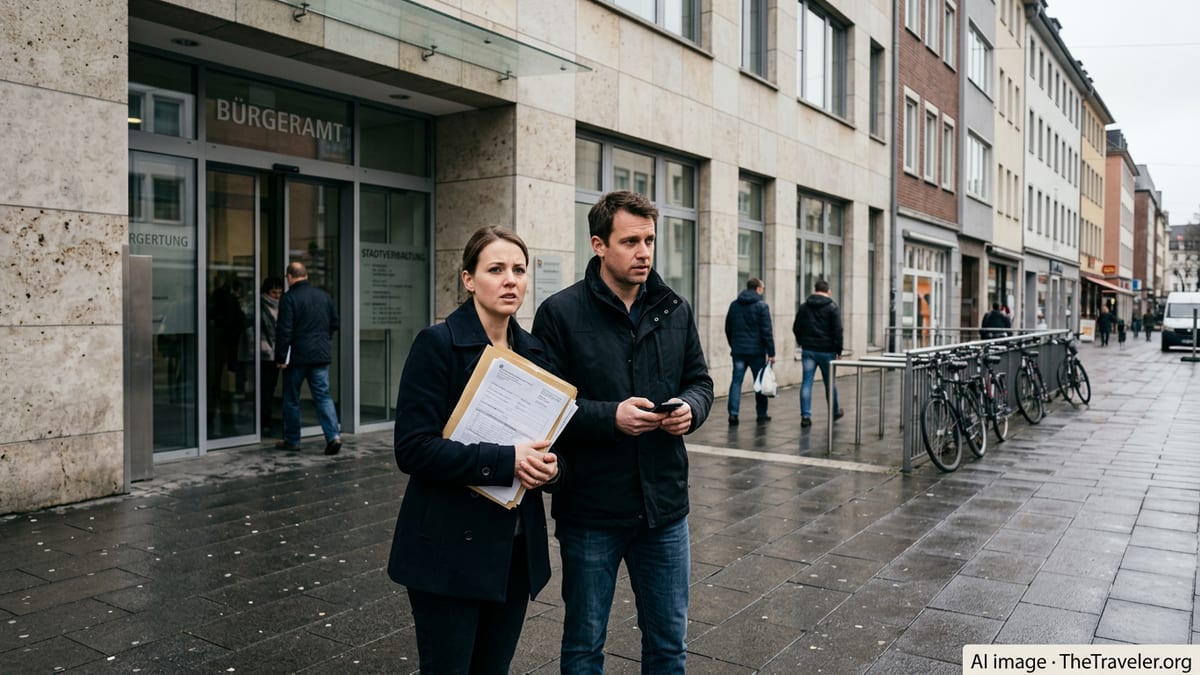
Framework for the First 90 Days in Germany
Germany frontloads many legal and practical requirements into the first weeks after arrival. The key organizing principle is that most subsequent steps depend on registering a residential address with the local authorities. Without an address registration certificate it is often difficult to open a full bank account, obtain certain insurance contracts, or complete other formalities.
The legal requirement is based on the Federal Registration Act, which obliges residents to register their dwelling with the municipal registration office after moving in. In practice, municipalities expect this within roughly 14 days of taking up residence, although some flexibility exists in large cities when appointments are unavailable.
Within a 90 day horizon, new residents can group tasks into three phases: days 1 to 14 focused on core legal registrations and basic connectivity, days 15 to 45 focused on banking, subscriptions, and household services, and days 46 to 90 used to close remaining gaps, optimize contracts, and ensure all recurring obligations such as the broadcasting contribution are in place.
For decision makers evaluating relocation, this structure highlights that Germany requires early administrative capacity and time investment. However, once the foundational registrations are complete, the environment is predictable and rule based, with relatively few unannounced obligations appearing later in the stay.
Days 1–14: Legal Residence Registration and Immediate Essentials
The legally critical task in the first two weeks after moving into a German dwelling is the address registration, commonly called Anmeldung. Residents must appear at the local registration office, typically a Bürgeramt or Einwohnermeldeamt, to register themselves at a specific address. This duty applies irrespective of nationality and is triggered by taking up residence rather than by the date of border entry.
Municipal rules generally require registration within 14 days of moving into the dwelling. Failure to register correctly, register at all, or provide accurate information can theoretically lead to administrative fines that can reach several hundred euros, in some cases up to around 1,000 euros. In practice, authorities often show leniency if documented appointment shortages are the reason for delay, but the legal obligation remains and should be treated as a priority task.
For the registration appointment, residents normally need a valid passport or identity card, a completed registration form, and a written confirmation from the landlord that confirms the move in date. After successful registration, the office issues a registration certificate. This document is fundamental in Germany. It is routinely requested by banks, some insurers, telecom providers, and other institutions as proof of residence.
In parallel, newcomers should secure immediate practical essentials that do not require a full address registration. These include obtaining a prepaid mobile SIM or temporary phone contract, understanding local waste disposal rules in the building, and clarifying how to receive postal mail if living in temporary accommodation. These actions allow basic daily functioning while the more formal processes progress.
Days 15–45: Banking, Communications, and Contract Infrastructure
Once the registration certificate is available, the next phase focuses on financial and contractual infrastructure. A German current account is central to everyday life, as many services rely on SEPA direct debits and standing orders rather than card payments. Banks typically require identification and proof of address. Online only providers may be more flexible, but traditional banks will routinely request the registration certificate before opening an account.
New residents should expect that account opening can take several days from application to full activation, especially when video identification and additional checks are involved. Planning for a lag period of one to two weeks is prudent before relying on the account for salary payments or automated bills. During this time, international cards can usually cover everyday purchases, but recurring local charges will require a German IBAN.
Telecommunications contracts are another critical element during this phase. Mobile contracts with longer minimum terms often require a German IBAN and proof of address, while prepaid options usually accept foreign payment methods and minimal documentation. For home internet connections, lead times of two to six weeks from order to activation are common, especially in buildings requiring technician visits. Aligning internet orders soon after receiving the registration certificate avoids extended periods without stable connectivity.
Residents should also consider German language support from day 15 onward, even if not strictly mandatory. Many administrative interactions and contracts are available only in German. Enrolling in a language course or establishing trusted translation support reduces the risk of misunderstandings in later contractual commitments, such as utilities and subscriptions.
Days 15–45: Mandatory and Quasi Mandatory Household Charges
In the early weeks, new residents encounter specific recurring charges that function as standard household obligations. The most distinctive among these is the public broadcasting contribution, known as the Rundfunkbeitrag. This is a legally prescribed fee that finances public radio and television services and applies to almost every private household regardless of actual media usage.
The contribution is charged per dwelling, not per person. As of early 2026 the standard rate for a residential household is approximately 18.36 euros per month. The fee is usually billed quarterly, resulting in a typical invoice of around 55 euros every three months. If several adults share one flat, only one person needs to be registered as the payer, while others document that they live in a covered household.
Registration for the broadcasting contribution is linked to the address registration. In many cases, the broadcasting service obtains data from municipal registration offices and sends a letter to the new address within a few weeks of registration. The letter requests confirmation of who in the household will pay the contribution or invites the resident to register as the payer. If no letter arrives after some time, proactive self registration is expected and arrears can be charged retroactively from the date of residence registration.
New residents must incorporate this fee into their recurring budget planning and administrative routines. Ignoring letters from the broadcasting contribution service does not eliminate the obligation. Instead, unpaid months can accumulate and lead to back payments and enforcement measures. During the first 45 days it is advisable to identify which household member is registered as the payer, ensure bank details are correct, and understand the available payment rhythms such as monthly, quarterly, or annual debit.
Days 46–90: Optimizing Contracts, Compliance, and Documentation
By the middle of the second month, most new residents have completed core registrations and opened a local bank account. The focus then shifts to optimizing the configuration of contracts and ensuring all documentation is correctly archived. Germany places high value on written records. Future administrative interactions often require older documents such as the initial registration certificate or the first broadcasting contribution letter.
Between days 46 and 90, residents should review all existing contracts and obligations that were hastily arranged during initial setup. Mobile phone plans, internet contracts, and any subscription based services should be examined for minimum terms, termination notice periods, and price structures. This is the period to switch from potentially expensive temporary solutions to more cost effective long term arrangements, now that the resident better understands consumption patterns and local market options.
It is also good practice to set up systematic storage for key documents. At minimum, this includes the registration certificate, proof of broadcasting contribution registration, bank account opening documents, and signed contracts for telecommunications and utilities. Digital copies stored securely alongside paper originals can significantly reduce friction when authorities or service providers later request evidence.
Compliance tasks in this period include confirming that all residents in the household are correctly reflected in the broadcasting contribution records and checking whether any official letters have remained unanswered. It is also advisable to verify that mail forwarding or address updates have been completed if the resident moved from a temporary to a permanent address within Germany during the first weeks.
Practical Risks and Bottlenecks in the First 90 Days
The German setup environment is predictable but can generate bottlenecks that affect daily life. The most common structural constraint is limited appointment availability at registration offices. In popular cities, appointments for address registration may book out weeks in advance. Authorities often treat a timely booked appointment as sufficient evidence of compliance with the 14 day rule, but this leniency depends on local practice. Residents should book registration appointments as soon as a move in date is known and keep records of unsuccessful booking attempts.
Another frequent bottleneck is the dependency chain: the bank may require proof of address before opening a full account, while certain landlords or service providers may prefer local bank details for payments. This can temporarily force residents to rely on international accounts or prepaid services during the early weeks. Recognizing this sequence in advance allows for interim measures such as maintaining accessible funds in international accounts while the German banking setup completes.
Administrative correspondence can also create risk. Official letters are predominantly in German and often use formal or bureaucratic phrasing. Misunderstanding a payment request or deadline, especially from the broadcasting contribution service or local authorities, can lead to avoidable reminders or late fees. New residents benefit from proactively translating such letters and reacting promptly rather than setting them aside.
Finally, temporary housing arrangements create specific challenges. Not all hotels or serviced apartments allow official address registration, and in some municipalities registration in commercial accommodation is restricted to longer stays exceeding a few months. Residents should clarify before arrival whether their initial accommodation can be used for address registration or whether a move to a registerable address is required within the first 90 days.
The Takeaway
The German environment concentrates several critical administrative tasks into the first 90 days of residence. Success in this period depends less on complex legal analysis and more on sequencing and diligence. The cornerstone is timely address registration within approximately 14 days of moving into a dwelling, which unlocks access to banking, stable telecommunications contracts, and other core services.
Once registration and a local bank account are in place, residents can systematically add broadcasting contribution registration, home internet, and other contracts in a controlled way, ensuring that obligations such as the public broadcasting fee are understood and budgeted. The predictable nature of German rules means that, while the initial workload is high, unplanned obligations after the first three months are relatively limited.
For individuals and employers evaluating relocation to Germany, this pattern implies that sufficient time and administrative support should be scheduled into the first weeks of any assignment or move. With structured planning that follows the 1 to 14, 15 to 45, and 46 to 90 day phases, most residents can reach a stable, compliant, and functional setup within the first three months.
FAQ
Q1. How soon after moving in must a new resident register their address in Germany?
The general expectation is registration within about 14 days of moving into a dwelling. Authorities often accept later appointments if booking capacity is limited, but residents should treat the two week period as the planning target and secure an appointment as early as possible.
Q2. What are the consequences of not registering an address on time?
Failure to register, registering late without justification, or providing incorrect information can lead to administrative fines that may reach several hundred euros. More importantly, lack of registration complicates opening bank accounts, concluding certain contracts, and receiving official correspondence.
Q3. Is the address registration deadline linked to arrival in Germany or to moving into an apartment?
The obligation is triggered by moving into a residence, not by crossing the border. A person staying temporarily in non registerable accommodation usually becomes subject to the registration duty once they move into a regular dwelling intended as their place of residence.
Q4. Can a bank account be opened before completing the address registration?
Some online banks may accept foreign addresses or alternative documentation, but many institutions require proof of German residence. In practice, a full feature local account is easier to obtain once the registration certificate is issued, so residents should plan for a transition phase using international banking.
Q5. How much is the German public broadcasting fee and who has to pay it?
The standard public broadcasting contribution for private households is currently around 18.36 euros per month and is charged per dwelling. Typically, one adult per household registers as the payer, while other residents document that they are covered under the same contribution number.
Q6. When does the obligation to pay the broadcasting fee start?
The obligation generally starts from the time a person takes up residence in a dwelling and registers their address. The broadcasting service can charge contributions retroactively, so ignoring initial letters does not remove the requirement and may lead to back payments.
Q7. What documents are usually needed for the address registration appointment?
Most registration offices ask for a valid passport or identity card, the completed registration form, and a written move in confirmation from the landlord that specifies the address and move in date. Some municipalities may also request marital status information or previous address details.
Q8. Are short stays under three months subject to address registration and the broadcasting fee?
Short term visitors who do not register an address with the municipality are generally outside the regular registration and broadcasting contribution systems. Once a person registers a residence for a longer stay, they enter both the municipal records and the broadcasting contribution framework.
Q9. How long does it usually take to get home internet installed after ordering?
Lead times vary by region and provider, but new residents should expect a waiting period of roughly two to six weeks from order to activation, especially where a technician visit is required. Ordering soon after receiving the registration certificate reduces the risk of extended delays.
Q10. What should be archived from the first 90 days for future administrative needs?
Key documents include the address registration certificate, any letters and confirmations from the broadcasting contribution service, bank account opening documents, and signed contracts for mobile, internet, and other subscriptions. Retaining both paper originals and digital copies is advisable for future interactions with authorities and service providers.