


Most visitors come to Pisa for the Leaning Tower and leave without ever discovering the Sinopie Museum. Tucked along the southern edge of Piazza dei Miracoli, this quiet space holds one of the most unusual collections in Italy: the ghostly red preparatory drawings that once lay hidden beneath the famous frescoes of the Camposanto Monumentale. If you are visiting for the first time, a bit of context and planning will make the difference between a quick walk-through and a genuinely memorable experience.
Get the latest updates straight to your inbox!
Understanding What the Sinopie Museum Actually Is
The Sinopie Museum (Museo delle Sinopie) is not a typical painting gallery filled with finished masterpieces. Instead, it houses the large-scale preparatory drawings, called sinopie, that artists sketched directly onto plaster walls as guides for frescoes in the Camposanto, Pisa’s monumental cemetery on Piazza dei Miracoli. When a devastating fire during the Second World War damaged many of those frescoes, conservators lifted the painted layers from the walls and uncovered these reddish-brown drawings beneath them.
The sinopie you see today are therefore the underdrawing phase of some of the most important Tuscan fresco cycles from the 14th to 16th centuries. They reveal planning lines, corrections, and even abandoned ideas. Artists such as Buonamico Buffalmacco, Benozzo Gozzoli, and Spinello Aretino left behind scenes of the Last Judgment, stories of Job, and allegories of Death that you can now read almost like giant sketchbook pages spread across the museum walls.
For first-time visitors, it helps to remember that these drawings once sat exactly behind the frescoes still visible in the Camposanto next door. Many travelers find it useful to visit both spaces on the same day and mentally “reconstruct” the original wall: the finished color fresco in the cemetery, and the red sinopia drawing in the museum. This back-and-forth gives a rare look into how medieval and Renaissance artists constructed complex religious images step by step.
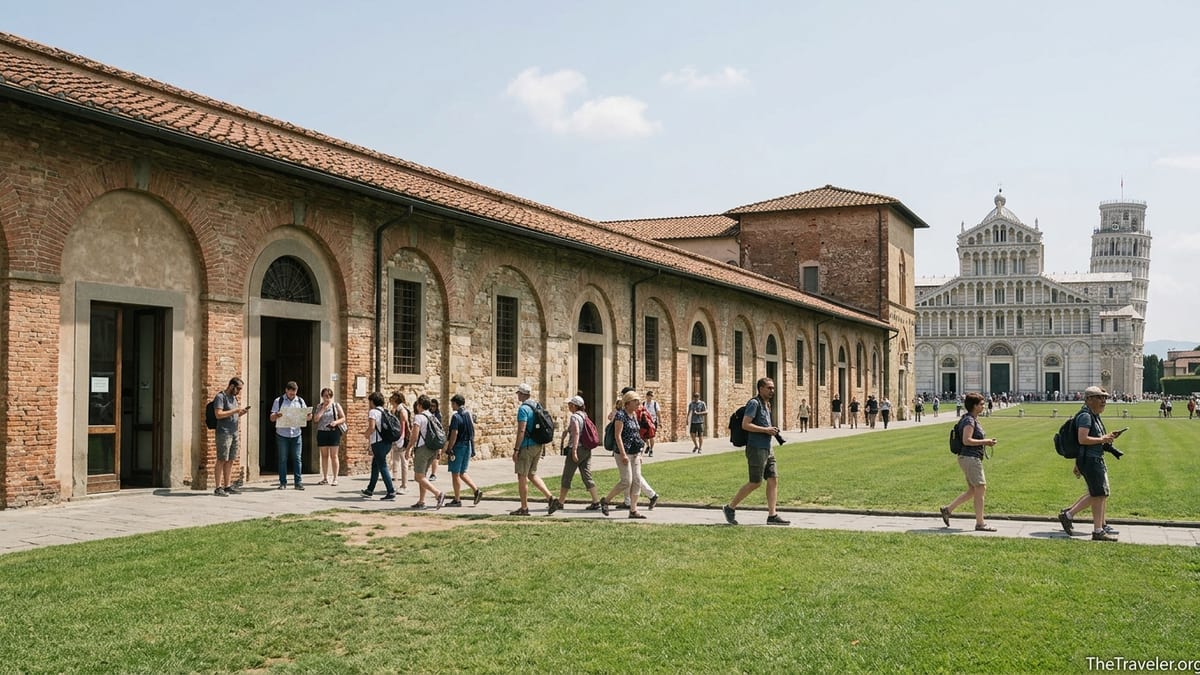
Architecturally, the museum occupies part of the former Ospedale di Santa Chiara on the south side of the square, close to one of the main ticket offices for the entire Piazza dei Miracoli complex. Inside, a system of raised walkways and suspended panels allows you to see these long, delicate drawings at eye level or from slightly above, which is very different from craning your neck in a typical church or chapel.
Location, Tickets, and How to Plan Your Visit
The Sinopie Museum stands along the southern edge of Piazza dei Miracoli, opposite the Camposanto and a short walk from the Leaning Tower and cathedral. If you enter the square from the main tourist bus drop-off on Via Pietrasantina, you will usually pass souvenir stalls and then see the long brick building that houses the museum and one of the official ticket offices of the Opera della Primaziale Pisana.
Tickets are managed as part of the broader cathedral complex. A common arrangement is a combined ticket that lets you choose several monuments on the square, such as the Baptistery, Camposanto, Opera del Duomo Museum, and the Sinopie Museum, in addition to the free entry to the cathedral itself. As a rough guide, a ticket for one monument is typically priced in the mid single digits in euros, while multi-monument passes cost more but remain solid value compared with other major Italian sites. Exact prices and options can change seasonally, so it is wise to check the official Opera della Primaziale Pisana information close to your travel dates or to confirm at the ticket office on arrival.
First-time visitors often assume they must decide everything online weeks in advance, but for the Sinopie Museum that is rarely necessary outside of peak summer weekends. Many travelers simply buy a same-day combined ticket at the museum’s ticket counter and then organize their time between the Baptistery, Camposanto, and the two museums. By contrast, climbing the Leaning Tower usually does require a specific timed ticket, so it can make sense to secure that online and then fill the gaps in your schedule with the Sinopie Museum and other monuments.
Opening hours for the Piazza dei Miracoli monuments typically run from morning into early evening, with slightly reduced hours in winter and extended ones in high season. Because timetables are periodically adjusted, especially around public holidays, make a habit of double-checking current hours rather than relying on old guidebooks. If you arrive at the square mid-morning, plan roughly 45 to 60 minutes inside the Sinopie Museum itself, which fits comfortably into a half-day visit including the Camposanto and a relaxed look at the cathedral façade.
When to Go and How to Avoid the Crowds
One of the underappreciated advantages of the Sinopie Museum is that, even during busy months like June and July, it is usually much quieter than the Leaning Tower or Baptistery. Tour groups tend to focus on outdoor photo stops and short cathedral visits, leaving the museum as a calm retreat just a few steps away from the lawns full of people posing with the tower.
If you are arriving on a day trip from Florence or Rome, consider booking the latest possible Leaning Tower slot in the afternoon and visiting the Sinopie Museum earlier, around late morning or just after lunch. Around noon many visitors are eating or queuing for the tower, so you often find yourself sharing the museum with only a handful of people. On cooler autumn or winter days, visiting mid-afternoon can be pleasant when the natural light filtering through the upper windows is softer and the interior feels especially contemplative.
Weather can also shape your experience. On very hot summer days, the museum provides welcome shade and airier conditions compared with standing in the open square. Conversely, if you arrive in Pisa on a rainy day and find the lawns closed or muddy, the Sinopie Museum and Camposanto become excellent indoor options, allowing you to still enjoy the art and history of the piazza without getting soaked.
Keep an eye on local holidays and special cultural weekends. In some cases, Italian state museums offer free entry days or reduced admission periods, which can increase visitor numbers at major sites. While the Sinopie Museum often remains manageable even then, you may find ticket queues at the main counters slightly longer, so arriving earlier or later in the day will help you avoid unnecessary waiting.
Reading the Sinopie: How to Get More From the Drawings
Because sinopie are inherently subtle, many first-time visitors walk through quickly, noting only “faded red drawings on big sheets of plaster.” To get more from the visit, it is worth slowing down and approaching the museum almost like a behind-the-scenes studio tour of medieval Pisa. Look closely and you will see measurement lines, squared grids used to scale up compositions, and small corrections where the artist changed the tilt of a head or the position of a figure’s hand.
Near the entrance you will often find panels explaining how fresco painting worked at the Camposanto. The process involved laying down fresh plaster, sketching the sinopia with a reddish pigment, and then applying pigments while the plaster was still damp, so that color and wall fused chemically. When you stand in front of a sinopia for a scene like “The Triumph of Death,” try to imagine the artist and assistants plotting out dozens of figures in advance, adjusting the curves of horses, or changing the placement of trees before any color was added.
Audio guides and printed brochures, sometimes available at the ticket counter or through your phone, can deepen this experience by pointing out specific details in individual panels. For example, a guide might draw your attention to the way Benozzo Gozzoli planned clusters of bystanders or the architectural backgrounds of certain scenes, which are easier to understand in drawing than beneath layers of color.
Many travelers find visiting the Camposanto either just before or immediately after the museum visit especially rewarding. You can compare the same narrative scene in its red preparatory state inside the museum and in its later restored color version on the cemetery wall. This side-by-side comparison is something most Italian churches cannot offer, and it is one of the key reasons art enthusiasts make time for the Sinopie Museum despite packed Tuscany itineraries.
Practical Tips: Accessibility, Facilities, and Photography
The Sinopie Museum was created inside part of a historic hospital complex, but its interior layout is relatively visitor friendly. A system of ramps and a lift allows access to the upper-level walkways where many of the large panels are displayed. If you are traveling with someone who uses a wheelchair or has mobility challenges, it is helpful to know that there is a small step at the entrance to the building, but staff are generally used to assisting visitors in navigating the threshold and the ticket area.
Inside the museum you will typically find basic facilities such as restrooms and a cloakroom or simple storage area. The building also contains one of the principal ticket offices for all the monuments on Piazza dei Miracoli, which means that lines for purchasing or collecting tickets can form just inside the entrance. If you already have your combined ticket or tower reservation, you can usually move past the main counter and proceed directly to the museum turnstile.
Photography rules can vary slightly over time, but visitors commonly report being allowed to take non-flash photographs of the sinopie. Because the drawings are delicate and the light levels purposely kept subdued to help with conservation, flash is almost always prohibited. Bringing a camera that performs well in low light or at higher ISO settings will help if you want clear images without blur. Keep in mind that the primary experience is contemplative: spending more time looking at the long narrative cycles with your eyes, rather than through a lens, is often more rewarding.
Like many Italian museums, the Sinopie Museum has a small bookshop area where you can pick up postcards or a slim catalogue with reproductions of the drawings and essays in Italian and sometimes English. If a particular panel or artist fascinates you, buying the catalogue on the way out can be a good way to revisit the experience after your trip, since reproducing the delicate reds and subtle lines accurately in your own photos can be challenging.
Combining the Sinopie Museum With the Rest of Pisa
For most travelers, the Sinopie Museum fits naturally into a half-day plan centered on Piazza dei Miracoli. A typical schedule might involve arriving around 9:30 in the morning, purchasing a combined ticket that includes the Baptistery, Camposanto, and Sinopie Museum, then visiting the cathedral interior when lines are shortest, stopping for a quick coffee or sandwich just outside the square, and dedicating late morning or early afternoon to the museum and the cemetery.
If you have more time in Pisa, the Sinopie Museum can serve as an introduction to the city’s broader art heritage. After seeing the preparatory drawings and Camposanto frescoes, you might walk or take a short local bus to the National Museum of San Matteo, where sculptures and painted panels from Pisa’s churches are displayed in a former convent. Alternatively, a late afternoon stroll along the Arno river and into the older university quarter can show you how the city’s medieval prosperity, funded partly by maritime trade, left its imprint in architecture and small churches scattered beyond the famous leaning tower.
Families traveling with older children or teens often appreciate the Sinopie Museum as a manageable, digestible slice of culture. The spaces are compact, the subject matter dramatic, and the visit rarely takes more than an hour. You can frame the experience as a detective story about how curators saved art after wartime damage: the fire at the Camposanto, the lifting of the frescoes from the walls, and the discovery of the hidden drawings below. Children who enjoy drawing themselves might be inspired to sketch a fragment of a sinopia or imagine how they would plan a large mural today.
Because Piazza dei Miracoli is a UNESCO World Heritage site, local authorities pay careful attention to visitor flow and conservation. That means that from time to time there may be small changes in how entrances are organized or how long combined tickets remain valid. When in doubt, ask staff at the ticket office how best to structure your visits that day, particularly if you are also climbing the tower or have a tight onward train connection.
The Takeaway
Visiting the Sinopie Museum in Pisa for the first time is less about ticking off another monument and more about understanding how art is made, preserved, and sometimes rediscovered by accident. In a city best known for its famously crooked tower, this quiet museum offers an inward-looking experience, where faint red lines on plaster reveal the minds and hands of artists who worked in the shadow of the cathedral nearly seven centuries ago.
With a little advance planning about tickets, timing, and how you want to combine the museum with the Camposanto and other sites on Piazza dei Miracoli, the visit fits easily into even a short stay in Pisa. Whether you are an art lover, a history enthusiast, or simply a curious traveler looking for a calmer corner of a very busy square, the Sinopie Museum rewards those who slow down and look closely.
FAQ
Q1. What exactly is displayed in the Sinopie Museum in Pisa?
The museum displays large reddish preparatory drawings, called sinopie, that artists sketched on plaster as guides for frescoes in the Camposanto Monumentale.
Q2. Where is the Sinopie Museum located within Pisa?
The museum stands along the southern side of Piazza dei Miracoli, in part of the former Santa Chiara hospital complex, opposite the Camposanto cemetery.
Q3. How much time should I plan for a first visit?
Most first-time visitors spend about 45 to 60 minutes inside, which allows enough time to read key panels, walk the raised pathways, and connect the drawings to the Camposanto frescoes.
Q4. Do I need to book tickets for the Sinopie Museum in advance?
Outside of peak summer weekends, advance booking is usually not necessary. Many visitors buy same-day combined tickets for the museum and other Piazza dei Miracoli monuments at the on-site ticket office.
Q5. Is the Sinopie Museum included in combined tickets for Piazza dei Miracoli?
Yes, it is commonly offered as one of the selectable monuments in combined tickets that also cover the Baptistery, Camposanto, and the Opera del Duomo Museum, alongside free cathedral entry.
Q6. Is the Sinopie Museum suitable for children and teens?
Yes. The museum is compact and the story of damaged frescoes and rediscovered drawings can be engaging for older children and teens, especially if presented as a behind-the-scenes look at art making.
Q7. Are there accessibility provisions for visitors with reduced mobility?
Inside, ramps and a lift connect the main levels and walkways. There may be a small step at the entrance, but staff are generally prepared to assist visitors who need help entering and moving through the space.
Q8. Can I take photos inside the Sinopie Museum?
Non-flash photography is often permitted, but flash is typically prohibited to protect the delicate drawings. It is best to confirm current rules with staff upon arrival.
Q9. What is the best way to combine the Sinopie Museum with other Pisa sights?
A common plan is to pair it with the Camposanto, Baptistery, and a quick cathedral visit, using a combined ticket and visiting the museum when other monuments are busiest.
Q10. Is the Sinopie Museum crowded like the Leaning Tower?
Generally no. Even in high season it tends to be much quieter than the tower or Baptistery, making it a peaceful escape from the busiest parts of Piazza dei Miracoli.