


More news on this day
Air travel across Europe and beyond faced fresh disruption on 14 May 2026 as more than a dozen flights in France were grounded, with services operated by or on behalf of British Airways, Air France, SAS and Delta at Paris Charles de Gaulle and Nice Côte d’Azur cancelled or heavily delayed, causing knock-on effects for passengers connecting to and from London, Copenhagen, Oslo, Dubai, Tel Aviv, Dublin, New York and other major hubs.
Get the latest news straight to your inbox!
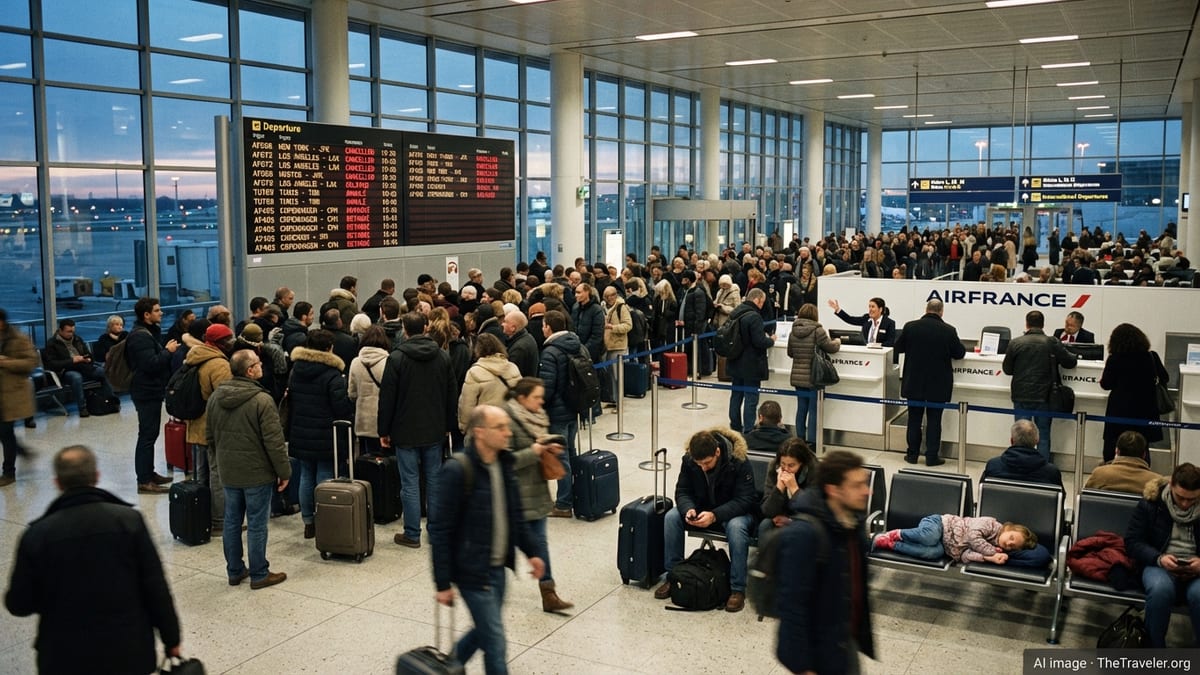
Cancellations and Delays Hit Paris Charles de Gaulle
Publicly available operational data shows that Paris Charles de Gaulle (CDG), France’s largest airport, recorded significant disruption on 14 May 2026. Monitoring services tracking departures and arrivals indicate that CDG saw hundreds of delayed flights and a cluster of cancellations across domestic, European and long haul networks, affecting both legacy and partner-operated services.
Reports indicate that Air France, together with codeshare and joint-venture partners such as Delta Air Lines and KLM, was among the most affected at CDG. Several flights were retimed or withdrawn from the schedule, including services linking Paris to Scandinavian gateways and Mediterranean destinations, which feed onward long haul traffic. Passengers booked on these flights faced missed connections and extended layovers as airlines attempted to rebook them onto later services.
According to aggregated disruption tracking, at least a handful of departures and arrivals operated by or on behalf of major alliance carriers were cancelled outright at CDG, with further flights experiencing substantial delays. While the exact causes ranged from operational constraints to wider network pressures, the result was a busy day of schedule changes and re-accommodation for travelers using the Paris hub.
The disruption has been particularly challenging because CDG functions as a key transfer point between European short haul routes and intercontinental services. When feeder flights are grounded or delayed, passengers traveling onward to cities such as New York, Dubai and Tel Aviv can lose carefully timed connections, forcing airlines to reroute them via alternative hubs or postpone their journeys by a day or more.
Nice Côte d’Azur Services Affected on Key Leisure and Feeder Routes
Nice Côte d’Azur Airport (NCE), France’s main gateway to the Riviera, also saw cancellations and delays linked to services involving British Airways, Air France and their partners. Flight schedules for 13 and 14 May show adjustments on routes connecting Nice with London Heathrow and London Gatwick, with some British Airways services not operating as originally planned, and others retimed or consolidated.
Data from real time trackers and timetable providers suggests that Air France’s shuttle-style operations between Paris Charles de Gaulle and Nice, some of which carry Delta and other codeshare numbers, have been running with altered departure times and occasional cancellations. These flights are critical links between the Riviera region and long haul departures at CDG, meaning disruption on the route can strand passengers who are relying on same day connections to North America and the Middle East.
On the London to Nice corridor, services typically operated multiple times per day by British Airways form an important leisure and business link, particularly in spring and summer. The latest schedule changes have left some travelers with reduced options or enforced overnight stays when onward connections are missed. Travel forums and passenger reports describe instances of last minute cancellations and gate-hold delays that compound the wider regional disruption.
Nice is also used by Scandinavian and transatlantic carriers as a seasonal and year round destination, so cancellations at the French end of the route can cascade through airline networks. When a feeder flight into Nice is grounded, the impact can be felt as far away as Oslo, Copenhagen or Dublin if crews, aircraft or transfer passengers cannot be positioned as planned.
Ripple Effects Across London, Scandinavia and North America
The immediate cancellations in France have triggered wider schedule challenges for British Airways, SAS and Delta, particularly on routes connecting London, Scandinavia and the United States. British Airways relies heavily on flows between London Heathrow and regional European airports such as Nice to feed its long haul services to North America and the Middle East. When French sectors are cancelled or heavily delayed, passengers traveling from the Riviera to destinations like New York, Boston or Chicago via Heathrow may be forced onto alternative routings or later departures.
For SAS, which operates key links between Scandinavian capitals and major European hubs, interruptions to French operations can mean missed or misaligned connections in Copenhagen and Oslo. According to publicly available schedules, SAS and its partners had services touching both Paris and Nice that feed traffic to long haul flights bound for the United States and Asia. Grounded or retimed segments in France risk leaving long haul flights under-filled while simultaneously displacing customers whose connecting sectors no longer match.
Delta, as a transatlantic joint-venture partner of Air France and KLM, is closely intertwined with French operations. Many Delta-coded flights between Paris and cities such as Nice, Copenhagen and other European points are actually operated by Air France aircraft. When these intra-European legs are adjusted or cancelled, Delta customers originating in North America can lose through itineraries that were designed around tight minimum connection times at CDG.
Published flight information also indicates that New York services feature prominently in the disrupted network. CDG is one of the busiest transatlantic gateways, and irregular operations on its short haul feeders can disrupt large volumes of traffic. Travelers expecting seamless one-stop journeys from cities such as Dublin, London or Oslo to New York via Paris may find themselves rebooked onto direct or multi-stop alternatives, often involving long waits and changes of airport or airline.
Middle East Routes Already Under Pressure from Prior Suspensions
The latest French cancellations are unfolding against a backdrop of broader adjustments on routes to and from the Middle East. Earlier in 2026, Air France and other European carriers scaled back or temporarily suspended flights to cities including Dubai and Tel Aviv in response to heightened geopolitical and security concerns affecting regional airspace. Those reductions have already tightened capacity on remaining services linking Europe with the Gulf and the Eastern Mediterranean.
British Airways has also significantly reworked its Middle East network in recent months, with publicly available information and media coverage describing widespread suspensions or reductions on services to destinations such as Dubai and Tel Aviv. With these long haul options already constrained, any additional cancellations on feeder routes at CDG or Nice further complicate journey planning for travelers attempting to reach or return from the region via European hubs.
For passengers whose itineraries combine French domestic or intra-European sectors with long haul flights to the Middle East or North America, the interplay between pre-existing suspensions and fresh day-of-operations cancellations can be especially disruptive. A single grounded flight between Paris and Nice, or between Paris and a Scandinavian gateway, can sever a carefully constructed itinerary that threads through already limited long haul capacity.
Travel analysts note that when airlines are forced to trim schedules in one region for security or operational reasons, they often redeploy aircraft and crews to other parts of the network. In the short term, this can help maintain overall capacity but may result in less resilience on busy feeder routes. The latest disruptions in France appear to fit this pattern, with constrained spare capacity leaving carriers less able to absorb unexpected delays or technical issues.
What Travelers Are Being Advised To Do
Airlines affected by the French disruptions are using standard rebooking and communication channels to manage the fallout. Public guidance from carriers and travel advisories encourages passengers flying into or out of Paris Charles de Gaulle and Nice Côte d’Azur to monitor their bookings closely via airline apps and to check flight status before departing for the airport. Same day schedule changes remain possible when operations are already under strain.
Consumer advocacy organizations and compensation platforms highlight that travelers departing from or arriving in the European Union may be entitled to care, rerouting or financial compensation in certain circumstances when flights are cancelled or heavily delayed. However, entitlement can depend on factors such as the cause of the disruption, the length of delay and whether the operating carrier is an EU or UK airline, so passengers are being urged to review their specific situations carefully.
In practical terms, travelers connecting through Paris or Nice to long haul flights are being advised, in publicly available guidance, to build in additional buffer time, consider multi-hour layovers, and where possible choose itineraries with more than one daily frequency on each leg. Routes with multiple daily services between the same city pairs can provide more flexibility if an earlier flight is cancelled, whereas single daily flights leave little room for adjustment.
With the busy summer travel period approaching, the latest wave of cancellations in France underscores the fragility of complex international networks that depend on tightly sequenced feeder flights. As airlines continue to adjust their schedules in response to operational pressures and geopolitical uncertainty, passengers on routes touching Paris Charles de Gaulle and Nice Côte d’Azur are likely to face a continued risk of last minute changes and should plan accordingly.