


More news on this day
Severe disruption at Guangzhou Baiyun International Airport has triggered 485 flight delays and nine cancellations, creating a cascade of missed connections and overnight backlogs across China, Singapore, Malaysia, Thailand and Vietnam as carriers struggle to keep aircraft and crews moving.
Get the latest news straight to your inbox!
Weather Turmoil Slams One of China’s Busiest Hubs
Publicly available flight monitoring data and recent operational reports indicate that Guangzhou Baiyun International Airport, one of China’s busiest aviation gateways, has been hit by a fresh wave of disruption linked to persistent heavy rain across southern China. The latest tally points to 485 delayed flights and nine outright cancellations concentrated in a single extended operational window, disrupting schedules for tens of thousands of passengers.
The disruption coincides with sustained torrential downpours reported at major airports in Guangdong province, including Guangzhou and nearby Shenzhen, where low visibility and thunderstorm activity have periodically reduced runway capacity. Meteorological forecasts in local media describe a slow moving rain belt lingering over the region, prompting repeated flow control measures that compel airlines to hold or reroute aircraft and stretch already tight schedules.
Guangzhou Baiyun, which handled more than 60 million passengers in 2023 and serves as a primary southern hub for domestic and international traffic, is particularly vulnerable when weather hits during peak travel periods. The airport’s role as a connector between inland Chinese cities and Southeast Asian destinations means even short ground stops or extended taxi holds can quickly ripple across a wide geography.
Operational summaries for the current disruption show long strings of late departures and arrivals, some slipping beyond three hours, as carriers attempt to sequence aircraft through congested airspace and intermittent storm cells. Turnaround times have lengthened as ground crews work around lightning suspensions and saturated aprons.
Major Chinese Carriers Under Acute Operational Pressure
Air China, China Eastern, Hainan Airlines and China Southern are bearing the brunt of the latest irregular operations at Guangzhou Baiyun, according to publicly available tracking dashboards and airline schedule data. Collectively, these four carriers operate the majority of mainline services at the airport, particularly on trunk routes linking Guangzhou with Beijing, Shanghai and key Southeast Asian cities.
China Southern, which uses Guangzhou as a primary hub, appears to be the most heavily exposed, with a dense bank of domestic departures in the morning and late evening peaks. When inbound flights arrive late because of air traffic restrictions or weather diversions, subsequent rotations are pushed back, creating knock on delays throughout the day. Aircraft that were scheduled to continue to secondary Chinese cities or international points in Southeast Asia are forced into rolling rescheduling.
Air China and China Eastern, while anchored at Beijing and Shanghai respectively, rely on Guangzhou for important feeder and through services. Disruption at Baiyun therefore adds a second layer of complexity to networks that are already managing congestion at northern and eastern hubs. Hainan Airlines, with a smaller but growing presence in southern China and on Southeast Asian sectors, is similarly affected when its limited long haul and regional fleets are held on the ground longer than planned.
Industry analyses of Chinese airline networks have long highlighted the sensitivity of these four carriers to delay propagation when a single high volume node such as Guangzhou experiences a shock event. Once rotations slide beyond certain thresholds, crews and aircraft fall out of position, forcing airlines to consolidate flights, upgauge aircraft or cancel selected services to restore balance.
Regional Shockwaves From China to Southeast Asia
The operational turmoil at Guangzhou is not confined to mainland domestic routes. Flight data and schedule changes tracked by passenger rights and air travel analytics firms show knock on effects on services linking China with Singapore, Malaysia, Thailand and Vietnam, as well as onward connections deeper into Southeast Asia.
Singapore and Kuala Lumpur, both major regional hubs, have seen clusters of delayed arrivals from Guangzhou that in some cases miss onward connection banks by narrow margins. Passengers aiming to connect from Chinese carriers onto other Asian or long haul airlines face elevated risk of misconnection when inbound flights arrive substantially behind schedule, particularly during late evening arrival waves.
Bangkok and Phuket in Thailand, along with Ho Chi Minh City and Hanoi in Vietnam, are also reporting late inbound operations on routes commonly served by China Southern, China Eastern and Hainan Airlines. In markets where frequencies are limited to one or two flights per day, a delay of several hours can effectively wipe out the day’s connectivity for travelers with time sensitive itineraries.
Regional aviation observers note that Southeast Asian airports often absorb some disruption by reassigning gates or holding connecting flights where feasible, but when a large volume of late operations arrives in quick succession, terminal congestion and crew duty limits restrict the flexibility of both local and Chinese carriers. The result is a patchwork of rolling delays, aircraft swaps and, in some instances, overnight stays for stranded passengers.
Passengers Confront Long Queues and Complex Rebooking
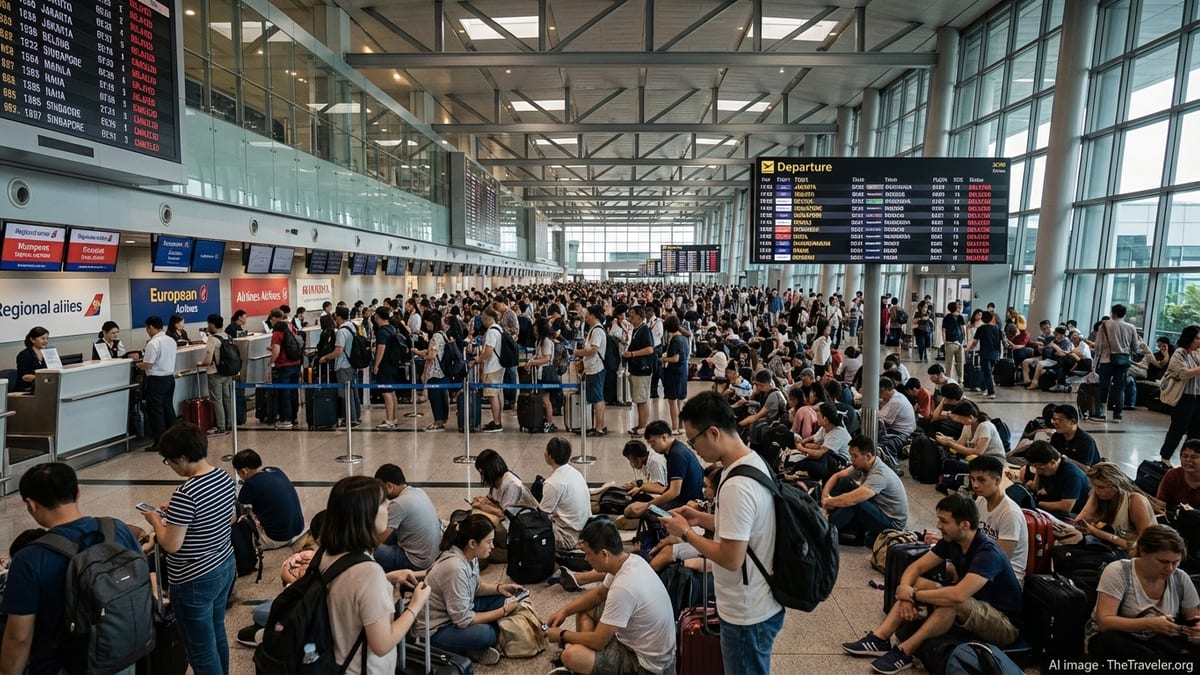
For travelers on the ground at Guangzhou Baiyun and across the affected network, the experience of this disruption cycle has been marked by long check in and security queues, crowded departure halls and rapidly changing departure boards. Accounts shared on public forums and social media describe repeated gate changes, boarding announcements followed by sudden holds, and extended waits on aircraft as crews await updated departure slots.
Publicly available airline notices show that major Chinese carriers have been encouraging passengers whose travel is not time critical to voluntarily rebook to later dates, in some cases offering free changes within specified windows. However, high summer and holiday demand on key domestic and Southeast Asian routes limits the availability of spare seats, particularly in economy cabins, making it harder for affected passengers to secure preferred alternatives.
Travel advisories from consumer organizations and delay compensation specialists recommend that passengers monitor airline apps closely, keep boarding passes and delay notifications, and consider contacting carriers via digital channels rather than queuing at service desks where possible. For those with separate tickets on different airlines or self arranged connections, the current environment is especially challenging, as protections are weaker and changes often incur additional charges.
At Guangzhou Baiyun specifically, anecdotal reports point to bottlenecks during international transfers, where passengers must clear security and in some cases immigration before reaching their connecting gates. When inbound flights land late, the combination of tight minimum connection times and crowded transfer channels leaves little margin for error.
Prospects for Recovery and What Travelers Can Expect Next
Short term prospects for a rapid normalization of operations at Guangzhou Baiyun will depend heavily on the evolution of the regional weather pattern and the capacity of airlines to reposition aircraft and crews. Forecasts from regional meteorological agencies suggest that heavy rainfall around Guangdong may persist in the near term before gradually shifting north, implying that delays could continue intermittently even as the worst of the storm activity passes.
Operational data from previous disruption events in China indicates that once weather related flow restrictions are lifted, major carriers typically require at least one to two full scheduling cycles to fully realign aircraft and crew resources. During this recovery phase, airlines often prioritize high demand trunk routes and long haul sectors, which can prolong irregular timings on thinner domestic and regional links.
Travel industry analysts advise that passengers scheduled to travel through Guangzhou and other southern Chinese hubs in the coming days build additional buffer time into itineraries, especially when connecting onward to international flights in Singapore, Malaysia, Thailand or Vietnam. Booking itineraries on a single ticket and with generous connection windows provides stronger protection when disruptions escalate.
While the current episode underscores the vulnerability of dense airline networks to local weather shocks, it also highlights the growing centrality of Guangzhou Baiyun as a connector between China and Southeast Asia. As airlines refine their recovery playbooks and invest in more resilient scheduling and real time communication tools, the challenge will be to translate those capabilities into a smoother experience for passengers whenever the next round of storms bears down on the Pearl River Delta.