


More news on this day
Hundreds of travelers were left stranded at Montréal–Trudeau International Airport on Monday as a wave of disruptions involving Jazz, Air Canada, PAL Airlines, Endeavor Air and Porter Airlines led to 33 flight cancellations and roughly 140 delays, snarling traffic on key North American and transatlantic routes.
Get the latest news straight to your inbox!
Major Carriers Hit as Operations Falter
According to live airport tracking data and publicly available schedules, the disruption at Montréal–Trudeau involved a cross-section of regional and mainline operators, including Air Canada and its partner Jazz, PAL Airlines, Delta affiliate Endeavor Air and Porter Airlines. The combination of cancellations and extended delays affected domestic, cross-border and long-haul departures, creating knock-on congestion across the terminal complex.
Data compiled from flight-status platforms indicates that the 33 cancellations were concentrated in short-haul services within Canada and to the United States, where regional aircraft typically provide frequent shuttle-style links to Toronto, Ottawa, Halifax, New York and other business markets. Because many long-haul flights depend on these feeder services, the loss or late arrival of connecting passengers contributed to further delays on larger aircraft bound for overseas destinations.
Publicly available information on departure boards shows that the roughly 140 delayed flights spanned the full day’s schedule, from early-morning departures through late-evening banked connections. With so many movements pushed back, airport congestion built steadily, particularly at security checkpoints and boarding gates used by Air Canada and its regional partners.
Operational tools used by frequent flyers suggest that irregular operations were not limited to a single airline system, reinforcing the impression of a network-wide disruption at Montréal–Trudeau rather than an issue confined to one carrier’s internal technology or staffing.
Transatlantic Links to Europe Severely Disrupted
The day’s problems were most visible on key transatlantic links, where flights between Montréal and Marseille, Frankfurt, Keflavik, London and Madrid experienced notable disruption. Schedule data and delay reports indicate that some of these services were pushed back by several hours, while others were ultimately canceled, leaving passengers to compete for limited rebooking options at the height of the summer travel period.
Frankfurt and London, which serve as major European hubs for onward connections across the continent, were among the hardest hit. Delays on departures from Montréal risked misconnecting travelers booked on tight itineraries through these hubs, with some passengers reportedly facing overnight stays or rerouting through alternative airports such as Toronto or European secondary gateways.
Services to leisure-focused destinations, including Marseille and Madrid, also saw extended disruptions. Travel-industry reporting has highlighted particularly strong seasonal demand on these routes, meaning that spare seats on later flights were scarce. Many affected passengers reported via public forums that they were offered rebookings several days out or proposed routings involving multiple stops rather than a single nonstop segment.
Flights to Keflavik in Iceland, a key link for both point-to-point tourism and onward connections to Scandinavia and the United Kingdom, were similarly affected. Given the relatively limited daily frequency on this route, cancellations there carried an outsized impact for travelers with fixed tour and cruise start dates.
Ripple Effects for Domestic and Regional Travelers
While the spotlight fell on transatlantic flights, domestic and regional travelers bore much of the immediate brunt. Regional operators Jazz and PAL Airlines, along with Endeavor Air and Porter, collectively account for a large share of short-haul movements into and out of Montréal–Trudeau. When irregular operations cascade through these networks, passengers on short business trips or family visits often have fewer alternatives than those on long-haul itineraries.
Publicly accessible flight-status logs show clusters of cancellations on routes to and from smaller Canadian communities that rely on Montréal as their primary air link. In some cases, passengers faced the prospect of driving several hours to alternate airports or waiting until the following day for the next available seat. For travelers from remote or underserved regions, these disruptions can cut them off from medical appointments, university travel and time-sensitive work commitments.
Reports shared in traveler forums suggest that some passengers arriving from regional points missed onward long-haul flights as a result of the delays, creating a two-stage disruption: first at their origin airport, then again at Montréal–Trudeau when onward connections could not be met. Reaccommodation in these instances often involves complex re-ticketing across multiple carriers and booking systems, further slowing recovery.
Observers tracking Canadian aviation developments note that high load factors on many domestic routes this summer leave airlines with limited slack to absorb irregular operations. When a rotation is canceled, there may be few, if any, empty seats on later flights that can be used to rebook disrupted passengers, prolonging the period during which travelers remain stranded at the terminal.
Passengers Confront Long Queues and Limited Options
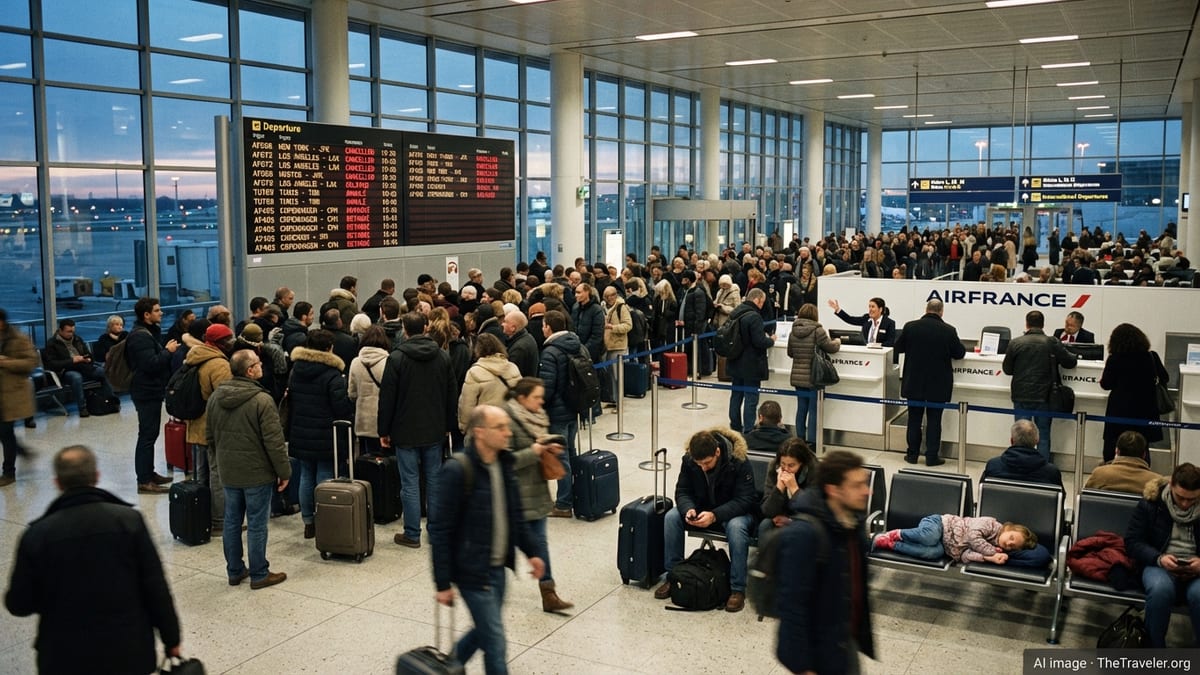
Inside the terminal, images and firsthand descriptions shared on social media platforms pointed to overcrowded check-in areas and long lines at airline service counters as travelers sought rebooking and information. With dozens of flights impacted, customer-service resources were stretched, contributing to wait times that in some cases appeared to last several hours.
Public guidance published by the Canadian Transportation Agency outlines specific obligations for airlines during flight delays and cancellations, including requirements to provide meals, accommodation and rebooking in certain circumstances. Travel-rights advocates frequently encourage passengers to document their disruption, retain receipts for out-of-pocket expenses and request written explanations of the cause of delay in case they choose to pursue compensation or refunds later.
For some travelers, particularly those on tight timelines or with complex itineraries, the most practical alternative was to abandon same-day air travel altogether. Rail and intercity bus operators serving the Montréal–Toronto–Ottawa corridor are often cited as fallback options when short-haul flights are disrupted, although same-day capacity on those modes can also be limited during peak periods.
Travel forums and consumer sites show that stranded passengers increasingly turn to third-party travel apps and airline mobile tools to monitor standby lists, track incoming aircraft and identify open seats, sometimes securing solutions more quickly than by waiting in physical queues. However, these strategies offer little comfort when widespread cancellations remove large numbers of seats from the network at once.
Broader Questions for Canada’s Summer Travel Season
The turbulence at Montréal–Trudeau comes at a sensitive moment for Canada’s air transport system, as carriers ramp up capacity for the peak summer season amid persistent cost pressures and evolving route networks. Recent route adjustments by Canadian airlines, including Air Canada and Porter, reflect an industry seeking to balance strong demand with volatile fuel prices and infrastructure constraints at key hubs.
Aviation analysts who track Canadian traffic trends have noted that Montréal–Trudeau plays a dual role as both a transatlantic gateway and a vital connector for regional communities in Quebec and Atlantic Canada. Disruptions on the scale seen on Monday highlight how quickly strain at a single hub can reverberate through smaller airports that depend on it for connections to the wider world.
Publicly available operational data suggests that airlines are likely to spend several days untangling the schedule impact of 33 cancellations and around 140 delays, as aircraft and crews are repositioned and passengers work their way to final destinations. Travel specialists often advise that once a network is heavily disrupted, full normalization can lag the initial incident by multiple rotations, particularly on long-haul routes with limited daily frequency.
With the heart of the summer travel period approaching, the episode at Montréal–Trudeau is likely to intensify scrutiny of carrier contingency planning, staffing levels and communication practices. For travelers, it serves as another reminder to build additional buffers into itineraries involving tight connections, especially when relying on regional flights to feed major transatlantic departures.