


More news on this day
Passengers connecting through Paris Charles de Gaulle Airport on April 29 faced fresh disruption as a cluster of flight cancellations by Air France, Kuwait Airways and EL AL left travelers bound for Milan, Kuwait City, Tel Aviv and other destinations stranded amid continuing instability in global airline schedules.
Get the latest news straight to your inbox!
Cluster of Cancellations Hits Europe–Middle East Links
Published coverage and real time schedule data on April 29 indicate that flight operations between Europe and the Middle East remain under heavy strain, with Paris Charles de Gaulle acting as a pressure point in the network. The knock-on effect from regional airspace restrictions and suspended routes has led to targeted cancellations affecting services to cities including Milan, Kuwait City and Tel Aviv.
Air France, which has already suspended multiple services to the Middle East region in recent weeks, continues to operate a reduced long haul schedule while trimming selected European rotations connected to disrupted hubs. Publicly available information shows that flights touching Tel Aviv, Beirut, Dubai and Riyadh remain suspended, narrowing options for passengers who normally route through Paris to reach those destinations.
Kuwait Airways, meanwhile, is still operating under significant constraints. Operational bulletins from logistics and travel industry sources state that the carrier’s inbound and outbound schedule continues to see widespread cancellations, with services to Kuwait City particularly affected by evolving security and airspace conditions. This has complicated itineraries for travelers who depend on Paris as a key transfer point between Europe, India and North America.
EL AL’s network, centered on Tel Aviv, has been rebuilding in phases as Israeli airspace reopens under tighter controls. However, reports indicate that frequencies remain limited and that short notice adjustments are common, especially on services linking Tel Aviv with major European hubs such as Paris Charles de Gaulle. The combination of reduced capacity and intermittent cancellations has heightened the risk of last minute disruption for passengers planning onward connections.
Passengers Stranded as Four Departures Scrapped
Against this backdrop of regional volatility, four departures linked to Paris Charles de Gaulle were canceled on April 29, affecting at least one Air France Airbus A320 service on the Milan route and a set of Kuwait Airways and EL AL flights tied to ongoing Middle East restrictions. While some flights between Milan and Paris operated normally, cancellation of specific rotations left passengers with limited same day alternatives.
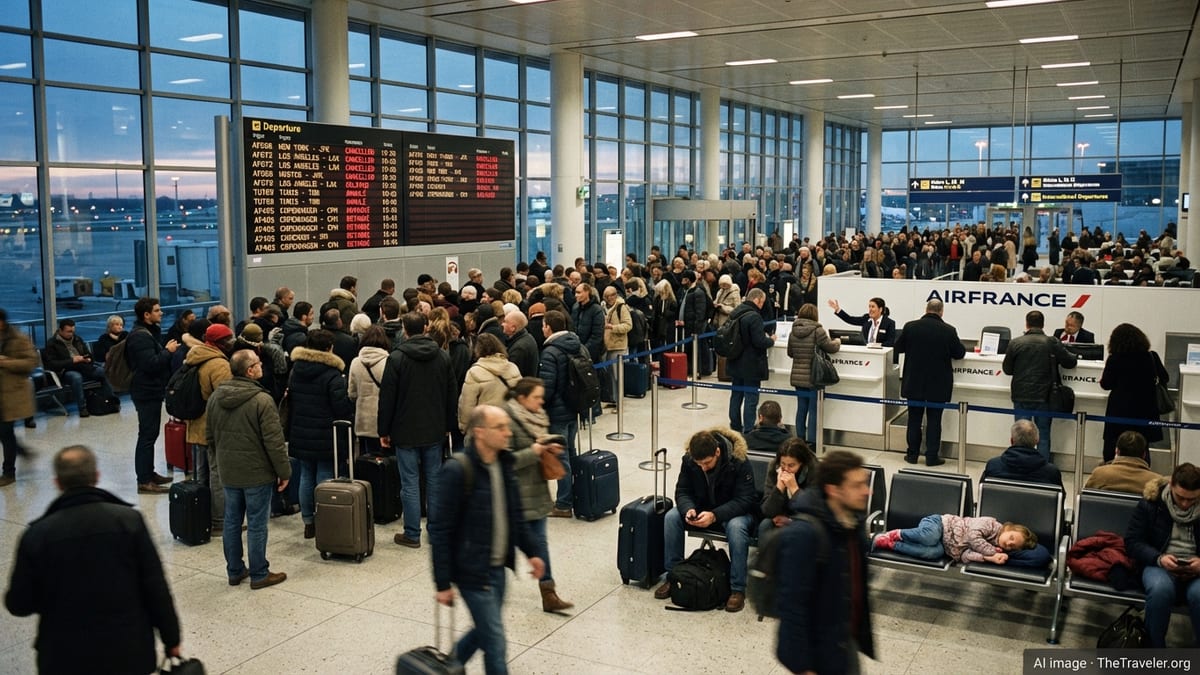
Travelers heading to Kuwait City faced even fewer options. With Kuwait Airways still operating a curtailed schedule and many other carriers avoiding certain Gulf routings, passengers whose flights were removed from the departure board encountered long rebooking queues and extended layovers in Paris. Accounts shared on travel forums described crowded transfer halls, stretched customer service desks and difficulty securing updated itineraries during peak hours.
For passengers booked to Tel Aviv, the situation was similarly complex. Even where EL AL and selected European carriers have resumed operations under special frameworks, connections via Paris remain vulnerable to cascading delays and last minute operational decisions. This means a single canceled outbound flight can strand travelers for 24 hours or more if spare seats on remaining services are scarce.
The cancellations also affected travelers whose journeys did not originally involve the Middle East. With aircraft and crew tied up in reshuffled patterns, short haul European routes such as Paris to Milan are seeing occasional cuts as airlines attempt to protect long haul operations and comply with emerging safety guidance on overflight routes.
Regional Crisis Keeps Schedules Volatile
The immediate disruptions at Paris Charles de Gaulle are part of a wider pattern that has unfolded since late February, when the latest Middle East crisis triggered a series of airspace closures and airport shutdowns. Industry analyses describe thousands of cancellations worldwide and a sustained rerouting of traffic to avoid affected regions, placing additional pressure on European hubs.
Studies of the current disruption note that carriers have been forced to fly longer, more circuitous routes around key conflict zones, increasing flight times and fuel burn. These operational demands have translated into tighter aircraft rotations, less slack in daily schedules and an elevated risk of delays and cancellations when weather, technical issues or crew availability intervene.
European groups such as Air France KLM have responded by extending suspensions on several Middle East routes and by adjusting capacity on certain European city pairs. Travel trade reporting highlights that suspensions to Tel Aviv and other cities have been prolonged into May and, in some cases, until further notice, underscoring the uncertainty facing travelers planning trips for the coming weeks.
Gulf and Levant carriers are taking a gradually more optimistic stance, incrementally restoring services as conditions permit. However, most have signaled that full pre crisis schedules are unlikely to return in the near term. As a result, connections that once relied on dense daily frequencies now depend on thinner patterns, where the cancellation of a single flight can strand large numbers of passengers.
Knock-on Impacts for Travelers at Paris Charles de Gaulle
At Paris Charles de Gaulle itself, the operational picture on April 29 reflected this fragile equilibrium. Network level data from European air traffic management sources describe overall traffic volumes as broadly stable compared with recent weeks, but with delays and punctuality increasingly influenced by the Middle East situation. Discussions between airport and network managers are reported to be ongoing to manage capacity and mitigate disruptions.
For individual passengers on the ground, the experience is more immediate. Social media posts and forum discussions from travelers transiting through Paris in recent days describe long waits at customer service counters, difficulties accessing timely rebooking information and confusion over compensation or voucher policies when cancellations occur close to departure time.
Travel tips circulating among frequent flyers emphasize the importance of monitoring airline apps closely, building longer connection times into itineraries involving Paris and other major hubs, and considering backup routings where possible. Some travelers report success in proactively rerouting via alternative European airports when signs of disruption appear, while others have faced overnight stays when hotels near the airport quickly reach capacity.
The disruption is also affecting baggage handling and missed connections. When an outbound leg from Paris is canceled, checked luggage often has to be retrieved and reprocessed, adding to stress for travelers and workload for ground staff already coping with high passenger volumes.
What Travelers Can Expect in the Coming Days
Looking beyond the immediate wave of cancellations on April 29, publicly available forecasts and airline travel alerts suggest that schedule instability is likely to persist into May. Carriers are continuing to publish rolling updates for routes linked to Tel Aviv, Beirut, Riyadh, Kuwait City and other affected destinations, often with only limited visibility beyond a two to three week horizon.
Industry observers note that airlines are gradually adding back capacity where airspace and security conditions permit, but caution that the recovery is uneven and subject to rapid change. Travelers planning to connect through Paris, particularly on itineraries touching the Middle East, are being advised by travel agents and online booking platforms to check schedules regularly and to be prepared for last minute adjustments.
In the short term, passengers caught up in cancellations at Paris Charles de Gaulle can typically expect rebooking on the next available service, although seat availability may be constrained on popular routes such as Milan. For longer haul journeys involving Kuwait City or Tel Aviv, re-accommodation may involve complex multi stop routings or extended waiting times as airlines juggle limited capacity.
With global aviation networks still adapting to the latest phase of the Middle East crisis, Paris Charles de Gaulle is likely to remain a focal point for both disruption and recovery efforts. For now, travelers making their way through the French hub are navigating a landscape of shifting schedules, partial route suspensions and lingering uncertainty that can turn a routine connection into an unplanned extended stay.