


More news on this day
Thousands of travelers across Asia faced hours-long queues and missed connections today as major hubs from Shanghai to Jakarta and Manila reported 56 flight cancellations and 511 delays, snarling regional and long haul networks.
Get the latest news straight to your inbox!
Chinese Mega Hubs Lead Regional Wave of Disruptions
Publicly available aviation data for the day indicates that Chinese airports once again shouldered the heaviest operational strain, with Shanghai Pudong International Airport among the most affected. Reports indicate that Pudong alone logged dozens of cancellations and well over two hundred delayed departures and arrivals, reflecting both the scale of the airport’s traffic and the fragility of current scheduling buffers.
Additional disruption was recorded at Shanghai Hongqiao, Beijing Capital and Daxing, Guangzhou Baiyun, Shenzhen Bao’an and Chengdu’s twin airports, building on a pattern of elevated congestion seen across the country’s network in recent weeks. Industry trackers show that, taken together, China’s primary hubs accounted for the majority of today’s 56 cancellations and a significant share of the 511 delayed flights across Asia.
Operational analysts point to a combination of tight turnaround times, crowded airspace and knock on effects from earlier delays as key factors. According to published coverage, regulators in China have already acknowledged the pressure on infrastructure at the busiest airports and signaled a review of runway and slot management practices, but structural changes will take time to filter through to day to day performance.
The latest bout of disruption comes just as Shanghai Pudong marks a milestone of more than 10 million international passenger movements so far in 2026, underscoring how even minor schedule shocks can cascade rapidly through a system operating near capacity.
Jakarta and Manila Struggle With Knock On Delays
Beyond China, Indonesia’s Jakarta Soekarno Hatta International Airport and Manila’s primary international gateway in the Philippines also reported sizable disruption, with a mix of cancellations and rolling delays spreading across regional and long haul services. Tracking platforms show that departures to and from China, Japan and key Southeast Asian destinations were particularly exposed.
Recent terminal reshuffles and infrastructure upgrades at Manila’s airport were designed to ease congestion, yet today’s figures suggest that the facility remains vulnerable when upstream hubs in East Asia experience schedule shocks. Reports indicate that carriers operating dense shuttle routes between Manila, Shanghai, Taipei, Hong Kong and Tokyo faced tight aircraft rotations, making it harder to recover punctuality once delays accumulated through the day.
Jakarta’s main hub has experienced similar strains. Publicly available data in recent weeks has highlighted persistent congestion, with aircraft frequently waiting for gates or takeoff slots during peak hours. When long haul and regional flights arrive out of sequence, local ground handling and immigration resources are quickly stretched, compounding delays for connecting passengers bound for secondary Indonesian cities or onward to Australia and the Middle East.
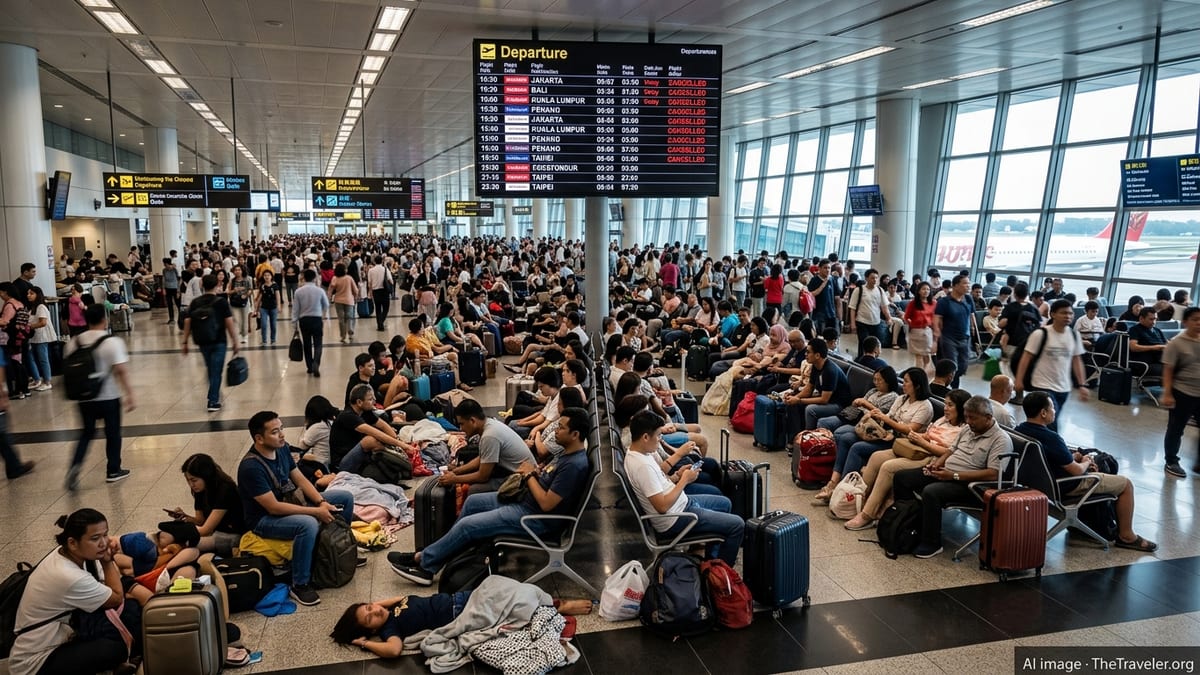
For many travelers in both Jakarta and Manila, today’s disruption translated into missed domestic connections, extended waits in packed departure halls and last minute hotel stays while airlines worked to rebook itineraries on already busy services.
Japan and Wider Northeast Asia Feel the Ripple Effect
In Japan, flight status boards at major airports reflected the regional turbulence, with delay counts rising on routes linking Tokyo and other Japanese cities to Chinese and Southeast Asian hubs. According to regional media digests, services to and from Shanghai, Hong Kong, Taipei and Manila accounted for a large share of the impacted Japan traffic.
Airlines across Northeast Asia have already been navigating a challenging environment this spring, balancing strong demand with higher operating costs and lingering airspace restrictions tied to geopolitical tensions further west. Disruptions originating at Chinese and Southeast Asian hubs today amplified those pressures, especially for carriers that rely on tight ground times to maintain dense schedules on popular business and leisure routes.
South Korea, Taiwan and Hong Kong each reported scattered cancellations and clusters of delays on Asia regional sectors, extending the impact of the 56 total cancellations and 511 delays far beyond the airports most immediately affected. Industry reports describe a fragmented pattern of irregular operations, with some city pairs operating close to normal while adjacent routes endured prolonged disruptions.
For travelers attempting multi segment journeys that stitched together hubs in China, Japan and Southeast Asia, even modest delays at the first point of departure were often enough to break legal connection times later in the itinerary, triggering involuntary reroutings and overnight stays.
Multiple Airlines Adjust Schedules Amid Fuel and Airspace Pressures
Today’s operational problems come against a backdrop of broader schedule adjustments by Asian and Middle Eastern airlines responding to higher fuel prices and shifting airspace availability. Over recent weeks, several carriers in the region have thinned frequencies to parts of the Middle East and South Asia, or rerouted flights to avoid conflict affected regions, adding extra flight time and complexity to crew and fleet planning.
Budget airlines in particular have been trimming or suspending some routes from hubs such as Manila, Kuala Lumpur and Jakarta to destinations including Shanghai, Taipei, Japan and northern Australia. According to recent industry coverage, these cuts are intended to preserve reliability on core routes but can also leave fewer options for rebooking when irregular operations occur suddenly, as they did today.
Legacy carriers based in China, Japan and Southeast Asia have responded with a mix of equipment upgauges on trunk routes and ad hoc schedule tweaks on quieter days, attempting to clear backlogs of disrupted passengers. However, when disruptions hit multiple hubs simultaneously, the available spare capacity is quickly absorbed, extending the recovery window beyond a single operating day.
The combination of constrained capacity, higher operating costs and episodic airspace restrictions has created an environment in which seemingly modest daily disruption metrics such as 56 cancellations and 511 delays can still translate into thousands of stranded travelers and prolonged inconvenience.
What Travelers Are Experiencing on the Ground
Across affected airports today, travelers encountered long check in and security lines, crowded gate areas and frequent last minute gate changes as airlines shuffled aircraft and crews. With many flights held on the ground waiting for connecting passengers or delayed inbound aircraft, departure boards cycled through rolling estimated times rather than clear schedule restarts.
Passenger accounts shared on social media and travel forums describe families sleeping in terminal seating, business travelers reworking itineraries around missed meetings and tour groups attempting to re coordinate ground transport at short notice. In some hubs, airport operators activated overflow queuing areas to manage crowds around passport control and baggage reclaim.
Consumer advocates note that the patchwork of passenger rights across Asia can leave travelers with varying levels of protection depending on the airline and route involved. While some carriers have proactively offered meal vouchers, hotel accommodation and free rebooking on the next available service, others have relied heavily on digital self service tools, asking passengers to manage their own changes through apps and websites while airport staff focused on immediate operational tasks.
As airlines and airports across the region work to stabilize schedules, industry observers suggest that travelers planning itineraries through Shanghai, Jakarta, Manila and other key Asian hubs in the coming days should allow extra connection time, monitor flight status closely and be prepared for further short notice adjustments if upstream disruptions ripple through the network again.