


More news on this day
Passengers at Bahrain International Airport are facing long waits, missed connections and overnight stays as a new wave of delays and cancellations disrupts flights across key routes linking the Gulf with India, Saudi Arabia, the United Arab Emirates, Kuwait, Egypt, Turkey and Europe.
Get the latest news straight to your inbox!
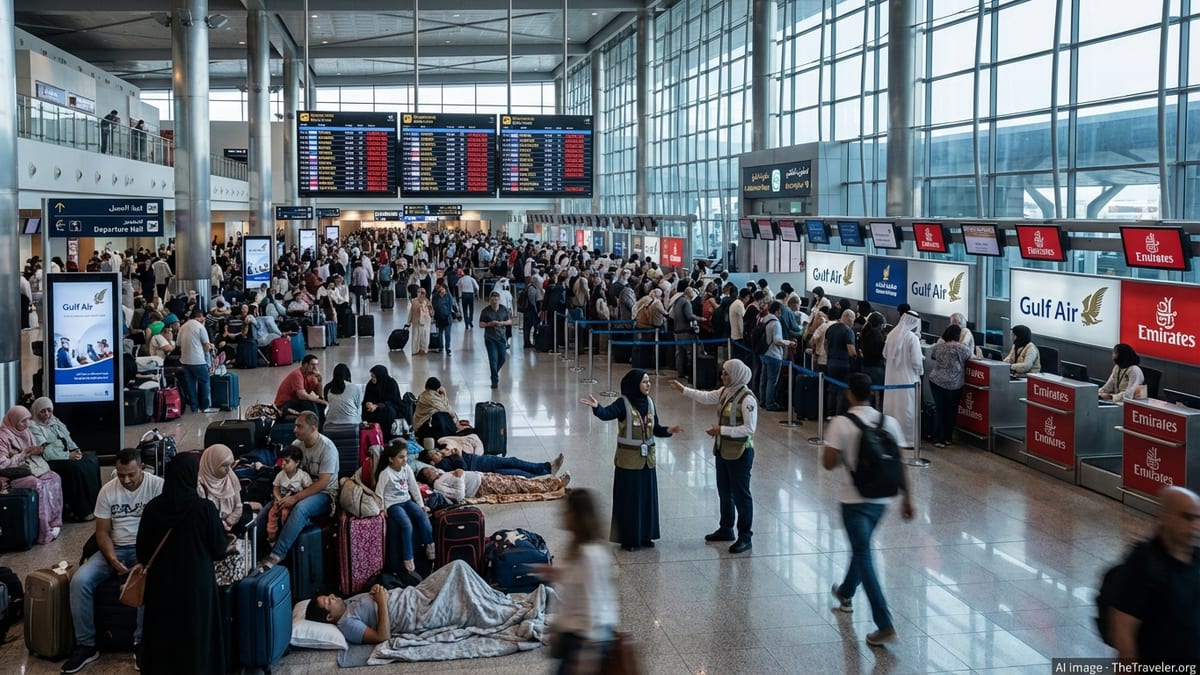
Fresh disruption hits Bahrain hub with 39 delays and 6 cancellations
Operational data from aviation trackers on Friday indicates that Bahrain International Airport is once again grappling with a concentrated burst of irregular operations, with about 39 flights delayed and at least 6 outright cancellations recorded within a relatively short operating window. The affected services include both arrivals and departures, many of them operated by regional and international carriers using Bahrain as a key transfer point.
The latest figures come on top of months of instability in Gulf airspace, where temporary closures, reroutings and capacity limits have repeatedly disrupted passenger and cargo movements. For travelers on the ground in Bahrain, the statistics translate into long queues at service desks, uncertainty over rebooking options and concerns about expiring visas and accommodation costs.
Several online flight-status boards on Friday showed disrupted services to and from major Gulf hubs, including Dubai and Abu Dhabi, as well as regional connections to Riyadh, Jeddah, Dammam and Kuwait City. At the same time, cancellations and rolling delays on services to Istanbul, Cairo, Delhi and other South Asian and European gateways underlined how a single Gulf hub’s difficulties can quickly ripple across multiple continents.
Passenger accounts posted on social platforms over recent months describe travelers remaining in the terminal for many hours or being bussed to alternative airports when Bahrain’s airspace or runway capacity has been curtailed. The current wave of delays and cancellations appears to be less severe than earlier full closures but is still leaving many passengers without clear onward options.
Knock-on effects for Saudi, Indian, UAE and Kuwait routes
The brunt of the latest disruption is being felt on the short- and medium-haul routes that tie Bahrain to neighboring Saudi Arabia, the United Arab Emirates and Kuwait, as well as to high-demand destinations in India. Publicly available flight boards on Friday showed late or canceled services involving cities such as Riyadh, Jeddah, Dammam, Dubai, Abu Dhabi and Kuwait City, along with several Indian destinations like Kochi, Bengaluru, Mumbai and Thiruvananthapuram.
These routes form some of the densest corridors in the region, serving migrant workers, business travelers and families connecting onward to long-haul flights. When frequencies are reduced or disrupted, passenger volumes quickly back up in transit lounges and check-in areas. Many travelers moving between India and Europe or North America rely on smooth Gulf connections, meaning that a missed leg in Bahrain can unravel an entire multi-stop itinerary.
Travel advisories published this week by regional media and airlines continue to urge passengers flying between the Gulf and India or Saudi Arabia to check flight status frequently, arrive early at the airport and be prepared for schedule changes at short notice. In some cases, carriers have proactively trimmed capacity on selected departures or merged flights to consolidate demand onto fewer services, which can further complicate rebooking for those whose flights are already disrupted.
Compounding the impact, full flights on alternative routes through Doha, Riyadh or Dubai limit the options available to passengers stranded in Bahrain. In recent incidents, some travelers have reported needing to purchase entirely new tickets on different airlines or routing via more distant hubs in order to reach their final destination within a reasonable timeframe.
Egypt, Turkey and European links face cascading delays
The turbulence at Bahrain International Airport is also affecting services to Egypt, Turkey and Europe, where many flights use Gulf hubs as intermediate stops. Schedule boards on Friday showed selective cancellations for Istanbul services and delays on flights involving Cairo and other regional gateways, which in turn disrupt onward links to European cities.
Airlines operating these routes have already been dealing with a more complex operating environment this year, as carriers factor in evolving airspace restrictions and demand shifts triggered by broader geopolitical tensions. Longer routings, higher fuel consumption and tighter crew scheduling margins leave less flexibility when a key hub like Bahrain experiences even short-lived disruptions.
Flight-compensation and analytics platforms tracking the wider Gulf region have reported several recent windows in which more than a hundred flights across Bahrain and neighboring hubs were either delayed or canceled within a few hours. While today’s tally at Bahrain alone is lower than some of those earlier spikes, the interconnected nature of long-haul networks means that even a modest cluster of cancellations can trigger missed connections for passengers scheduled to continue to European destinations.
Travelers on itineraries connecting through Istanbul, Frankfurt, London or other major European hubs are therefore being urged by airlines and travel agents to monitor their booking status closely, especially if their first leg touches Bahrain or another Gulf airport that has experienced recent volatility.
Operational strains and a fragile regional recovery
The current situation at Bahrain International Airport highlights how fragile the regional aviation recovery remains after months of turbulence. Reports from industry consultancies and logistics providers over the past quarter have described a pattern of intermittent closures and restrictions across several Middle Eastern airspaces, leading to longer routes, schedule reshuffles and periodic suspensions on selected city pairs.
Bahrain’s role as both a point-to-point destination and a transfer hub amplifies the impact of disruptions there. When the airport previously experienced extended suspensions, some airlines temporarily shifted traffic through Saudi Arabian airports such as Dammam and Riyadh or via Doha and Dubai, but capacity and regulatory constraints limit how quickly those workarounds can absorb additional demand. Even after full closures end, reinstating previous frequencies and connection banks can take weeks.
Airline notices reviewed in recent days show carriers continuing to juggle schedules across Saudi Arabia, the United Arab Emirates, Kuwait and Bahrain, sometimes adding capacity on resilient routes while holding back on others where operational risks are higher. Services to Egypt, Turkey and Europe remain particularly exposed to changes in overflight permissions and crew duty limits, which can force last-minute adjustments.
Analysts tracking Gulf aviation trends say the industry is likely to see more short, sharp episodes of disruption as operators respond to evolving security assessments and air-traffic constraints. For passengers, that means the kind of disruption visible today at Bahrain International Airport may recur, even if full-scale shutdowns become less frequent.
What stranded travelers can do now
For travelers currently isolated in Bahrain International Airport by delays and cancellations, available guidance from regulators, passenger-rights groups and airline policy documents converges on a few practical steps. Passengers are generally advised to stay in contact with their airline’s official channels, monitor flight-status tools, and retain all documentation such as boarding passes, receipts for food and accommodation, and written notices of disruption.
Depending on the airline, route and jurisdiction, travelers affected by severe delays or cancellations may be entitled to assistance such as meals, hotel stays or rebooking at no additional cost. On some itineraries beginning or ending in regions with stronger passenger-protection rules, cash compensation may be available if the disruption is not classified as caused by extraordinary circumstances. Specialist websites and consumer organizations provide tools that help passengers assess potential claims once they have safely reached their destination.
With seats on alternative departures out of Bahrain selling quickly when disruption hits, passengers who can be flexible on routing and timing are sometimes able to secure earlier options via other Gulf hubs or through major European or Asian gateways. However, during peak periods, many travelers find that the most realistic strategy is to accept rebooking several days later, particularly on popular routes to India, Saudi Arabia and Europe.
As airlines continue to manage a challenging operating backdrop, all indications from public schedules and recent travel advisories suggest that passengers planning to transit Bahrain, or to travel between the Gulf, India, Egypt, Turkey and Europe, should be prepared for conditions to remain unpredictable in the days ahead.