

More news on this day
Travelers across Colombia faced mounting disruption on Thursday as a cluster of delays and cancellations involving Avianca, LATAM Colombia and SATENA cascaded through Bogota’s El Dorado International Airport and onward to Medellín and Cartagena, snarling one of South America’s busiest domestic networks.
Get the latest news straight to your inbox!
Ripple Effects Across Colombia’s Busiest Routes
Publicly available operational data and local media coverage indicate that at least 36 departures and arrivals linked to Avianca, LATAM Colombia and SATENA were delayed, with a further nine flights cancelled across Bogota, Medellín and Cartagena. The disruption centered on Bogota’s El Dorado International Airport, the main hub for Avianca and a key base for LATAM Colombia and SATENA, before spreading to major coastal and regional routes.
The pattern of delays hit core domestic links such as Bogota to Medellín and Bogota to Cartagena, which are among the most heavily trafficked corridors in the country. Tracking sites show a mixture of late departures and extended arrival delays on these routes, with knock-on effects that reduced connectivity for travelers relying on onward domestic and international connections.
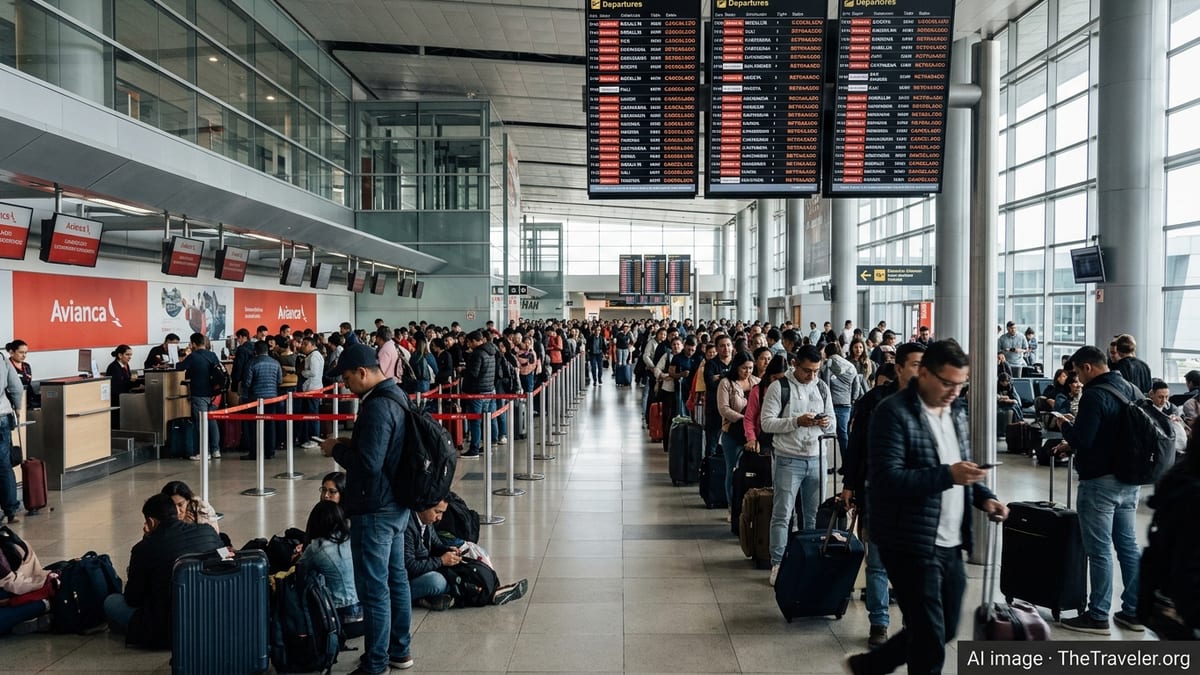
Although most affected services eventually operated, the combination of rolling delays and select cancellations created long queues at check-in desks and boarding gates, and crowded customer service points across the three main airports. Social media posts from passengers also pointed to gate changes and last-minute schedule updates that added to confusion during peak travel periods.
El Dorado’s Central Role Amplifies Disruption
El Dorado International serves as the primary hub for Avianca and an important node for LATAM Colombia and SATENA, making operations in Bogota highly sensitive to irregularities. When flights in and out of El Dorado run behind schedule, the impact can quickly spread across Colombia’s domestic grid, especially on routes linking the capital with Medellín’s José María Córdova Airport and Cartagena’s Rafael Núñez Airport.
Industry data consistently show Bogota at the heart of Colombian aviation, with Avianca basing its global headquarters and largest operations at El Dorado and LATAM Colombia and SATENA maintaining significant activity there as well. This concentration allows airlines to offer dense schedules and competitive frequencies but also means that localized issues in Bogota can rapidly translate into nationwide travel disruption.
On the day of the latest operational turbulence, a number of flights using Bogota as a connection point saw estimated departure times repeatedly revised. Travelers arriving late into El Dorado from secondary cities, or from international gateways such as Mexico and Central America, faced missed connections and rebooking challenges that extended delays by several hours in some cases.
Avianca, LATAM Colombia and SATENA Under Scrutiny
Avianca, Colombia’s largest carrier, has been working to rebuild and expand its post-pandemic and post-labor-dispute operations, with recent press coverage highlighting that the airline has restored the vast majority of its domestic capacity. At the same time, passenger forums and recent travel experiences continue to flag concerns over schedule reliability and customer service responsiveness when disruptions occur.
LATAM Colombia, part of the broader LATAM Airlines group, remains a major competitor on key domestic routes, including those linking Bogota with Medellín, Cartagena and other regional centers. Historic regulatory disputes over route and slot allocations have kept the airline’s Bogota operations under close public observation, and fresh delays at El Dorado reinforce ongoing traveler concerns about resilience on popular LATAM-operated services.
SATENA, a state-owned carrier focused on linking remote and underserved regions with major cities, has also drawn heightened attention following previous safety and operational incidents. Disruptions involving SATENA on routes to and from Bogota can have an outsized impact because many of the communities it serves have limited alternative transport options, amplifying the effect of delays and cancellations when they arise.
Recent Strain on an Already Stretched System
The latest wave of delays arrives amid a broader period of stress for Colombian aviation. In recent months, airlines operating at El Dorado have been adjusting route maps, frequencies and fleet assignments in response to shifting demand, economic pressures and changing regulatory conditions in nearby markets. These adjustments have contributed to a fragile operating environment in which minor issues can escalate into wider service disruptions.
Flight tracking histories for several routes into and out of Bogota show a pattern of extended delays on certain services, particularly those linking the capital with major regional and international gateways. On some days, affected flights have departed hours behind schedule, complicating crew rotations and aircraft availability for subsequent legs and increasing the risk of missed connections for passengers.
Travel discussion forums have captured a steady stream of complaints in recent weeks about schedule changes, tight connection windows and challenges reaching airline support channels. While these accounts are anecdotal, they align with the broader picture of a system operating with limited margin for error, in which any surge of delays at a central hub such as El Dorado can quickly lead to wider travel chaos.
What Travelers Can Expect in the Coming Days
Based on recent operational patterns, analysts expect Colombian domestic networks to gradually absorb the current disruption, but travelers connecting through Bogota, Medellín and Cartagena may continue to encounter residual delays and altered departure times in the short term. Repositioning aircraft and crews after a day of widespread irregular operations can take several cycles, particularly on high-frequency domestic routes.
For passengers planning imminent trips with Avianca, LATAM Colombia or SATENA, publicly accessible tracking tools and airline communication channels remain essential resources for monitoring last-minute schedule changes. Given the recent bout of travel chaos, itinerary flexibility, longer layover windows and contingency planning for missed connections are likely to be especially important for those relying on El Dorado as a transfer hub.
Colombia’s role as a growing regional aviation center means that operational reliability at Bogota, Medellín and Cartagena will remain under close watch by travelers and industry observers. The latest cluster of 36 delays and nine cancellations underscores how quickly disruption at a single hub can ripple across networks and reshape travel plans for thousands of passengers in a single day.