

More news on this day
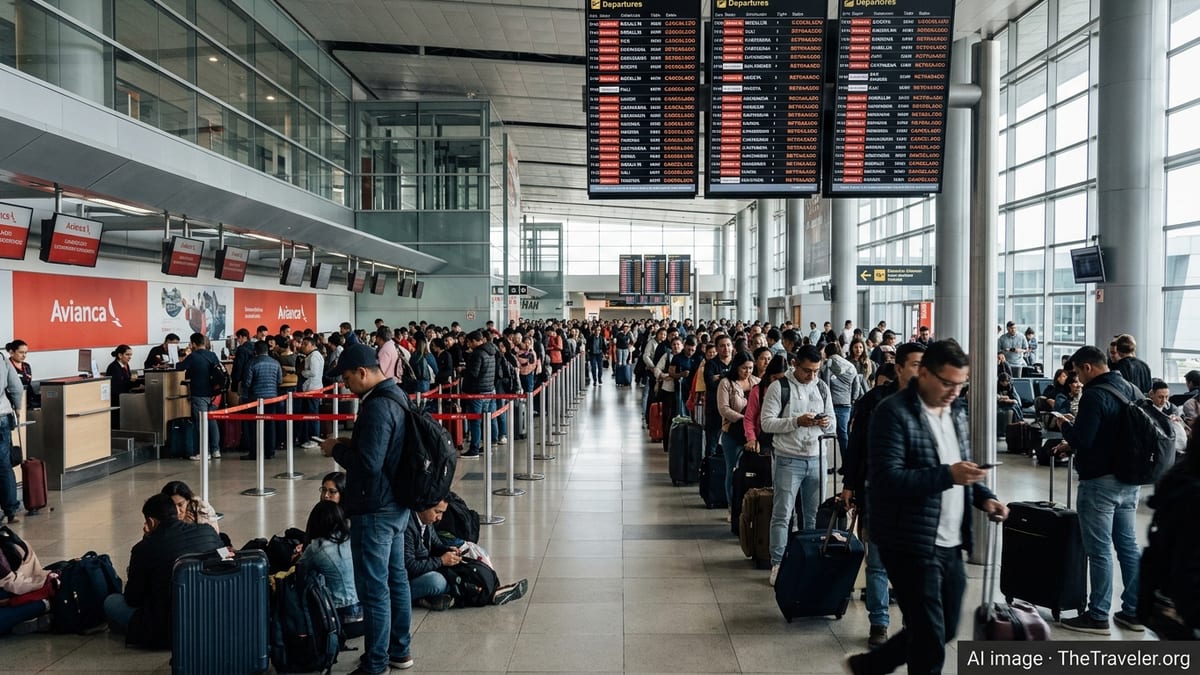
Travelers passing through Bogotá’s El Dorado International Airport on May 22 are facing widespread disruption, as more than 70 flight delays and at least two cancellations ripple across domestic and international routes operated by LATAM Colombia, Avianca, Delta Air Lines, American Airlines, Clic Air and other carriers.
Get the latest news straight to your inbox!
Operational Strain at Colombia’s Busiest Hub
Publicly available tracking data for May 22 shows an unusual build-up of late departures and arrivals at El Dorado International Airport, with around 72 delayed flights and two outright cancellations affecting the morning and early afternoon schedule. The disruptions are concentrated on high-frequency domestic routes linking Bogotá with Medellín and Cali, but several international services are also reporting off-schedule operations.
The pattern is most visible among the airlines that maintain significant operations at the Bogotá hub, including LATAM Colombia, Avianca and regional carrier Clic Air. Major international partners such as Delta Air Lines and American Airlines, which connect El Dorado with hubs in the United States, are also seeing knock-on delays as crowded departure and arrival banks compress already tight turnaround times.
While the precise trigger for the day’s operational strain remains unclear, data from flight-monitoring portals highlights clusters of late departures in narrow time bands, a sign that congestion in airspace or on the ground is compounding routine schedule variability. Current punctuality figures indicate that the number of late-running services at El Dorado on May 22 is well above the typical daily baseline for the airport at this time of year.
The disruption comes at a time when Colombian aviation has been steadily rebuilding traffic, and El Dorado has retained its role as the principal gateway for both domestic and international travel. With heavy use by Colombia’s main carriers and a growing roster of foreign airlines, even limited disruptions at the Bogotá hub can quickly propagate through the wider network.
Ripple Effects Across Bogotá, Medellín and Cali
The impact of the El Dorado delays is most acutely felt on the country’s trunk routes between Bogotá and the key regional centers of Medellín and Cali. These sectors are among the busiest in Colombia, with multiple daily frequencies operated by Avianca, LATAM Colombia, Clic Air and other carriers. On May 22, monitoring services show a series of late departures out of Bogotá and corresponding schedule pressure at arrival airports serving these cities.
At Medellín’s José María Córdova International Airport and Olaya Herrera Airport, departure boards for Bogotá-bound flights reflect accumulating delays that appear linked to late inbound aircraft. Available data points to rolling knock-on effects, where even modest initial delays of 20 to 40 minutes out of El Dorado create longer waits for passengers later in the day as turnaround buffers are consumed.
In Cali, flight information for services to and from Bogotá also indicates a pattern of slippages. Aircraft coming from the capital are arriving behind schedule, and some outbound flights are subsequently pushed back as ground handlers, crews and airport facilities work to re-sequence operations. Reports from public dashboards suggest that a number of intra-Colombian connections through Bogotá, including itineraries linking Cali and Medellín via the capital, are experiencing missed or at-risk connections.
Additional Colombian destinations, including mid-sized and regional cities served from Bogotá by Clic Air and other domestic carriers, are likewise recording irregular operations. These routes typically rely on tight rotations and smaller aircraft fleets, making them especially sensitive to any disruption radiating from El Dorado.
Major Carriers Confront Network-Level Challenges
For LATAM Colombia and Avianca, which both maintain extensive domestic networks from El Dorado, the current wave of delays underscores the vulnerability of hub-and-spoke systems to congestion at the main node. Their Bogotá schedules are designed around coordinated arrival and departure banks to facilitate connections between Colombian cities and onward international flights. When one or more of these banks is disrupted, aircraft, crew and passengers are quickly out of position.
Regional operator Clic Air, which uses El Dorado as a principal base for connecting smaller Colombian cities, is also exposed to such conditions. With fewer spare aircraft and limited ability to reassign crews, any extended delay early in the day can have repercussions across multiple rotations, particularly on routes that lack alternative carriers or frequencies.
Internationally, Delta Air Lines and American Airlines depend on relatively narrow connection windows in Bogotá to feed North American and regional traffic. On May 22, publicly accessible flight tracking suggests that some of these long-haul and medium-haul services are departing behind schedule, in part to accommodate passengers and luggage arriving late from disrupted domestic feeders.
Aviation analysts have long noted that even well-rated hubs such as El Dorado can experience days where small operational issues coincide with adverse weather patterns, high traffic peaks or air traffic flow restrictions. These factors can combine to produce exactly the sort of system-wide delay picture visible today, with multiple carriers affected regardless of individual airline performance on any given route.
Passenger Experience and Consumer Protections
For travelers, the immediate effect of May 22’s disruptions is measured in longer waits at gates, missed connections and the need to rebook itineraries across several Colombian cities. Some passengers using Bogotá as a transfer point between regional airports such as Cali and Medellín, or between domestic and international flights operated by Delta and American, are likely to face itinerary changes and potential overnight stays.
Colombian consumer-protection rules set out obligations for airlines in the event of significant delays or cancellations, including assistance such as refreshments, communications and, in certain circumstances, accommodation. Regulatory documents and guidance published by the country’s transport oversight bodies emphasize that airlines must clearly inform passengers of the status of their flights, the reasons for disruption where known, and the options available for re-routing or refunds.
Travelers experiencing disruption at El Dorado, Medellín or Cali are being encouraged by consumer advocacy materials to monitor official airport and airline information channels closely, keep boarding passes and receipts, and document delays and any additional expenses. Such records can be important when filing claims or seeking reimbursements from carriers after the fact.
Given the scale of delays recorded today, experts in air-travel planning generally advise allowing generous connection times when routing through Bogotá, particularly during peak travel seasons and busy weekend or holiday periods. The events of May 22 may reinforce that recommendation for both domestic and international passengers relying on Colombia’s main aviation hub.
What Travelers Should Expect in the Coming Hours
Based on historical patterns observed in Colombian air travel and similar congestion events at El Dorado, conditions are likely to remain irregular through the remainder of the day before gradually stabilizing. Once the main wave of delays has passed, airlines typically work through a combination of schedule adjustments, aircraft swaps and crew reassignments to restore normal operations.
However, some late-evening flights may still depart behind schedule as carriers attempt to complete planned rotations and position aircraft at the correct airports for the following morning. This is particularly relevant on dense routes such as Bogotá to Medellín and Bogotá to Cali, where aircraft often operate multiple sectors in quick succession.
Travel planning resources recommend that passengers with flights scheduled for later on May 22, or early on May 23, continue to check their flight status repeatedly, rather than relying solely on the original itinerary details. At times of elevated disruption, departure and arrival times can change more than once as airlines adjust to evolving conditions on the ground and in the air.
For travelers heading to or from Bogotá in the days ahead, the situation at El Dorado on May 22 serves as a reminder of the importance of flexible itineraries, travel insurance that covers delays and cancellations, and contingency planning for tight connections involving multiple airlines. While Colombia’s main hub generally maintains solid on-time performance, episodes such as today’s illustrate how quickly network-wide disruption can develop when several variables align.