


More news on this day
Flight operations at São Paulo–Congonhas Airport faced significant disruption in early June 2026, with around 150 delayed departures and arrivals and at least six cancellations affecting major Brazilian carriers LATAM, Gol and Azul.
Get the latest news straight to your inbox!
Technical issue in São Paulo airspace triggers cascading delays
Reports from Brazilian aviation and general news outlets indicate that a technical problem in the air traffic management system serving the São Paulo terminal area led to a temporary interruption of operations on a June morning. The pause in movements at Congonhas lasted only a short period, but the high density of traffic at one of Brazil’s busiest domestic hubs meant that the knock-on effects stretched across the day.
Publicly available information from the Brazilian Air Force, which oversees airspace control, describes the event as an operational or technical issue occurring within a defined time window. While the system was restored relatively quickly, the interruption forced controllers to hold, divert or reschedule a large number of flights that were due to land at or depart from Congonhas and nearby airports such as Guarulhos and Viracopos.
Data compiled from flight status platforms and media coverage suggests that Congonhas alone saw around 150 flights operating outside their planned schedules that day, with delays ranging from minor schedule slips to holds exceeding two hours. At least six services connected to the airport were ultimately canceled instead of re-timed, as airlines worked to reset their operations once the airspace constraint was lifted.
The incident followed a similar disruption in April, when a separate issue affecting the regional air traffic control center also halted movements at São Paulo’s main airports for part of a day. Together, the episodes have renewed scrutiny of the resilience of Brazil’s air traffic management infrastructure in its most heavily used air corridor.
LATAM, Gol and Azul forced to reorganize domestic networks
The disruption had immediate operational consequences for Brazil’s three largest carriers, LATAM, Gol and Azul, all of which maintain dense schedules at Congonhas connecting São Paulo to key business and leisure destinations around the country. Flight tracking data for the affected day shows late departures and arrivals across multiple trunk routes, including services to Brasília, Rio de Janeiro, Belo Horizonte, Porto Alegre, Recife and other major markets.
According to published coverage and airline advisories, carriers responded by implementing standard irregular operations procedures, including delaying departures to accommodate aircraft and crew positioning, consolidating lightly booked flights onto single services and canceling rotations where the delay would have pushed operations beyond Congonhas’s strict operating hours. In several cases, passengers were reprotected on later flights from Congonhas or rerouted via São Paulo–Guarulhos, which retained more flexibility during the recovery period.
Gol, which uses Congonhas as a core hub for its point to point domestic network, saw a significant portion of its early and mid morning wave disrupted, with some rotations to cities in the Southeast and Center West experiencing extended ground time in São Paulo. Azul, which maintains a smaller but growing presence at Congonhas, also reported irregular operations on links to destinations such as Belo Horizonte, Curitiba and coastal cities.
LATAM, for its part, had to adjust operations both at Congonhas and at Guarulhos, where connections to its longer haul network were at risk of missed connections due to late arriving domestic feeders. The carrier used its combined São Paulo footprint to move affected customers where possible, but many travelers still faced multi hour delays or overnight stays.
Passenger experience marked by long waits and rebookings
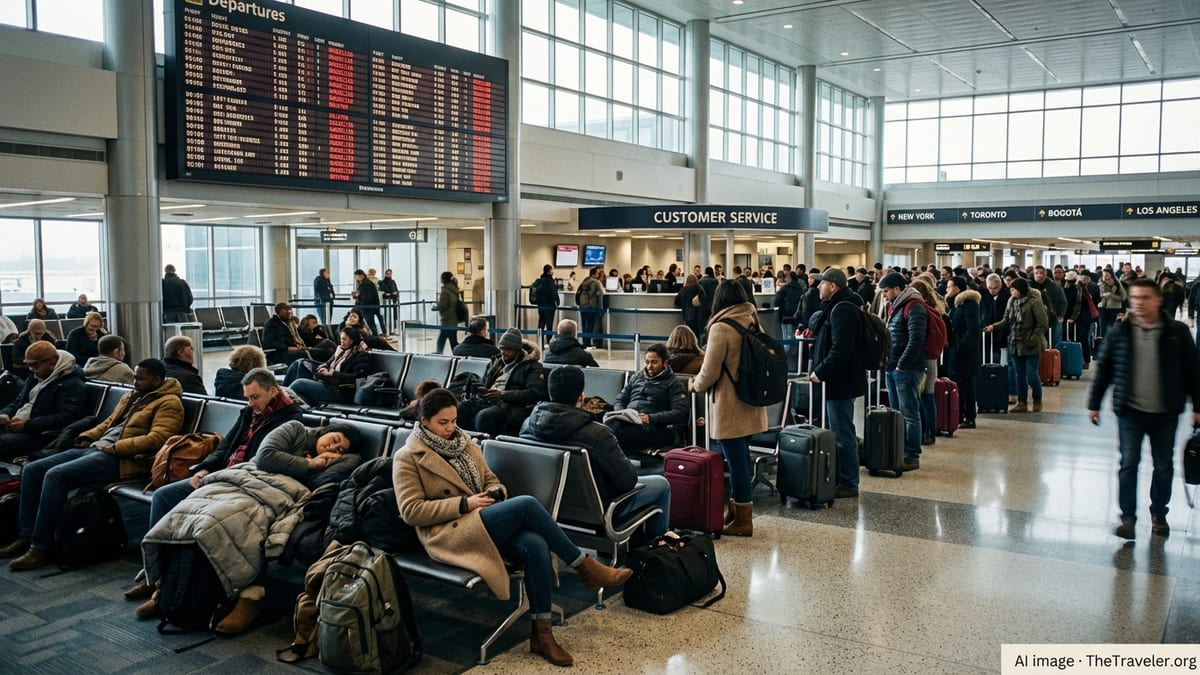
Images and descriptions circulating on social media and in local press coverage showed crowded departure halls at Congonhas as passengers waited for updated departure times and rebooking options. Many travelers reported spending several hours in the terminal after check in, with boarding times repeatedly revised as airlines awaited new slots in the congested post interruption schedule.
Public guidance from airport operator Aena and from Brazilian consumer agencies emphasized that passengers affected by cancellations or significant delays are entitled under national aviation rules to options such as rebooking, refund or alternative transportation. Airlines also provided food vouchers, accommodation or ground transport in cases where delays extended late into the day or forced travelers to remain overnight in São Paulo.
While weather was not the primary driver of the June disruption, the incident occurred against a broader backdrop of operational challenges that often include seasonal storms and low visibility in the São Paulo region. Travelers caught up in the latest delays described the experience as particularly frustrating because conditions on the ground appeared normal, even as technical constraints in the airspace system restricted movements.
The episode highlighted once more the sensitivity of Congonhas to any interruption, given its slot constrained environment and short runway configuration. With movements tightly scheduled from early morning to late evening, the loss of even a brief operational window can leave little room to recover punctuality before the end of the operating day.
Renewed debate on infrastructure resilience and contingency planning
The June disruption has fed into a growing debate in Brazil about how to bolster the resilience of critical aviation infrastructure around São Paulo. Analysts cited in domestic aviation coverage argue that the combination of high demand, limited runway capacity and dependence on a central control system leaves the region vulnerable to cascading delays when technical issues occur.
Discussion has focused on the need for robust backup systems at air traffic management facilities, clear redundancy in communications and data feeds, and more transparent reporting on the root causes of each incident. Aviation observers also point to the importance of simulation and contingency exercises that prepare airports, airlines and regulators to respond quickly when unexpected outages affect the flow of traffic.
Some commentators have called for a review of slot allocation policies at Congonhas to determine whether the current intensity of operations leaves adequate buffer for irregular events. Others underline that, despite the disruptions, the safety focused decision to stop operations when systems are degraded remains essential, and that improvements should aim at shortening the duration and impact of any necessary pauses rather than pushing more traffic through compromised systems.
For airlines, the incident is likely to prompt further investment in operational control centers, data tools that anticipate knock on effects across their networks and customer communication channels that can better manage expectations when disruption occurs. The events at Congonhas in April and June have underscored how quickly a localized technical problem can ripple across Brazil’s domestic air transport system.
Practical advice for travelers using São Paulo–Congonhas
Travel industry commentary following the June disruption has stressed the importance for passengers of planning extra time when connecting through São Paulo, particularly on days with historically high traffic such as Monday mornings and Friday evenings. Experts recommend avoiding very tight self planned connections between different airports in the region and allowing sufficient margin for potential delays.
Consumer organizations and travel publications also advise travelers to monitor flight status closely on the day of departure, using both airline channels and independent tracking platforms, and to ensure contact details are updated in bookings so that rebooking offers and gate changes can be communicated quickly. Passengers are encouraged to familiarize themselves with their rights under Brazilian aviation rules, including entitlements to assistance and compensation in certain situations.
For those with time sensitive commitments, booking earlier flights in the day and avoiding the last departure on a route can provide additional flexibility if disruption occurs. Travel planners further suggest considering travel insurance policies that explicitly cover missed connections and extended delays, particularly for itineraries that combine domestic segments from Congonhas with international departures from Guarulhos.
Although the June 2026 incident caused significant inconvenience, operations at Congonhas gradually returned to normal over the following hours, and airlines cleared most of the backlog within a day. Even so, the episode serves as a reminder that in one of Latin America’s busiest aviation markets, travelers and carriers alike must remain prepared for unexpected interruptions to the tightly choreographed schedules that keep São Paulo connected to the rest of Brazil.