


More news on this day
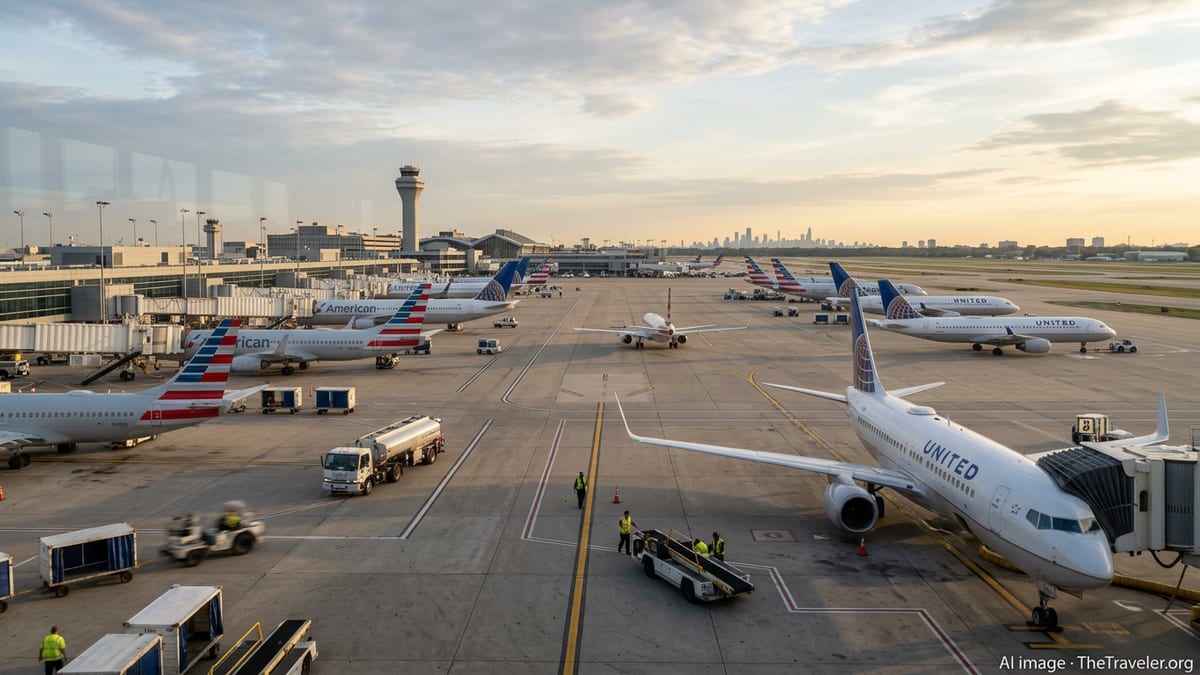
Chicago O’Hare International Airport is undergoing another shake-up in 2026, with American Airlines accelerating its expansion, United Airlines trimming flights under federal pressure, and new and returning international links from North America, Europe, South America and Asia reshaping the city’s role as a global hub.
Get the latest news straight to your inbox!
American Airlines Bets Bigger on Its Chicago Hub
Publicly available information shows that American Airlines is committing to a larger footprint at O’Hare in 2026, positioning Chicago as a centerpiece of its domestic and regional strategy. Company announcements indicate that American is adding roughly 100 additional daily departures compared with 2025, lifting its schedule toward 500 flights a day during the peak summer period. The carrier is also emphasizing more connectivity to smaller and midsize communities in the Midwest, Great Plains and Southeast, aiming to pull additional traffic into its transcontinental and international network.
Recent schedule filings and industry analysis highlight new and returning routes such as Chicago to Lincoln in Nebraska and Erie in Pennsylvania, as well as expanded frequencies to leisure markets including Florida and the U.S. West. Reports indicate that American intends to offer more than 25 additional destinations from Chicago next spring versus a year earlier, a mix of entirely new cities and seasonal routes set to begin earlier in the travel calendar. The move is framed as part of a broader campaign to solidify American’s position in one of the country’s most hotly contested hub airports.
Airport planning documents reviewed for 2025 and 2026 show that American’s build-up aligns with significant investments in gates, operational areas and customer facilities at O’Hare. The expansion is timed to capture both strong demand for domestic leisure travel and a continued rebound in corporate flying through Chicago’s dense business corridors. For travelers, the outcome is a more extensive bank of departures throughout the day, with tighter connections across the Midwest and the coasts.
United Airlines Pulls Back After Record Growth
United Airlines, long regarded as O’Hare’s largest and most globally connected tenant, is moving in the opposite direction in the short term. After touting plans earlier this year for a record operation at Chicago, with hundreds of daily departures and nonstop access to more than 200 destinations, the airline has begun cutting back flights as part of a network-wide capacity adjustment. Industry coverage notes that United is trimming roughly 5 percent of its schedule over the next two quarters as higher fuel prices and infrastructure constraints bite.
The most immediate pressure on United in Chicago comes from a federal directive requiring airlines at O’Hare to reduce peak operations this summer. Publicly available reports describe a cut on the order of 12 percent of daily flights airport-wide between early June and late October 2026, introduced to relieve congestion and reduce the risk of delays. As the single largest operator at the airport, United is bearing a significant share of those reductions, with more than 100 daily flights reportedly removed from its schedule and some thinner routes and off-peak frequencies consolidated.
Financial filings and hub profiles still portray Chicago as United’s primary global gateway, and the airline continues to describe O’Hare as a cornerstone of its long-term strategy. However, the near-term pullback leaves room for rivals to grow relative share of departures and gates. Compared with American’s aggressive build-up, United’s focus has tilted toward optimizing profitability on core routes out of Chicago, tightening its schedule around destinations with strong demand rather than pursuing maximum volume at any cost.
Delta Adds More Competition on Key Domestic Flows
While American and United recalibrate their strategies, Delta Air Lines is edging deeper into Chicago from its coastal hubs. Network announcements over the past year show Delta introducing additional service between Los Angeles and Chicago O’Hare, including plans for three daily flights on the route in mid-2026. This builds on existing Delta links from Chicago to its core hubs in Atlanta, Minneapolis and other cities, creating more one-stop options for travelers who prefer to avoid United or American.
Delta’s incremental growth at O’Hare is relatively modest in absolute numbers but strategically important. The Los Angeles to Chicago corridor is one of the most competitive domestic business markets in the United States, and added Delta capacity offers an alternative for corporate travelers tied into SkyTeam or Delta’s own corporate deals. As the airline upgrades aircraft and on-board products across its network, these routes further link Chicago passengers to West Coast, transpacific and Latin American flights via its major hubs.
Schedule data and fleet information indicate that Delta is leaning on a mix of narrowbody aircraft with refreshed cabins to serve Chicago, positioning itself as a quality-focused challenger rather than a volume-driven hub operator at O’Hare. For passengers, the increased competition on trunk routes could help to temper fares and improve schedule choice, even as overall airport capacity is constrained by federal limits.
Air Canada and Cross-Border Growth Reinforce Chicago’s North American Role
North of the border, Air Canada is stepping up its presence in the Chicago market, underscoring O’Hare’s importance as a transborder gateway. Recent announcements from the Chicago Department of Aviation highlight the launch of a new route from O’Hare to Billy Bishop Toronto City Airport, marking Air Canada’s first service linking the downtown Toronto airport with Chicago. The addition complements existing flights to Toronto Pearson and other Canadian cities served from the region.
Airport statistics compiled by local authorities show that scheduled seats between Chicago and Canada across both O’Hare and Midway are now running noticeably above pre-pandemic levels. Growth has come not only from Air Canada’s expansion, but also from Canadian carriers such as Porter Airlines, as well as from added or resumed routes to Halifax and Edmonton by United over the past year. The net effect is a denser North American network that makes Chicago an attractive connecting point for passengers moving between the central United States and secondary Canadian markets.
This cross-border momentum is particularly significant as airlines reconsider how to balance domestic capacity against long-haul flying. By weaving more Canadian routes into the O’Hare schedule, carriers are able to feed transatlantic and transpacific departures on both sides of the border, strengthening alliances and code-share partnerships. For Chicago-area travelers, the result is more choice for short-haul cross-border trips and better one-stop options to smaller Canadian cities that once required multiple connections.
Global Links From Europe, Brazil and South Korea Strengthen the Hub
Beyond North America, Chicago’s long-haul map is evolving in ways that support its status as a global hub, even as airlines fine-tune individual routes. Recent legislative and aviation planning documents for O’Hare show that the airport has added or regained several international destinations in the last two years, including services to Bogota, San Salvador, Mexico City’s Felipe Ángeles airport, and leisure-focused routes such as Curaçao and Naples. These additions, offered by a mix of U.S. and foreign airlines, deepen Chicago’s reach into Latin America and southern Europe.
Publicly available route databases and airline announcements also point to a steady flow of adjustments on links with the United Kingdom, Brazil and South Korea. Carriers from those countries, along with U.S. partners, have been reintroducing capacity and, in some cases, increasing weekly frequencies as demand for transatlantic and transpacific travel recovers. South Korea’s role as a technology and manufacturing hub, Brazil’s importance in commodities and agribusiness, and the United Kingdom’s financial and cultural ties all help sustain Chicago’s long-haul traffic base.
As these global routes ramp up, Chicago benefits from its dual-hub dynamic. American’s and United’s long-haul partners from Europe, South America and Asia channel connecting passengers through O’Hare from smaller U.S. cities, while foreign carriers tap into the local Chicago market and beyond. Even with constrained flight counts during the summer peak, the spread of destinations now served nonstop from O’Hare underlines the airport’s enduring pull as a crossroads between North America and the wider world.