


More news on this day
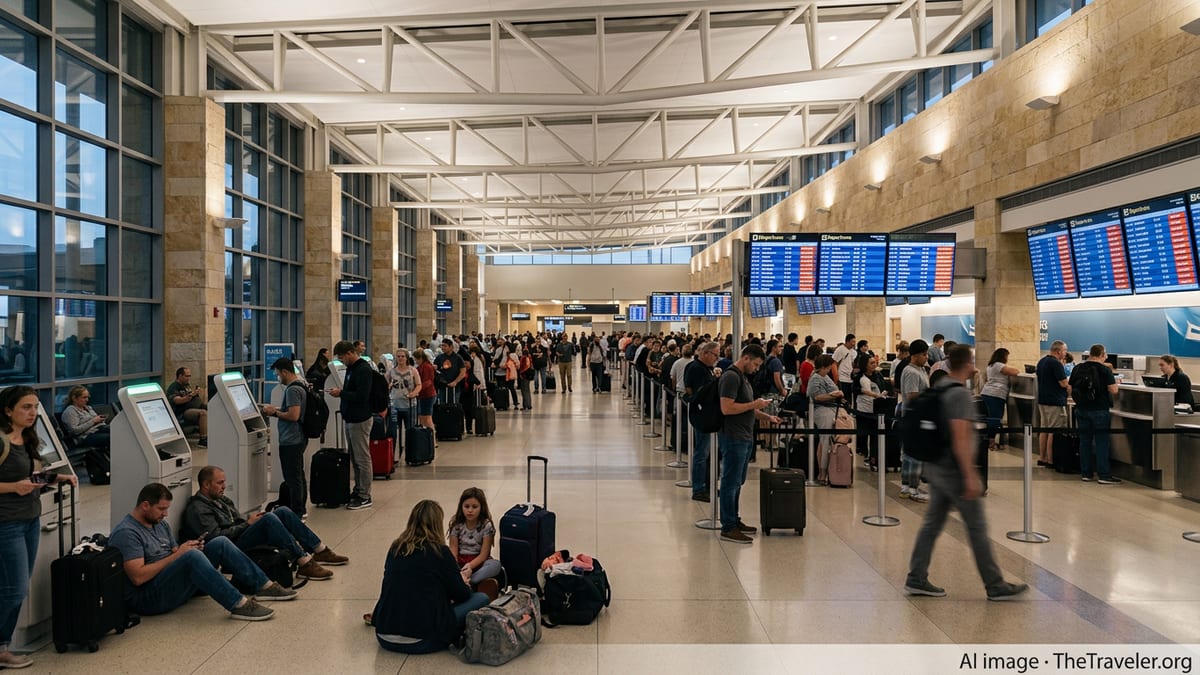
Travelers passing through Austin-Bergstrom International Airport faced a difficult day as 95 delayed departures and nine cancellations disrupted American, Frontier, Southwest and other airline operations, with knock-on effects across the United States and on international routes to Canada, the Netherlands, Panama and beyond.
Get the latest news straight to your inbox!
Cluster of delays hits major domestic and international carriers
Publicly available flight-tracking data for Austin-Bergstrom on the affected day show an unusually high concentration of late departures and cancellations across multiple carriers, led by large domestic operators including American Airlines, Southwest Airlines and Frontier Airlines. The disruptions affected both mainline services and codeshare operations, complicating schedules for passengers relying on onward connections.
While delays are common during the busy summer travel period, the scale of the latest disruption at Austin-Bergstrom stood out, with nearly one hundred flights departing behind schedule. Cancellations remained in the single digits but still forced hundreds of passengers to be rebooked onto later services or alternate routings out of Texas and neighboring hubs.
Operational data indicate that the impact was spread throughout the day rather than confined to a single burst of activity, suggesting that initial delays early in the schedule cascaded as aircraft and crews cycled through multiple legs. As a result, services that might otherwise have operated on time later in the day departed significantly behind schedule or were scrubbed outright.
The disruption came as airlines continue to operate at or near peak summer capacity. High load factors limit the availability of spare seats on alternative flights, magnifying the effect of each individual delay or cancellation for travelers attempting to reach their final destinations.
Knock-on effects across U.S. hubs and cross-border routes
The pattern of delays at Austin-Bergstrom rippled quickly through the domestic network. Key U.S. hubs such as Dallas-Fort Worth, Denver, Chicago, Phoenix and Atlanta experienced additional strain as late-arriving aircraft from Austin were slotted into already busy arrival and departure banks. This created further congestion for both local passengers and those connecting through large hub airports.
Because Austin is closely tied into cross-border networks, the disruption extended beyond U.S. borders. Routes linking Austin with major Canadian gateways, including Toronto and other transborder markets served through U.S. hubs, experienced schedule pressure as misaligned arrival and departure times reduced connection windows and forced some passengers onto later flights.
Transatlantic and Latin American connectivity was also affected. Austin’s role as a spoke for services to Amsterdam in the Netherlands and to Panama City in Panama meant that delayed departures from Texas had the potential to cause missed or compressed connections at those international hubs. Passengers traveling onward to other European or Central and South American destinations faced tighter transfer times and, in some cases, unplanned overnight stays.
Industry observers note that such knock-on effects are a feature of today’s highly interconnected aviation network. A midday disruption in one fast-growing U.S. airport can, within hours, influence schedules in multiple time zones, particularly when it intersects with long-haul and cross-border operations that run on fixed daily or near-daily patterns.
Factors behind the latest operational strain
While detailed cause-of-delay breakdowns for each individual flight are not yet fully compiled, aviation data and recent traffic patterns point to a familiar combination of pressures that likely contributed to the Austin-Bergstrom disruption. Seasonal thunderstorms across parts of the central and southern United States, together with congestion at major hubs, have frequently triggered route restrictions and spacing requirements in recent weeks.
National airspace advisories show that several large airports have been operating under ground delay programs or other traffic management initiatives, which slow the rate of arrivals and departures and can force airlines to hold aircraft on the ground at origin airports such as Austin. When those constraints intersect with already tight summer schedules, delays can accumulate rapidly.
Airlines are also contending with the broader industry challenge of matching staffing, aircraft availability and maintenance windows with record or near-record travel demand. Even small disruptions in crew scheduling or aircraft rotation can have outsized downstream impacts when there is little slack left in the system for recovery.
Analysts have noted that carriers serving Austin, including Southwest, American and Frontier, have seen on-time performance fluctuate during recent months as storms, air traffic control constraints and high utilization of fleets combined to test operational resilience. On a day when multiple factors converge, an airport like Austin-Bergstrom can see punctuality quickly deteriorate.
Impact on passengers and guidance for affected travelers
For passengers, the latest episode at Austin-Bergstrom translated into longer waits at gates, extended time on board aircraft awaiting departure slots and, for those whose flights were cancelled, the need to queue at service counters or navigate rebooking tools on airline apps and websites. Travelers connecting through other hubs often faced additional uncertainty as they monitored whether onward flights would be held or whether alternative routings would become available.
Consumer advocates emphasize that passengers dealing with extensive delays or cancellations should document their original itinerary, boarding passes and any written communication from airlines about changes. This information can be critical when seeking refunds, travel credits or, on eligible itineraries, compensation under applicable regulations.
Travel planners advise building additional buffer time into itineraries that rely on tight connections through weather-prone regions or congested hubs, especially during the peak summer travel season. Booking earlier departures, avoiding the last flight of the day on critical legs and monitoring flight status frequently are among the strategies recommended to reduce the risk of becoming stranded.
At the same time, industry data suggest that most flights at Austin-Bergstrom still operate without major disruption, even on challenging days. For many travelers, the heightened risk translates into inconvenience rather than full-scale trip failure, though the experience can be particularly stressful for those on time-sensitive journeys or traveling with families.
Growing scrutiny of reliability at fast-expanding airports
The disruption at Austin-Bergstrom is drawing renewed attention to the reliability of service at fast-growing airports that have added significant capacity in recent years. Austin has emerged as a major regional gateway, attracting new domestic routes and international links to destinations such as Toronto, Amsterdam and Panama City as airlines tap into the region’s economic and population growth.
With that growth has come pressure on terminal space, runways and support infrastructure, particularly during peak morning and evening travel banks. Aviation analysts note that even modest imbalances between departing and arriving traffic can strain gate availability and contribute to turn-time challenges for carriers operating tight schedules.
Local and federal planning documents highlight ongoing efforts to expand facilities and improve operational resilience at Austin-Bergstrom, including additional gates and airfield improvements. However, such projects take time to complete, and in the meantime, day-to-day reliability remains heavily dependent on cooperative weather, smooth national airspace operations and careful scheduling by airlines.
For now, the latest wave of delays and cancellations serves as another reminder that the summer travel season can be unpredictable, even at well-run airports. Travelers using Austin-Bergstrom in the coming weeks are likely to continue watching departure boards and flight-tracking apps closely as airlines work to keep schedules on track.