


More news on this day
Thousands of air travelers across Canada are facing a difficult start to the week as at least 79 flight cancellations and 299 delays disrupt schedules for Air Canada, Jazz, Air Canada Rouge, Air Inuit, PAL Airlines, WestJet, Pacific Coastal and other carriers at major and regional airports from Calgary and Edmonton to Ottawa, Halifax, Kelowna, London and Swan River.
Get the latest news straight to your inbox!
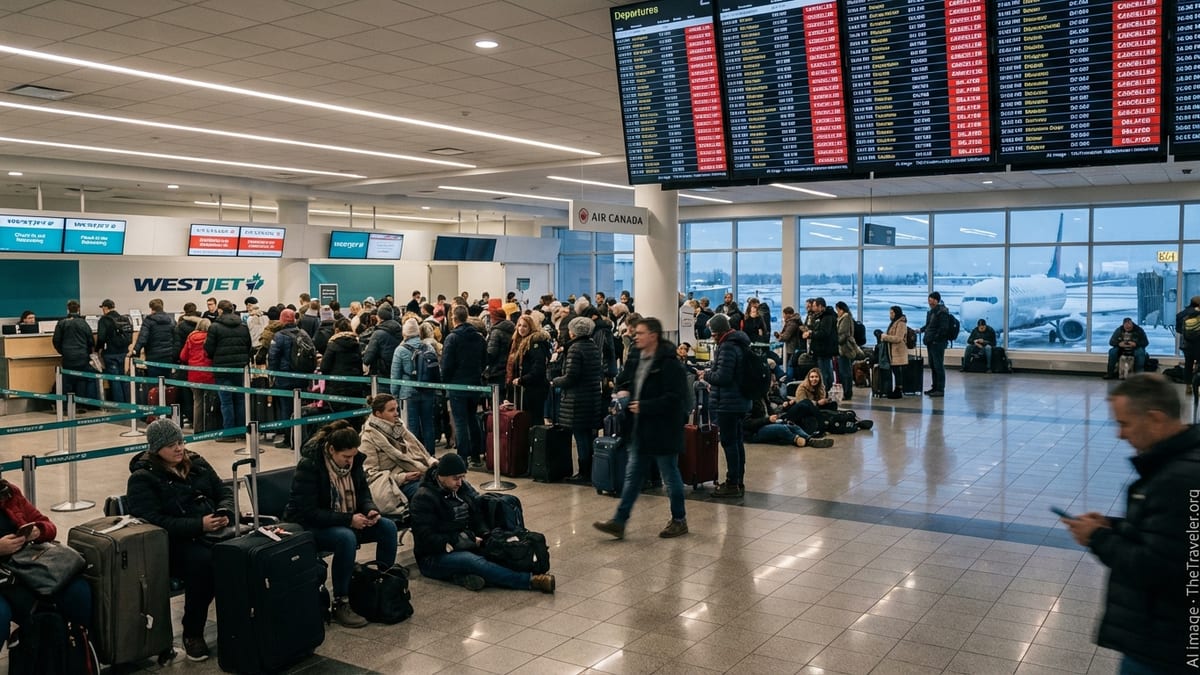
Network Strain Ripples From Major Hubs to Regional Communities
Publicly available flight-tracking data and airport departure boards for early June 2026 indicate a broad pattern of disruption across Canada, with cancellations and delays affecting both trunk routes and thinner regional services. While Toronto and Montreal often draw attention during irregular operations, recent data shows secondary hubs and smaller communities bearing a substantial share of the impact as schedules come under strain.
Calgary and Edmonton, key nodes in Western Canada’s domestic network, have recorded clusters of disrupted flights involving Jazz, Air Canada and WestJet on routes linking Alberta with Vancouver, Toronto, Montreal and regional destinations. Similar patterns appear in Ottawa and Halifax, where a mix of mainline and regional operations has left passengers facing missed connections, extended waits and last-minute gate changes.
Smaller airports such as Kelowna in British Columbia, London in Ontario and Swan River in Manitoba are also feeling the knock-on effects. When aircraft and crews run late on earlier legs or are reassigned to protect higher-volume routes, regional communities can quickly see services consolidated, delayed or cancelled outright, reducing options for travelers who rely on a limited number of daily flights.
Across the network, the combined tally of 79 cancellations and 299 delays reflects how quickly a single day of irregular operations can cascade into a nationwide challenge, particularly in a system where aircraft and crews are scheduled tightly and turnaround times leave little margin for error.
Multiple Airlines Affected, From Mainline to Regional Carriers
The latest disruption wave is touching a wide range of carriers, underscoring the interconnected nature of Canada’s domestic aviation sector. Air Canada and its partners Jazz and Air Canada Rouge have seen a significant share of the cancellations and delays, reflecting their extensive networks and heavy reliance on connections through Calgary, Edmonton, Ottawa and Halifax, among other hubs.
WestJet and its affiliated operations are also contending with schedule pressure, particularly on routes linking Western Canada to central and Atlantic provinces. Pacific Coastal Airlines, PAL Airlines and Air Inuit, which operate vital regional links, are reporting smaller but still notable numbers of disrupted flights, especially where services intersect with congested hubs or rely on aircraft arriving from already delayed sectors.
Because many of these carriers operate under codeshare and capacity-purchase arrangements, a single cancellation can affect passengers booked under different airline brands on the same aircraft. This structure can complicate rebooking, as travelers may need to navigate different customer-service channels or fare rules even when they originally boarded the same flight.
The breadth of airlines affected also means that no single carrier can easily absorb the displaced demand. With loads already strong at the start of the summer travel period, spare seats on alternate flights are limited, increasing the likelihood that some passengers will face overnight stays, circuitous routings or multi-day delays in reaching their destinations.
Weather, Tight Scheduling and Operational Constraints Converge
Reports from flight-tracking platforms, airport information screens and publicly available airline advisories suggest that a familiar mix of factors is driving the latest disruptions. Variable early summer weather across multiple provinces, including thunderstorms, low cloud and changing wind conditions, has triggered intermittent flow restrictions and ground holds at several airports.
Operational constraints are amplifying the impact. Airlines continue to run dense schedules across their networks, and small delays early in the day can expand as the hours pass. When an aircraft or crew arrives late into a hub such as Calgary, Edmonton, Ottawa or Halifax, subsequent legs may be forced into shortened turn times, increasing the risk of further delay or cancellation if any additional issue arises.
Crew duty-time limits and maintenance requirements add further complexity. If a late-running aircraft reaches the threshold for scheduled inspections or if a crew approaches maximum duty hours, airlines may have no choice but to reshuffle rotations or cancel individual flights to remain within regulatory limits. These adjustments often fall most heavily on lower-frequency routes and smaller airports, contributing to cancellations in places such as Kelowna, London and Swan River.
Industry observers note that while each disruption event has its own trigger, the recurring pattern of widespread delays and cancellations underlines the sensitivity of current schedules. Even modest weather events or localized bottlenecks can now produce network-wide effects when they coincide with peak travel periods.
Travelers Confront Missed Connections, Longer Journeys and Limited Options
For passengers, the statistical picture of 79 cancellations and 299 delays translates into missed family gatherings, disrupted business plans and extended days in airport terminals across Canada. At major airports, delayed departures have left travelers queueing at customer-service desks and scrambling to secure scarce seats on alternative flights, particularly on popular domestic corridors.
Connections through hubs such as Calgary, Edmonton, Ottawa and Halifax have proven especially vulnerable. Late-arriving inbound services can easily push tight onward connections beyond their limits, leaving travelers stranded until the next available departure. Where onward flights operate only once or twice daily, this can turn a brief delay into an overnight stay or longer detour.
At smaller airports, the impact can be even more severe. When a single daily flight from a community such as Swan River or a limited schedule from cities like Kelowna and London is cancelled, there may be no same-day alternative at all. In such cases, travelers must often choose between extended ground journeys to larger hubs or waiting for the next scheduled air service, potentially losing nonrefundable bookings for hotels, events or connecting tickets in the process.
Consumer advocates and travel-rights organizations generally advise passengers caught in such disruption to monitor airline apps and airport departure boards closely, retain receipts for any additional expenses and review the terms of carriage and applicable compensation rules, which can vary depending on the cause of delay and the size of the carrier involved.
Ongoing Monitoring Needed as Early Summer Travel Ramps Up
The current wave of cancellations and delays comes as Canada’s airlines transition into the busy summer season, when leisure demand peaks and spare capacity in both aircraft and crews is at its tightest. Recent patterns in May and early June have shown that once a disruption cycle begins, knock-on effects can linger for days, even after the immediate weather or technical trigger has subsided.
Publicly available data suggests that airports such as Calgary, Edmonton, Ottawa, Halifax, Kelowna, London and several smaller regional facilities will remain under close watch in the coming days, as airlines work to reposition aircraft, reset schedules and rebuild on-time performance. Any additional weather systems or operational challenges could prolong or deepen the current difficulties.
Travel planners recommend that passengers with upcoming trips build extra time into itineraries that require connections, particularly when routing through multiple hubs or pairing regional services with long-haul flights. Allowing wider connection windows, avoiding last flights of the day where possible and confirming real-time status before heading to the airport are among the steps suggested to reduce the risk of being caught in the next wave of disruptions.
As the count of 79 cancellations and 299 delays illustrates, early summer 2026 is testing the resilience of Canada’s aviation network. With demand strong and schedules tight, even localized turbulence in the system can quickly spread, leaving travelers from major cities and small communities alike bracing for another uncertain day at the airport.