


More news on this day
Travelers moving through Japan’s major air gateways faced significant disruption today as operations at Narita, Kansai, and Osaka Itami airports were hit by a technical issue, delaying 175 flights and canceling one across a web of domestic and international routes operated by Japan Airlines, All Nippon Airways, Delta Air Lines, and other carriers.
Get the latest news straight to your inbox!
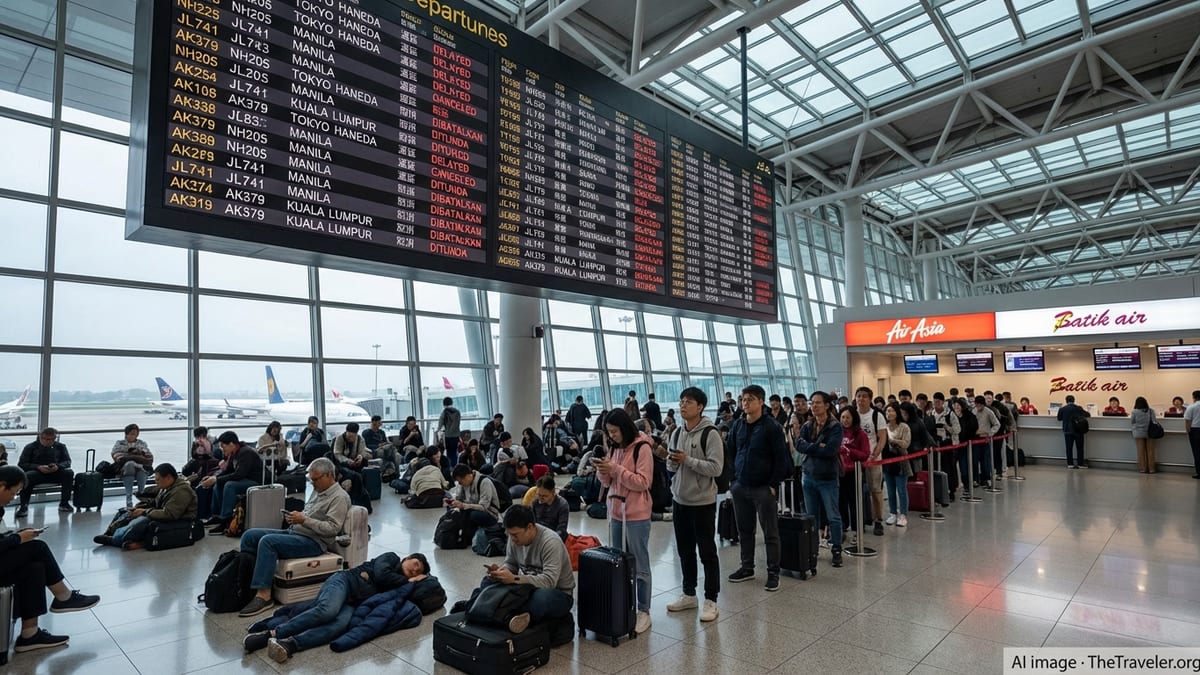
Delays Ripple Across Japan’s Primary Hubs
Publicly available flight-tracking boards and airport status pages showed widespread knock-on delays through the day at Narita International Airport outside Tokyo, Kansai International Airport serving the Osaka region, and Osaka Itami Airport, a key domestic hub. The disruption affected both short-haul and long-haul services, complicating connections for passengers traveling within Japan and onward to North America and China.
Data from live departure and arrival boards indicated that around 175 flights were delayed and one flight was canceled, as aircraft and crews fell out of position and airlines adjusted schedules. The pattern of delays suggested a system-related problem rather than weather, with clear conditions reported at the affected airports while schedules continued to fray.
Japan Airlines and All Nippon Airways, which together operate a large share of domestic and international services from these airports, saw multiple departures pushed back. International partners including Delta and other global carriers also recorded late-running departures and arrivals as they relied on shared airspace and congested ground handling capacity.
Operational information available from Narita and Kansai showed delays clustering during peak departure banks, amplifying crowding at check-in, security, and boarding gates. Passengers connecting between domestic legs at Itami and Kansai and long-haul flights from Narita faced particular challenges as minimum connection times were compressed by rolling delays.
Impact on Key Routes to Tokyo, Osaka, Los Angeles, New York, and Beijing
Among the most closely watched services were links between Japan and major global cities including Los Angeles, New York, and Beijing. Schedules published by Japan Airlines, ANA, and their alliance partners show multiple daily departures on these routes from Narita and Kansai, meaning even short hold-ups can cascade into missed connections and overnight disruptions for travelers.
Flight-status tools tracking departures from Narita indicated late departures on transpacific services toward Los Angeles and New York, with some widebody aircraft held on the ground while outbound slots were reorganized. At the same time, inbound services from North America arrived behind schedule, narrowing the available window for passengers to re-clear security and board onward domestic legs to Osaka and other Japanese cities.
Routes between Japan and Beijing were also affected as carriers adjusted timing on east Asian flights to fit around the congestion. Japan Airlines, ANA, and several Chinese and alliance airlines typically thread their Tokyo and Osaka departures through tightly packed afternoon and evening banks; today’s disruption squeezed these windows further, with a higher risk of late-night arrivals and missed last-train connections into city centers.
Within Japan, passenger itineraries that combine flights into Itami with onward departures from Kansai or Narita came under particular strain. Itami primarily handles domestic services, and irregular operations there limited options for travelers hoping to reposition quickly for international departures out of Kansai or Narita.
What Is Known About the Cause of the Disruption
As of the latest updates, publicly available information from flight-data aggregators and airport advisories pointed to a systems-related disruption affecting air-traffic or operational networks rather than severe weather. Recent coverage of similar events in Japan has highlighted how relatively short outages in air-traffic management systems can trigger extensive cancellations and delays when they occur during morning departure peaks.
Reports on previous disruptions at Japanese hubs have described technical faults in air-navigation systems and support networks resulting in temporary suspensions of departures and complex recovery operations. Today’s patterns, with a modest number of outright cancellations but a large number of delayed flights across three major airports, are broadly consistent with a scenario where traffic is slowed and capacity reduced while systems are checked and gradually restored.
Airport timetables and operational notices show that Narita, Kansai, and Itami collectively handle hundreds of flights each day across multiple terminals, carriers, and alliances. Any interruption to shared infrastructure or scheduling tools can therefore produce disproportionate effects, even if the underlying issue is resolved within a relatively short window.
Authorities responsible for national aviation infrastructure in Japan typically publish post-incident summaries after similar events, outlining causes and any remedial steps. As of now, detailed technical explanations have not yet appeared in public reporting, and the immediate priority remains clearing backlogs and returning operations to published schedules.
How Airlines Are Responding and What Passengers Can Expect
According to airline advisories and general industry practice, carriers affected by the disruption are expected to adjust schedules, rebook passengers on later flights, and in some cases route travelers via alternative hubs to keep journeys as close as possible to their original timings. For long-haul services, particularly to destinations such as Los Angeles and New York, airlines commonly prioritize maintaining at least one viable daily option even if timings shift.
Japan Airlines and ANA, as home carriers with extensive domestic networks, are typically able to offer rerouting via Haneda or alternative domestic gateways when seats are available. International partners like Delta and other alliance members may also rebook travelers onto codeshare services if their own departures from Narita or Kansai are heavily delayed or disrupted.
Travel advisories published by airports and carriers during irregular operations generally recommend that passengers check their flight status frequently on official channels before leaving for the airport, arrive earlier than usual when disruption is ongoing, and be prepared for longer queues at security and immigration. Same-day rebooking options may be more limited on popular transpacific and regional routes, especially during holiday or weekend peaks.
For passengers already en route when delays intensified, real-time flight-tracking and gate information at Narita, Kansai, and Itami provided crucial updates about retimed departures, gate changes, and baggage handling. Those connecting onward to North America or China often faced extended layovers but, in many cases, were able to remain on the same calendar-day departure after schedule adjustments.
Ongoing Recovery and Outlook for Travelers
Operational data late in the day showed signs of gradual recovery, with some later departures moving closer to scheduled times as airlines and airports worked through the backlog. Nonetheless, residual delays were expected to persist into subsequent rotations as aircraft and crew rosters continued to normalize.
Travelers booked over the next 24 to 48 hours on routes touching Narita, Kansai, and Itami, particularly those connecting through Tokyo or Osaka to Los Angeles, New York, or Beijing, may still encounter altered departure times or aircraft changes as airlines rebalance their fleets. Published schedules often take several cycles to fully realign after a large-scale disruption of this kind.
Industry data and past experience in Japan suggest that once underlying technical issues are resolved, on-time performance at major hubs typically improves quickly, helped by robust ground handling and coordinated slot management. However, heavily utilized transpacific and regional corridors leave little slack in the system, so even a single canceled flight can have lingering effects on seat availability across multiple days.
For now, the immediate focus for airlines and airports involved appears to be stabilizing operations, preserving core international links, and minimizing further inconvenience for travelers who found their plans unexpectedly disrupted by today’s wave of delays at three of Japan’s most important air gateways.