


More news on this day
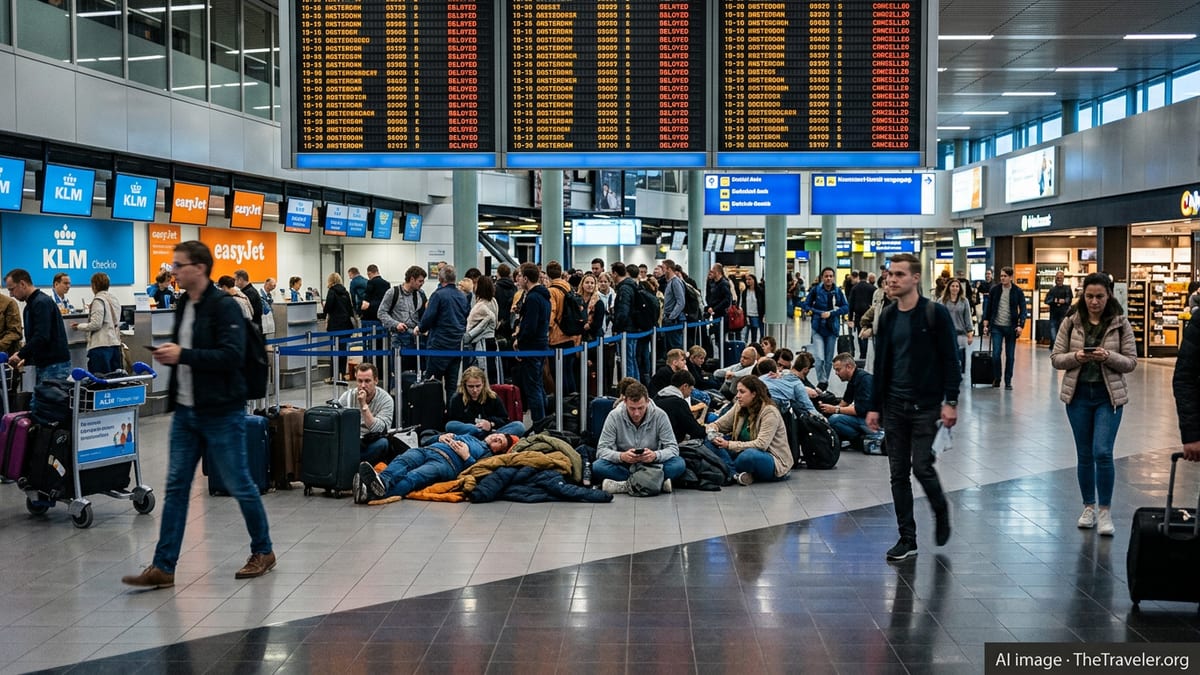
Air travelers across Europe are facing fresh waves of disruption as a mix of strikes, staffing constraints and volatile summer storms drives up delays and cancellations at some of the continent’s busiest airports.
Get the latest news straight to your inbox!
Summer Traffic Surges Against a Strained Network
The latest operational data for August 2026 show a European air traffic system under sustained pressure even as overall performance has improved compared with recent years. Eurocontrol’s summer flash briefing for early August reported an average of more than 36,000 flights per day, with 73 percent of arrivals on time and Air Traffic Flow Management delays averaging 3.44 minutes per flight across the network, a figure that is higher than in 2025 but still markedly better than the post-pandemic peaks in 2023 and 2024.
Eurocontrol’s broader performance reviews highlight how structural issues continue to shape this summer’s travel experience. Previous assessments linked high en route delay levels to capacity constraints, weather and ongoing difficulties in rebuilding air traffic control staffing after the pandemic, with total ATFM delay minutes in 2024 significantly above 2023. Those underlying weaknesses now intersect with heavier traffic and localized disruptions, leaving little margin when storms or strikes hit key hubs.
While network indicators point to gradual improvement over a multi-year horizon, the aggregate numbers mask sharp day-to-day variations. Even small spikes in en route delay or airport capacity restrictions can quickly cascade, particularly on peak travel days when Friday traffic is forecast around 37,500 flights. As a result, individual passengers frequently encounter a reality that feels far more chaotic than the averages suggest.
Industrial Action and Staffing Shortfalls Hit Key Airports
Industrial disputes and staffing gaps are a major driver of the latest wave of disruptions. At Amsterdam’s Schiphol Airport, security staff have mounted brief work stoppages that the airport operator warns may lead to longer than usual waits at checkpoints. Public advisories posted on August 26 urge travelers to arrive early and caution that prebooked security timeslots may not be honored during the actions, signaling a risk of knock-on delays for both departures and connections.
Further south, Barcelona’s Josep Tarradellas Barcelona El Prat Airport has faced an indefinite ground handling strike since early August, affecting airline turnaround times and baggage operations. Regional government notices describe the walkout by Groundforce Barcelona personnel as open-ended and advise passengers to expect delays at check in and boarding. Independent monitoring from passenger rights firm AirHelp indicates that storms combined with the Barcelona labor dispute disrupted roughly 2,400 flights across Europe on August 11 alone, underscoring how localized industrial action can reverberate through the wider network.
Staffing challenges are not limited to airport ground operations. In mid-August, Ryanair publicly criticized the UK’s National Air Traffic Services over what the airline described as repeated controller shortages that forced flow restrictions over southern England, delaying dozens of flights and affecting several thousand passengers in a single morning. Performance reports from Eurocontrol and other oversight bodies have previously flagged the contribution of controller staffing constraints to delay levels, particularly during peak summer periods.
Storm Systems Expose Weather Vulnerabilities
Weather remains another critical stress factor for European aviation, especially as convective storms intensify during late summer. Eurocontrol’s seasonal network reports for recent years show that weather accounted for roughly one third of total ATFM delay minutes, with convective thunderstorm systems over busy corridors repeatedly triggering capacity-reducing measures and reroutings.
This August, a series of storm fronts over the western Mediterranean and parts of France caused further disruption. Passenger compensation specialists tracking operations across the region link thousands of delayed flights to combined impacts from storms and local strikes, particularly around Barcelona and other coastal hubs. Network management briefings note that pre-agreed weather scenarios now routinely redirect flows away from affected airspace, saving hundreds of thousands of minutes of potential delay but still leaving airlines struggling to recover schedules when storms stall over major routes.
Although improved coordination between air navigation service providers has reduced the worst peaks in weather-related delay compared with the summers immediately following the pandemic, the system remains highly sensitive to fast-changing conditions. Heavy rainfall, low cloud ceilings and crosswinds continue to force runway capacity cuts at large hubs such as Amsterdam and London, leaving aircraft and crews out of position and amplifying reactionary delays across regional networks.
Patchwork Passenger Experience Across Major Hubs
The cumulative effect of strikes, staffing constraints and weather is most visible at Europe’s busiest airports, where even modest disruptions can affect thousands of travelers. Tracking data for London Gatwick, one of the continent’s largest low cost hubs, show at least 82 cancellations in August 2026 so far, with British Airways and other major carriers among the most affected. Popular leisure routes to southern Europe feature prominently in the cancellation statistics, suggesting that holidaymakers are bearing a disproportionate share of the disruption.
In the Netherlands, Schiphol’s warnings about industrial action at security come against a backdrop of previous winters where storms and low visibility led to large numbers of cancellations and delays. Earlier in 2026, Storm Anna forced the cancellation of more than 300 flights and delayed hundreds more at Schiphol in a single day, illustrating how weather events can rapidly overwhelm mitigation measures when combined with already stretched ground and security resources.
Across the wider network, Eurocontrol’s rolling seasonal plan emphasizes that many air navigation service providers are meeting their planned capacity targets this summer, yet overall punctuality still hovers in the low to mid 70 percent range for arrivals. That patchwork performance leaves some hubs operating relatively smoothly while others endure recurring bottlenecks, making travel experiences highly route dependent even within the same week.
Travelers Face Limited Options and Complex Rights
For passengers caught up in the current wave of disruptions, rebooking options can be limited, particularly on peak days when most flights depart near capacity. Consumer advocacy coverage this month highlights examples of travelers waiting days for replacement flights after last minute cancellations, or accepting rerouting to airports far from their original destination in order to get home sooner. In some instances, long delays stem from aircraft and crews being stranded by earlier weather or air traffic control constraints, even when skies appear clear at the point of departure.
Under European Union Regulation EC261 and its UK equivalent, travelers generally benefit from stronger protections than in many other regions, although eligibility for compensation depends heavily on the cause of the disruption. Guidance from both official and independent sources notes that passengers can usually claim meals, accommodation and rerouting when flights are heavily delayed or cancelled, but direct financial compensation is often excluded when weather or certain types of strike activity are deemed outside an airline’s control.
National consumer agencies in Spain and other EU states have recently reissued advice on passenger rights during strikes, reminding travelers that they may be owed refunds or alternative transport if subcontracted staff walkouts force cancellations, and that extraordinary circumstances exemptions do not automatically remove all carrier obligations. Even so, reports from traveler forums and rights organizations suggest considerable confusion about when compensation applies, particularly when multiple factors such as storms, staffing shortages and industrial action overlap on the same day.
With traffic levels expected to remain high through the end of the summer season, operational outlooks from Eurocontrol stress the importance of close coordination between airlines, airports and air navigation providers to contain further spikes in delay. For now, however, many passengers flying in and out of Europe face an unpredictable mix of minor inconveniences and major itinerary changes as the network works through another turbulent peak period.
Eurocontrol Summer 2026 Flash Briefing
AirHelp: Barcelona strike and storms disrupt flights
Amsterdam Schiphol disruption advisory