


More news on this day
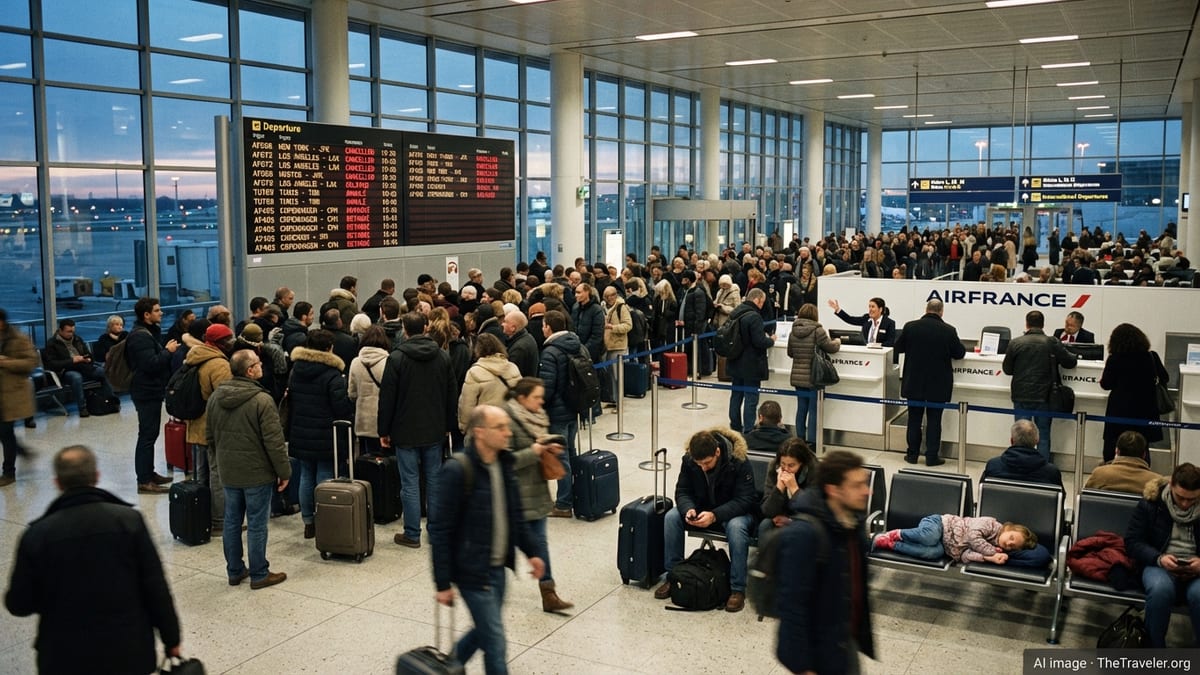
Hundreds of passengers were left stranded across France on Monday as a new wave of flight disruption swept through Paris, Nice, Lyon, Marseille and several regional hubs, with operational data indicating 508 flight delays and 44 cancellations affecting services operated by Air France, easyJet, Lufthansa, Ryanair and other carriers.
Get the latest news straight to your inbox!
Major French Hubs Buckle Under Peak Summer Pressure
Operational monitoring figures from French aviation data providers indicate that the sharpest disruption has been concentrated at Paris Charles de Gaulle, Paris Orly and Nice Côte d’Azur, with knock-on effects at Lyon–Saint Exupéry, Marseille Provence and secondary airports. The pattern mirrors earlier episodes in 2026 when high traffic volumes and constrained airspace triggered widespread delays across the French network.
Reports compiled on the latest disruption show Charles de Gaulle recording the largest share of affected movements, with well over half of the total delays and most cancellations linked to departures and arrivals at the country’s main international hub. Paris Orly and Nice have also seen heavy schedule slippage, particularly on dense short-haul routes to other European cities and domestic corridors such as Paris–Nice and Paris–Marseille.
Industry analyses note that French airports have entered the height of the summer travel period with limited margin to absorb even minor operational shocks. Tight turnaround times, busy runways and packed terminal schedules mean that a short delay early in the day can quickly cascade into missed connections and last‑minute cancellations by evening.
Tracking services and passenger-rights platforms that monitor Europe-wide disruption indicate that the new wave of delays in France adds to a season of already elevated irregular operations, following earlier spikes linked to winter weather, air traffic control capacity issues and industrial action across parts of the continent.
Air France, easyJet, Lufthansa and Ryanair Among Worst Hit
Publicly available flight-status data show that national carrier Air France, together with low-cost rivals easyJet and Ryanair and network carrier Lufthansa, account for a large share of the 508 delayed services and 44 cancellations reported across French airports. These airlines operate many of the busiest domestic and intra-European routes touching Paris, Nice, Lyon and Marseille, making them particularly exposed when airports struggle to maintain schedule integrity.
Air France has been juggling a complex mix of long-haul departures from Charles de Gaulle and dense short- and medium-haul rotations within Europe. Industry commentators observe that when congestion or staffing bottlenecks emerge, airlines often prioritize long-haul departures and high-yield routes, which can lead to shorter sectors being delayed or removed from the schedule.
For easyJet and Ryanair, which run high-frequency point-to-point operations from French bases and nearby hubs, tight aircraft utilization can leave little room to recover after an initial disruption. Aviation analysts note that a prolonged delay on one rotation can force subsequent flights to depart late or be canceled if crews risk exceeding regulated duty-time limits.
Lufthansa’s involvement reflects both its own services to and from German hubs and the broader interconnectedness of European air travel. Disruptions on a single France–Germany leg can radiate into missed onward connections at Frankfurt, Munich or other transfer gateways, adding to the number of delayed flights reported in the French system.
Passengers Stranded in Paris, Nice, Lyon and Marseille
The immediate human impact has been felt in the terminals at major French airports, where images and accounts shared on social platforms describe crowded departure halls, passengers queueing at rebooking counters and long lines at customer-service desks as travelers attempt to salvage holiday and business itineraries.
At Charles de Gaulle and Orly, where many services are interconnected with long-haul or onward European flights, missed connections have compounded the disruption. Travelers arriving late from other European cities have reported being unable to board their planned onward flights, leaving them in need of hotel accommodation or alternative transport at short notice.
In Nice and Marseille, both key gateways to popular Mediterranean destinations, the disruption has affected travelers heading to and from beach resorts during one of the busiest weeks of the summer. Reports indicate that some passengers have faced extended overnight waits after late-evening departures were first delayed and then canceled when aircraft or crews could not be repositioned in time.
Regional hubs such as Lyon–Saint Exupéry have also seen schedule irregularities, with domestic and short-haul European services arriving and departing behind schedule. Passengers using these airports as starting points for onward rail or road journeys have had to rework carefully timed connections as delays stretched into several hours on some routes.
Operational Strains, Weather and Airspace Constraints
While a full post‑event breakdown is still emerging, aviation observers point to a combination of factors behind the latest round of disruption in France. Recent weeks have seen episodes of intense heat in parts of the country, along with active wildfire seasons in the south, prompting airspace management measures and occasional capacity reductions in affected regions.
Air traffic control capacity has been a recurring pressure point in French airspace, which serves as a critical transit corridor for flights linking northern and southern Europe. When traffic levels are high and sector staffing is tight, regulators may impose flow restrictions that slow the rate at which aircraft can depart or arrive at major hubs, lengthening taxi and holding times and feeding into the day’s delay statistics.
On the ground, airlines and airports continue to operate with finely balanced staffing after several years of volatility in the aviation labor market. Industry reporting throughout 2026 has highlighted how shortages in key roles, such as ground handling, security screening and aircraft maintenance, can turn routine operating challenges into extended disruptions.
Analysts also underscore the structural vulnerability of popular French city pairs where aircraft are scheduled for multiple short legs per day. When an early‑morning flight from one regional airport runs late due to a technical inspection or late‑arriving crew, every subsequent sector using the same aircraft is at risk of missing its slot, particularly at high-traffic airports like Charles de Gaulle and Nice.
What Travelers Need to Know When Disruption Hits
Consumer-rights specialists and passenger advocacy groups stress that travelers caught in large‑scale disruption events in France should familiarize themselves with protections available under European Union regulations. EU rules can, in many circumstances, require airlines to provide care such as meals, refreshments and accommodation, and in some cases financial compensation, depending on the cause and length of a delay or cancellation.
During major disruption, airlines typically encourage passengers to use digital tools to monitor live flight status, request rerouting and manage refunds or vouchers. However, recent events in France and other European hubs show that online systems can become congested when thousands of people are attempting to rebook at once, leading to frustration and long waits both online and at airport counters.
Travel advisers recommend that passengers build additional buffer time into itineraries that rely on tight intermodal connections, such as same‑day train departures or cruise embarkations following arrival in Paris, Nice or Marseille. Given the elevated level of disruption across the French network in recent months, a more conservative approach to connection planning may reduce the risk of missed onward travel.
As French airports and airlines work through the backlog created by the latest cluster of 508 delays and 44 cancellations, observers expect residual knock-on effects to linger for at least another operational cycle, with some aircraft and crews out of position and schedules still vulnerable to further weather or airspace constraints.