


More news on this day
Battery-powered regional trains are beginning to enter service on parts of France’s TER network, marking a significant step in efforts to cut diesel use on secondary lines and accelerate the decarbonisation of everyday rail travel.
Get the latest news straight to your inbox!
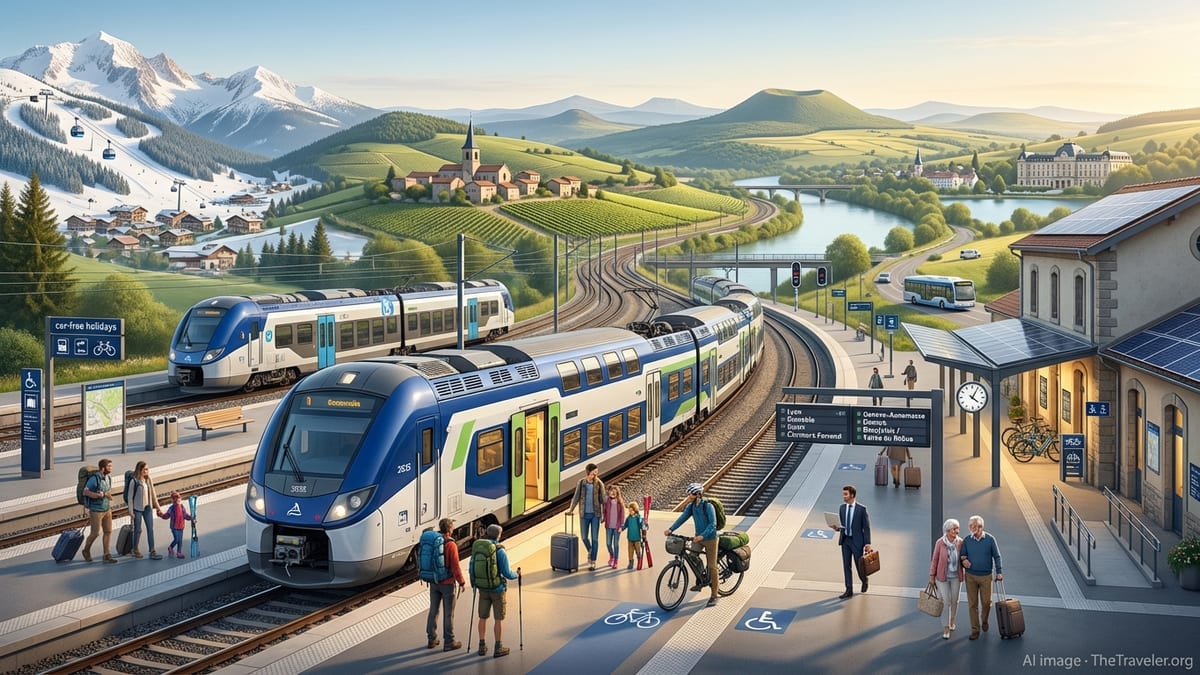
A New Generation of TER Trains Leaves Diesel Behind
France’s shift toward battery-powered regional trains is moving from prototype to passenger service, as converted TER units begin commercial deployment on non-electrified stretches of the network. Publicly available information from SNCF Group describes how existing AGC diesel multiple units have been rebuilt as bi-mode electric trains that draw power from overhead wires where available and switch to onboard lithium batteries on unelectrified sections.
The conversion replaces two diesel engines with traction batteries, creating what the operator refers to as battery TER trains. Reports indicate that the first converted trainset was tested at Alstom facilities and on the national rail network before being cleared for service, with additional units scheduled to follow in 2025 and 2026 as part of a small pre-production fleet. ([groupe-sncf.com](https://www.groupe-sncf.com/en/innovation/decarbonization-trains/battery-ter?utm_source=openai))
According to project documentation, five converted trainsets are expected to be in commercial service across several partner regions by mid 2026, forming an extended trial that will inform wider rollout. This early fleet is intended to demonstrate day-to-day reliability, validate charging strategies, and quantify energy and emissions savings on real routes. ([groupe-sncf.com](https://www.groupe-sncf.com/medias-publics/2026-03/full-year-financial-report-2025-sncf-group.pdf?VersionId=3h_wpxnOAJI4kCv8E_rBWvMFpfi2XgjQ&utm_source=openai))
Battery TER services are being introduced alongside other low carbon technologies on the French rail network, including hybrid and hydrogen regional trains. The overall strategy focuses on replacing diesel traction on lines where full electrification is considered too costly or disruptive, using train-borne energy storage instead of building new catenary infrastructure. ([groupe-sncf.com](https://www.groupe-sncf.com/fr/innovation/decarbonation-trains/ter-hydrogene?utm_source=openai))
Regional Partnerships Drive Early Commercial Deployment
France’s battery-powered regional trains are the result of a partnership between SNCF Voyageurs, rolling stock manufacturer Alstom, and several regions that fund and manage TER services. Auvergne Rhône Alpes, Hauts de France, Sud Provence Alpes Côte d’Azur, Nouvelle Aquitaine, and Occitanie are listed among the early backers of the conversion program, having co financed the initial pre production series. ([groupe-sncf.com](https://www.groupe-sncf.com/fr/innovation/decarbonation-trains/ter-batterie?utm_source=openai))
In Nouvelle Aquitaine, regional transport authorities highlight plans for one of the first commercial battery TER routes, building on more than a decade of trials with low carbon alternatives such as biodiesel, hybrid electric sets, and hydrogen powered trains. Local information describes the battery train project as a continuation of these efforts, designed to cut operating emissions while keeping services on unelectrified lines competitive. ([transports.nouvelle-aquitaine.fr](https://transports.nouvelle-aquitaine.fr/toute-lactualite-des-transports/le-premier-ter-batteries-roulera-en-nouvelle-aquitaine?utm_source=openai))
The Occitanie region presents a similar picture of layered technologies, noting that its territory hosts trials of regenerative braking systems, hydrogen traction and battery electric trains, making it one of the test beds for “future green trains.” Battery TER services are expected to complement these initiatives rather than replace them, allowing each corridor to adopt the technology that best fits its traffic patterns and infrastructure. ([laregion.fr](https://www.laregion.fr/En-Occitanie-des-trains-toujours-plus-vertueux?utm_source=openai))
Project partners frame the battery TER rollout as a way to modernise existing fleets while avoiding the cost and carbon impact of new vehicle production. By extending the life of AGC units through conversion instead of replacement, the program draws on the high recyclability of rail vehicles and reduces resource use compared with building entirely new trains. ([groupe-sncf.com](https://www.groupe-sncf.com/fr/innovation/decarbonation-trains/ter-batterie?utm_source=openai))
How Battery TER Technology Works on Mixed Networks
Technical information released by SNCF Group explains that the converted AGC units operate as bi mode electric trains, taking traction current from overhead catenary where it exists and automatically switching to battery power beyond the wire. The lithium traction batteries are sized to travel around 80 kilometers on non electrified sections, with an additional reserve to maintain margins for service recovery and degraded operation. ([groupe-sncf.com](https://www.groupe-sncf.com/en/innovation/decarbonization-trains/battery-ter?utm_source=openai))
Charging occurs primarily while the trains run under existing electrified segments, avoiding the need for extensive new fixed infrastructure. Studies are also examining static charging solutions at stations and depots, as engineers work to overcome constraints linked to high power charging below France’s standard 1.5 kilovolt DC overhead supply on certain routes. ([groupe-sncf.com](https://www.groupe-sncf.com/medias-publics/2025-06/2024-innovation-report-sncf-group.pdf?utm_source=openai))
Project documentation shows that SNCF’s innovation teams are using digital modelling to simulate the energy performance of different train types, including hydrogen, hybrid and battery electric units. These models support decisions on where to deploy each technology and help estimate the impact of replacing diesel engine modules with battery packs on specific regional lines. ([groupe-sncf.com](https://www.groupe-sncf.com/medias-publics/2024-05/innovation-report-2023-sncf.pdf?utm_source=openai))
For passengers, the transition is designed to be largely seamless. The converted trains maintain similar capacities and layouts to the diesel AGC units they replace, while promising lower noise and vibration in battery mode, particularly on rural routes where environmental concerns and air quality are growing priorities. ([groupe-sncf.com](https://www.groupe-sncf.com/en/innovation/decarbonization-trains/battery-ter?utm_source=openai))
Battery Trains Within France’s Broader Rail Decarbonisation Plan
Battery TER deployment forms one strand of a broader national effort to reduce emissions from regional rail. SNCF Voyageurs notes that around 80 percent of its passenger journeys are already made on electric trains, and that the remaining diesel operations are increasingly concentrated on unelectrified secondary lines. Replacing diesel units on these routes is therefore central to the company’s climate strategy. ([sncf-voyageurs.com](https://www.sncf-voyageurs.com/en/our-company/divisions-and-subsidiaries/rolling-stock-division/our-stakes/energy-transition/?utm_source=openai))
Hydrogen bi mode regional trains have been ordered for several regions, and trials are underway on lines where battery operation alone would be difficult because of long distances between electrified sections or depots. In parallel, experiments with hybrid trains and alternative fuels seek to improve the performance of existing rolling stock that is not yet scheduled for conversion or replacement. ([groupe-sncf.com](https://www.groupe-sncf.com/fr/innovation/decarbonation-trains/ter-hydrogene?utm_source=openai))
Policy documents on the greening of French railways emphasise that battery trains are particularly suited to short and medium length branches that connect to electrified main lines. On these corridors, trains can use the wired sections as rolling charging zones and avoid the need for full infrastructure upgrades, a factor that could accelerate deployment on dozens of routes if early trials are successful. ([fr.wikipedia.org](https://fr.wikipedia.org/wiki/Verdissement_du_ferroviaire_en_France?utm_source=openai))
Recent SNCF Group reports frame the first commercial services as a proving ground that will shape future investment decisions by national and regional authorities. Data collected from the initial five trainsets in service by mid 2026 is expected to inform decisions about scaling up battery conversions, procuring new battery electric units, or combining batteries with hydrogen and hybrid solutions across the TER network. ([groupe-sncf.com](https://www.groupe-sncf.com/medias-publics/2026-03/full-year-financial-report-2025-sncf-group.pdf?VersionId=3h_wpxnOAJI4kCv8E_rBWvMFpfi2XgjQ&utm_source=openai))
SNCF Group overview of battery TER trains
Alstom technical and project background on French battery trains
Nouvelle Aquitaine regional briefing on first battery TER service