


More news on this day
As Europe’s new Entry/Exit System moves from pilot to full use, travelers heading into France in June 2026 are finding a more digital border, but also longer and less predictable airport queues.
Get the latest news straight to your inbox!
EES Is Now Fully Operational, With Flexibility Built In
The European Union’s Entry/Exit System, or EES, became fully operational across the Schengen area on 10 April 2026 after a phased start that began in October 2025. The system replaces manual passport stamping for most non EU travelers with an electronic record tied to biometric data such as fingerprints and facial images. Publicly available EU documentation describes it as a cornerstone of the bloc’s new digital borders architecture, intended to tighten border control while speeding up routine checks.
In practice, EES still functions as an overlay on the familiar passport check. On arrival at a French external border, non EU short stay visitors are registered the first time with their passport details, biometric data and details of their stay. Subsequent crossings verify that data rather than collecting it again, which officials in Brussels have presented as a way to accelerate repeat trips. French government information notes that full functionality is now required at all border crossing points, including airports, ferry ports and international rail hubs.
At the same time, EU rules allow member states to scale back or temporarily suspend parts of EES when congestion becomes unmanageable. A recent State of Schengen report and national notices highlight that border authorities can pause biometric capture or revert to traditional passport stamping for limited periods if queues exceed agreed thresholds. This safety valve has already been used at some ports and airports outside France and is seen by airlines and airports as essential to getting through the summer 2026 peak.
French Airports Report Longer Queues And Patchy Performance
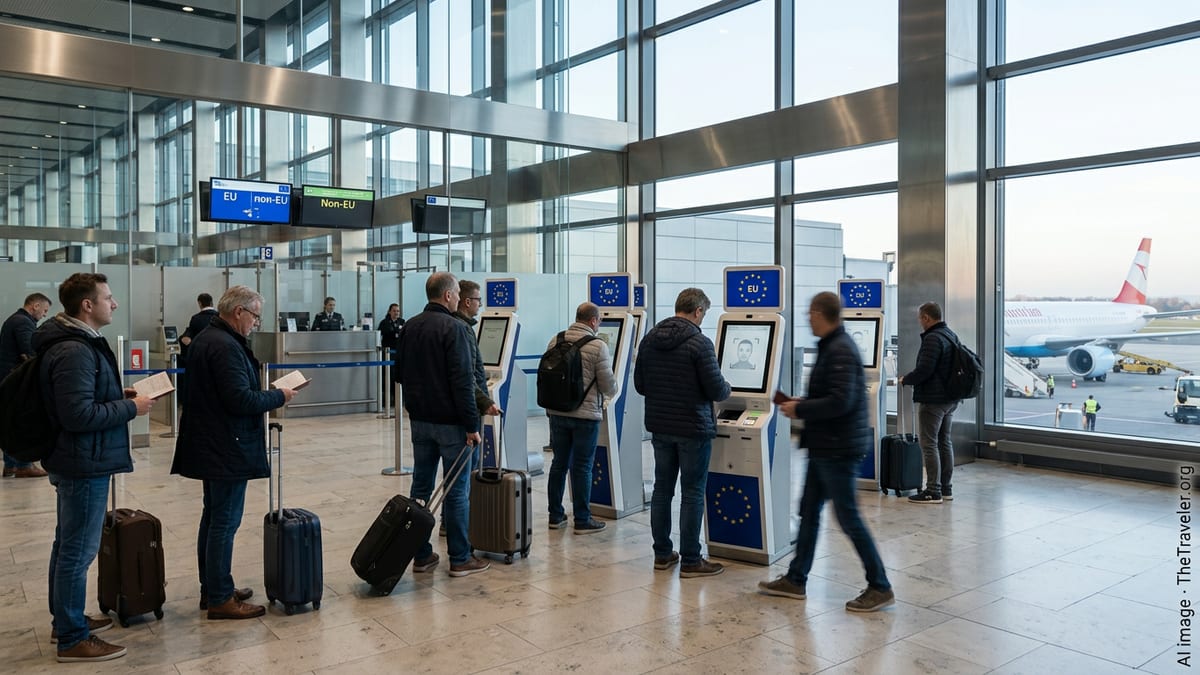
For travelers arriving in France by air, the biggest visible change is at manual border control booths and new biometric kiosks. Reports from French media and travel outlets since April indicate that registration and verification checks are lengthening processing times at several major airports. While delays in France were initially less severe than in countries such as Spain and Italy, more recent coverage points to a clear deterioration as passenger numbers ramp up and the system is used at more lanes and terminals.
At Paris Charles de Gaulle, France’s main long haul gateway, EES has now been rolled out across the non EU arrival flows, with biometric kiosks and upgraded booths handling first time registrations. Travel industry reporting describes CDG as a flagship test location, with France aiming to prove that the system can support high throughput once staff and passengers are familiar with the process. Even so, local press and traveler accounts in May and early June have highlighted morning and evening peaks where non EU visitors have waited one to two hours at border control.
Regional airports that receive seasonal traffic, including Marseille, Nice and Lyon, are also seeing bottlenecks at certain times of day. Coverage from European airport associations suggests that the first registration under EES can still take several minutes per traveler during busy periods, especially when passengers arrive unprepared at the kiosks or when equipment needs to be reset. In smaller terminals with fewer desks, this can quickly translate into long stationary lines stretching back into the arrivals hall.
Industry data cited by airport and airline groups across the continent points to an average increase in border processing times of between 30 and 70 percent since EES went live, with some locations experiencing queues of up to three hours in recent weeks. French platforms are not among the worst affected in Europe, but they are clearly part of the broader pattern of strain while the system beds in.
Summer 2026: Risks Of Severe Delays At Peak Times
The central concern for June through September 2026 is what happens when full summer traffic meets a still maturing border system. International airline and airport bodies have warned in public statements and briefings that waits of four to six hours are possible at the busiest European hubs if contingency plans fail. French airports and operators have been prominent voices in these calls, asking Brussels for explicit permission to throttle or pause EES checks during extreme peaks.
French media reports in February and March described how Paris airport operators and national industry groups lobbied for a longer transition, citing modeling that shows lines spilling far beyond current security and border areas if every non EU passenger needs a full biometric registration in a compressed time window. The European Commission has since clarified that member states, including France, may temporarily reduce the use of biometric capture or revert to simpler checks when objectively justified by congestion, although the expectation remains that full EES use is the norm.
Recent coverage from European news outlets illustrates how this flexibility works in practice. At one English Channel port serving ferries to France, enhanced EES checks were suspended for part of a busy holiday weekend after waits stretched to many hours in the heat, with processing times dropping once the extra steps were lifted. Similar, shorter pauses have been reported at some airports on the continent. Travel analysts say the same playbook is likely to be used at French airports if lines reach critical levels in July and August, though such decisions are taken case by case at local level.
For now, there is no single picture across France. Some flights and terminals are still moving passengers through passport control in under half an hour, while others see queues exceeding two hours at specific peaks. Much depends on staffing, the mix of first time and repeat EES travelers on a flight, and how many biometric kiosks or staffed booths are open at the moment of arrival.
Who Is Affected And How The Process Works In France
EES applies mainly to non EU, non Schengen travelers entering for short stays, including visitors from the United States, the United Kingdom, Canada, Australia and many Asian countries. French and other EU citizens are not enrolled in EES at external borders and generally continue to use e gates or EU lines, while non EU residents holding valid French or EU residence permits are recorded differently under existing systems. However, French and EU nationals who travel on a third country passport instead of their European one may be treated as non EU visitors at the checkpoint, a situation that official French guidance flags as a potential source of unnecessary delay.
At French airports, first time EES registration can take place either at self service kiosks in the arrivals area or directly at the staffed border booth, depending on the airport and the time of day. Travelers are typically asked to scan their passport, have a facial image captured and place fingers on a scanner for prints. The process also records the date, place of entry and intended length of stay. Once this is complete, subsequent trips within the system’s validity period should only require biometric verification, which is expected to be faster.
The system automatically counts the number of days a covered traveler has spent in the Schengen area against the standard 90 days in any 180 day limit. French government information notes that this reduces the room for interpretation at checks but also means overstays are more likely to be detected. Passengers who have made frequent trips in the past on manual stamps may therefore find that the digital calculation is applied more strictly on their next journey.
Importantly, EES is separate from the European Travel Information and Authorisation System, or ETIAS, which is the upcoming online travel authorisation for visa exempt visitors. ETIAS has not yet started as of June 2026, so travelers heading to France this summer face EES registration at the border but do not yet need an approved ETIAS in addition to their passport.
Practical Tips For Managing Airport Waits In June 2026
For travelers planning flights to France in June 2026, public information from airports, airlines and EU institutions all points to the same message: build in extra time and expect variation. Many airports and carriers now recommend arriving earlier than in previous years for flights into the Schengen area, particularly for families, large groups and passengers connecting onward to other destinations after landing. While EES processing happens on arrival rather than departure, disruption at border control can have knock on effects for baggage reclaim and onward transport.
Advance preparation can make the first registration smoother. French and EU guidance stresses the importance of traveling on a biometric passport, removing hats and sunglasses before using cameras and having travel details ready in case of questions. Where airports provide pre registration kiosks or online tools, using them may shorten the time spent at the border booth itself, though availability varies between terminals and is still evolving week by week.
Travelers are also being advised by airlines and consumer groups to check recent reports on their specific arrival airport, as conditions can differ markedly even within the same country. Monitoring airport social media feeds or information boards on the day of travel can alert passengers to unusual congestion or temporary changes in how lanes are organized. If long lines are expected, having water and any necessary medication in hand luggage is recommended, as facilities inside the border control area may be limited.
Looking beyond June, analysts expect the situation in France to gradually stabilize as more travelers complete their first registration and as border staff gain experience with the system. However, with peak summer demand still ahead, the consensus from publicly available reporting is that elevated wait times and occasional severe delays remain a real possibility at French airports while EES continues its first full season in operation.