


More news on this day
A commuter rail collision north of London has left one person dead and close to 90 injured after a moving train struck the rear of a stationary service near Bedford, disrupting a major route into the capital and prompting a large emergency response, according to early reports from Britain on Friday.
Get the latest news straight to your inbox!
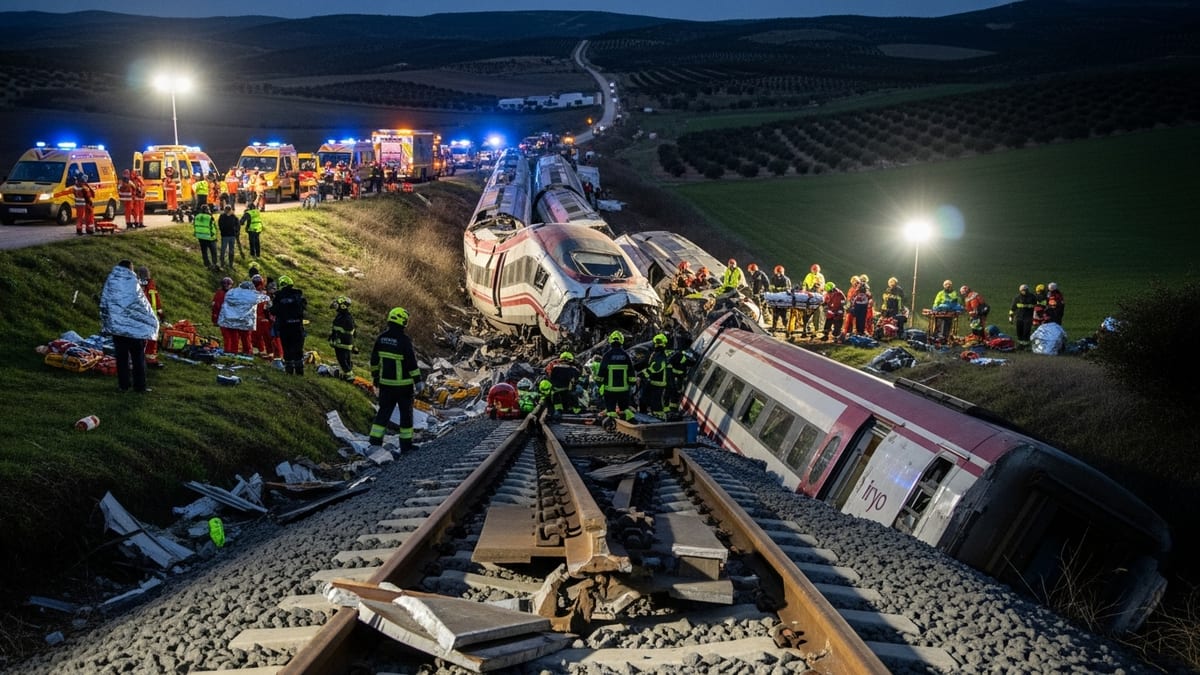
Collision on Busy Corridor North of London
Published coverage indicates that the crash occurred on Friday afternoon near Bedford, a key junction on the Midland Main Line linking towns in central and northern England with London St Pancras. Two southbound services were reported to be on the same route when one train, travelling toward the capital, ran into the back of another that had come to a halt on the line.
Initial tallies cited in local and national media describe one fatality, believed to be a train driver, and a casualty count approaching 90 people with varying degrees of injury. Among those on board, dozens were described as seriously or severely hurt, with many more suffering minor wounds, shock and bruising.
Images and accounts shared in UK media and on social platforms show carriages visibly crumpled at the point of impact and windows shattered, while passengers evacuated along the tracks under the guidance of rail staff and emergency personnel. The section of line was quickly closed in both directions, bringing long-distance and commuter services to a standstill during the evening travel period.
Publicly available rail tracking data cited in reports place the impact shortly after the evening rush began, intensifying the disruption both for passengers on the trains and for those waiting at stations along the route into London.
Major Incident Response and Disrupted Travel
According to published coverage, emergency services from the surrounding counties deployed a substantial response, including multiple ambulances, specialist trauma teams and air ambulance support. Nearby roads were partially closed to allow access for rescue vehicles and to establish a safe perimeter around the crash site.
Hospitals in the region were placed on heightened readiness, receiving patients with suspected fractures, head injuries and other trauma. Passengers with minor injuries or shock were treated at makeshift triage points set up close to the scene before being moved onward or released.
Rail operators and infrastructure managers reported that all lines through the affected section were suspended while safety checks, recovery work and a detailed on-site investigation got underway. Services to and from London St Pancras were heavily curtailed or diverted, with travellers advised to delay journeys or seek alternative routes. Some operators arranged ticket acceptance on other lines where possible, but capacity constraints created significant crowding elsewhere on the network.
With the collision taking place on one of the primary north-south rail arteries, the disruption extended well into the evening, affecting intercity connections and local commuter services far beyond Bedford itself.
Early Focus on Train Movements and Signalling
As information continued to emerge, attention quickly turned to how two southbound trains came to be on the same stretch of track at different speeds. Commentators and rail specialists quoted across British media noted early speculation that the moving train might have passed a signal at danger before striking the stationary service ahead.
Posts on rail enthusiast forums and eyewitness accounts cited by news outlets describe one train reportedly standing on the line due to a technical problem or delay, while a following service approached at normal speed. Some contributors suggested that automatic protection systems may have reduced the impact by braking the moving train, potentially preventing a higher death toll despite the severe collision.
Formal inquiries by Britain’s rail accident investigators typically examine a combination of signalling data, train recorder information, driver procedures and maintenance records. Observers expect the investigation to review whether any equipment malfunction, human error, or communication breakdown contributed to the chain of events north of Bedford.
Until those findings are published, reports emphasize that the precise sequence of events remains unconfirmed, and early commentary from specialists is being treated as provisional.
Passenger Experiences and Local Impact
Accounts gathered from passengers and bystanders in British media describe a sudden, violent jolt as the moving train slammed into the rear of the other service, sending travellers and luggage hurtling forward. Several passengers reported darkened carriages, dust and broken glass, followed by calls to remain calm as staff began evacuations.
Many travellers were led along the track to a safe distance from the damaged carriages, some wrapped in foil blankets and assisted by medics and rail workers. Others were able to leave the scene more slowly, waiting for replacement buses or alternative trains hours after the initial collision.
In Bedford and surrounding communities, the crash quickly became the focus of local concern, with residents reporting the sound of sirens and helicopter activity as emergency units converged. For many commuters, the incident revived memories of previous rare but serious rail crashes in Britain, reinforcing ongoing anxieties regarding capacity pressures and infrastructure resilience on busy corridors into London.
Local businesses around affected stations also experienced the ripple effects, as evening trade was disrupted by stranded passengers and cancelled services, while hotels and guesthouses saw a surge in last-minute requests from travellers unable to complete their journeys.
Renewed Questions Around Rail Safety and Investment
Britain’s rail network is widely regarded as one of the safer systems in Europe, with multiple layers of signalling and automatic train protection designed to prevent serious collisions. Nevertheless, the Bedford crash has triggered renewed debate, reflected in commentary across national press and broadcast coverage, about how effectively those systems perform in high-pressure, real-world conditions.
Transport specialists quoted in recent analyses have highlighted the role of modern safety technology that can slow or stop trains when drivers miss or misinterpret signals, while also warning that older infrastructure, complex timetables and growing passenger numbers can create operational challenges. The incident north of London is already being cited in these discussions as a test case for whether existing safeguards are sufficient on intensively used main lines.
Advocacy groups focused on passenger safety are expected to scrutinize the official investigation’s conclusions once released, particularly regarding compliance with speed restrictions, communication protocols between drivers and control centres, and contingency plans when a train becomes immobilized on a busy section of track.
For travellers planning rail journeys in and out of London in the coming days, transport bulletins and operator announcements are likely to remain important sources of information, as the network adjusts schedules, removes damaged equipment and undertakes any urgent inspections recommended in the immediate wake of the collision.