


More news on this day
Frankfurt Airport recorded a sharp drop in passenger traffic in April, handling about 4.8 million travelers as strikes, geopolitical tensions and softening long-haul demand combined to hit key markets including the United States, China, India and the Gulf.
Get the latest news straight to your inbox!
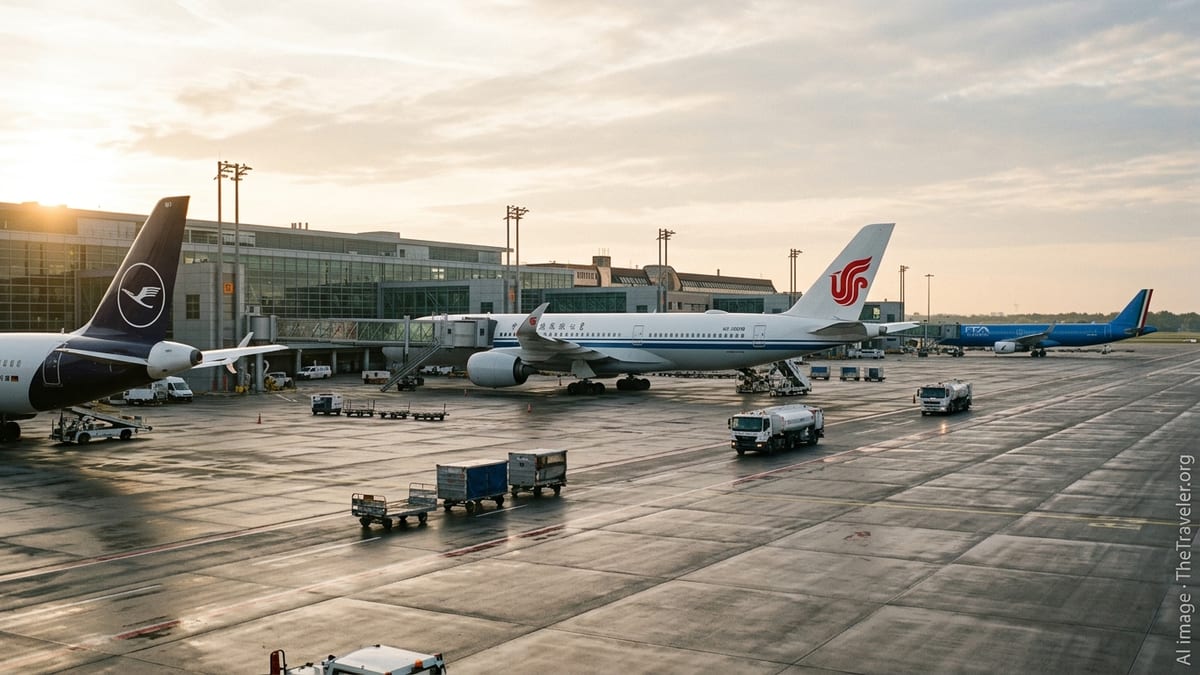
Frankfurt Traffic Slides After a Strong March
Newly released figures indicate that passenger numbers at Frankfurt Airport fell roughly 11 percent year on year in April, to around 4.8 million travelers. The setback contrasts with March, when Germany’s busiest hub handled about 4.7 million passengers and managed a modest increase compared with the previous year despite operational headwinds.
The April decline follows several months of gradual recovery in European aviation and breaks the pattern of incremental growth seen through early 2026. Analysts following the traffic data note that the month’s performance leaves Frankfurt further below its pre-pandemic peak and underscores how sensitive hub operations remain to labor disputes and global tensions.
Industry coverage also highlights that other major European gateways, while still growing in annual terms, have reported slower momentum this spring as macroeconomic uncertainty and elevated airfares weigh on discretionary travel. In this context, Frankfurt’s double-digit contraction stands out as one of the more pronounced reversals among large European hubs.
For airport operator Fraport, the weaker April figures will temper the optimism built up after a stronger first quarter and the much-anticipated opening of the new Terminal 3 complex, which was timed to support long-haul growth in the coming summer season.
Strikes, Middle East Conflict and Network Disruptions
Labor unrest played a central role in Frankfurt’s April downturn. Reports on German aviation indicate that strikes affecting Lufthansa and ground services disrupted schedules, forcing cancellations and reroutings at one of Europe’s most complex hubs. Each wave of industrial action tends to hit transfer-heavy airports particularly hard, as missed connections quickly propagate across long-haul networks.
At the same time, airlines continued to navigate a volatile security environment across the Middle East, a critical corridor for Europe–Asia and Europe–Gulf traffic. Reroutes around conflict zones have lengthened flight times and tightened capacity on some sectors, while persistent uncertainty has deterred a portion of leisure and business travelers from itineraries involving the Gulf and nearby regions.
Publicly available aviation and shipping assessments suggest that these route disruptions are adding costs for carriers and constraining the flexibility needed to restore pre-crisis frequencies. In Frankfurt’s case, the combination of labor disruption at home and airspace pressures abroad has reduced the reliability that is essential for a global transfer hub.
Industry commentary also notes that high jet fuel prices and capacity constraints have encouraged airlines to prioritize yield over volume on certain long-haul markets. This approach can support revenues but often results in thinner schedules and fewer marginal passengers, which is reflected in the month’s lower headcount through Frankfurt.
US, China, India and Gulf Demand Loses Momentum
Within the headline decline, long-haul markets stand out as particular weak spots. Traffic data and regional breakdowns cited in recent coverage show that routes linking Frankfurt with North America, China, India and the Gulf have cooled compared with earlier in the recovery cycle.
On US routes, travel volumes remain substantial but appear to have plateaued amid slower economic growth and tighter corporate travel budgets. High transatlantic fares, which many carriers have maintained even as fuel costs eased, are also prompting some leisure passengers to defer or downscale trips.
Travel flows between Europe and China have been slower to normalize than many airlines once anticipated. Capacity constraints under bilateral limits, lingering visa frictions and a still-fragile outbound Chinese tourism sector are combining to keep demand below pre-pandemic benchmarks. This is particularly visible at European hubs like Frankfurt that historically relied on dense China networks.
India and Gulf routes, meanwhile, are affected both by the broader Middle East security backdrop and by recalibrated schedules as airlines account for longer routings and slot pressures. Demand from the large South Asian diaspora remains resilient, but higher prices and fewer convenient one-stop options through Frankfurt are encouraging some passengers to favor alternative hubs in the Gulf, Turkey or Southern Europe.
Major Global Carriers Feel the Pinch
The traffic slump has implications across the portfolio of airlines that depend on Frankfurt for long-haul connectivity. Lufthansa, which operates its primary intercontinental hub at the airport, faces the most direct impact, with lower transfer volumes and reduced feed for its transatlantic and Asia-Pacific networks.
Foreign carriers are also exposed. United Airlines and Delta Air Lines use Frankfurt as an important European gateway for US-bound passengers, especially on routes linking major American hubs with Germany and beyond. Weaker demand and disrupted connections can erode the profitability of these services and may lead to schedule fine-tuning ahead of the peak summer season.
Emirates, Qatar Airways and other Gulf carriers compete aggressively for Europe–Asia and Europe–Africa traffic, and Frankfurt is among the key European cities they serve. A slowdown in flows between Germany, the Gulf and onward destinations in India and Southeast Asia reduces the feeder potential that underpins these airlines’ multi-hub strategies.
British Airways, while centered on London Heathrow, also taps Frankfurt-origin passengers for its global network via code-share and alliance partnerships. Softer German-origin traffic to long-haul markets can therefore ripple across alliance platforms, affecting load factors on connecting flights that originate outside Germany.
Outlook for Summer and Capacity Adjustments
With the April setback now visible, attention is turning to how airlines and Fraport will adjust capacity and operations heading into the key summer travel period. Early indications from network planning updates suggest a cautious stance, with carriers emphasizing flexibility rather than aggressive growth.
Some long-haul operators are expected to trim frequencies on underperforming routes, swap in smaller aircraft during shoulder periods or concentrate capacity on corridors that continue to show robust premium and leisure demand. This kind of fine-tuning may stabilize yields but is unlikely to restore Frankfurt to earlier passenger peaks in the near term if macro and geopolitical pressures persist.
On the infrastructure side, the recent opening of Frankfurt’s Terminal 3 adds modern gate capacity and is intended to improve the passenger experience for long-haul travelers. However, the benefits of the new terminal will depend on airlines’ willingness to deploy additional widebody aircraft and rebuild frequencies on the very routes that are currently softening.
Market observers will be watching May and June traffic figures closely for signs that the April slump was a one-off shock driven by strikes and acute disruptions, or the start of a more persistent slowdown in long-haul demand between Germany, North America, Asia and the Gulf.