


More news on this day
A coalition of leading French industrial groups led by Technip Energies, together with Airbus, Safran and agri‑industrial cooperative Tereos, is preparing to establish a new joint venture in France dedicated to producing sustainable aviation fuel, in a move that aims to accelerate the decarbonisation of European air travel.
Get the latest news straight to your inbox!
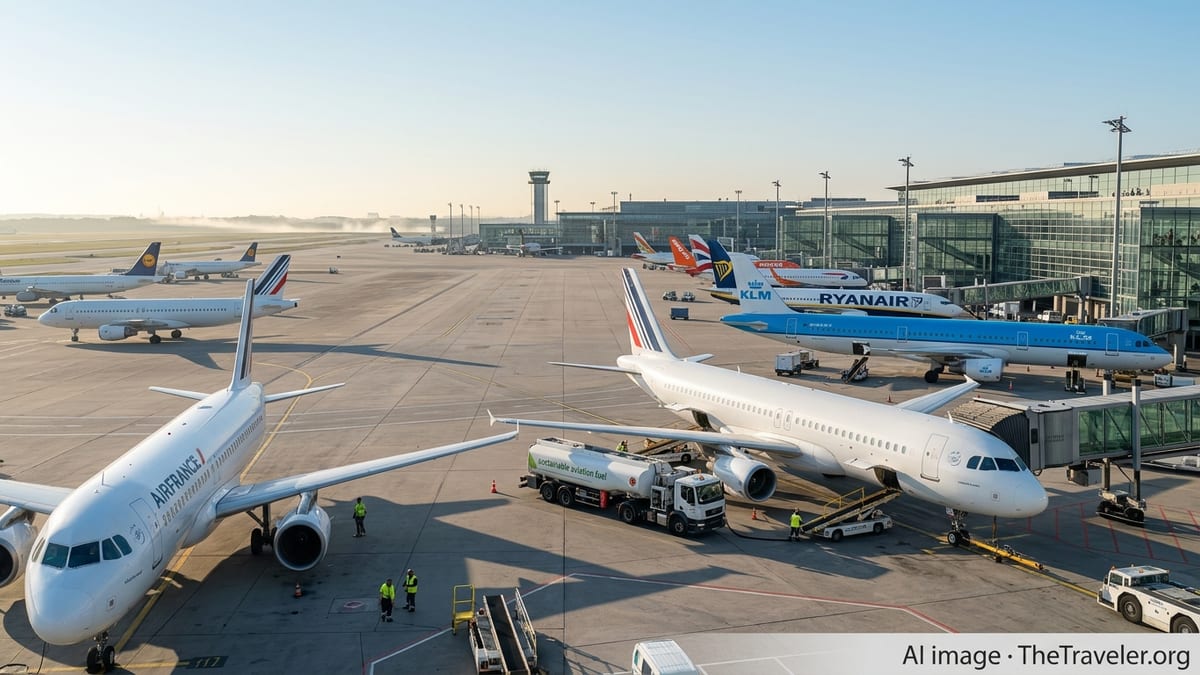
New Joint Venture Targets Industrial-Scale SAF in France
According to publicly available information from the companies involved and French business media coverage, the planned joint venture would combine Technip Energies’ process engineering expertise with the aviation know-how of Airbus and Safran and the biomass feedstock capabilities of Tereos. The partners are reported to be working on an industrial project that could supply low-carbon fuel to both domestic and international airlines operating in and out of France.
Reports indicate that the venture would focus on producing sustainable aviation fuel compliant with international jet fuel specifications, allowing it to be blended with conventional kerosene without modifications to existing aircraft or airport fuel infrastructure. This drop-in compatibility is considered essential for rapid deployment across airline fleets over the coming decade.
The initiative comes as France positions itself as a European hub for low-carbon fuels. Publicly available information shows that Technip Energies is already active in SAF-related projects at the Grandpuits biorefinery platform and in several European e-fuels initiatives, while Airbus and Safran have been trialling higher SAF blend ratios on test flights and developing future aircraft architectures with lower lifecycle emissions.
While specific capacity figures for the new joint venture have not yet been disclosed in open sources, industry analysts quoted in French trade coverage suggest that the partners are likely targeting a plant scale capable of producing several hundred thousand tonnes of SAF annually once fully ramped up, in order to make a meaningful contribution to upcoming European fuel mandates.
Strategic Alliance of Energy, Aerospace and Agri-Industry
The planned collaboration brings together four players occupying different but complementary positions in the future SAF value chain. Technip Energies has built a portfolio in biorefining, power-to-liquids and carbon management technologies, providing the process design and project delivery skills required to build complex fuel plants. Public corporate materials highlight its role in engineering both bio-based and synthetic fuel facilities in Europe and beyond.
Airbus has been active in promoting SAF as a key lever to reduce lifecycle emissions from existing aircraft, while it works on longer-term technologies such as hydrogen propulsion and advanced aerodynamics. Company documentation notes that all modern Airbus aircraft are already certified to fly with up to a 50 percent blend of SAF mixed with conventional jet fuel, and test campaigns are under way to validate higher blend levels on specific models.
Safran, which manufactures aircraft engines and propulsion systems, has been developing turbine technologies compatible with higher SAF use, alongside research into ultra-efficient regional aircraft configurations through European clean aviation programs. Publicly available information on these programs underlines that improved engine efficiency and greater SAF uptake are expected to work in tandem to cut per-flight emissions.
Tereos, for its part, is one of France’s major producers of sugar, starches and related agricultural products. Industry coverage indicates that the cooperative has been exploring ways to valorise agricultural residues and byproducts, a feedstock pool that is increasingly targeted for advanced biofuel production to avoid competition with food crops. Its role in the joint venture would likely centre on securing and conditioning this biomass supply.
Responding to ReFuelEU and Airline Climate Commitments
The timing of the joint venture aligns closely with tightening European Union rules on aviation emissions. The ReFuelEU Aviation regulation is phasing in minimum SAF blending requirements for fuel supplied at EU airports over the next two decades, with the first binding thresholds entering into force this decade. Public policy analyses emphasise that these mandates are designed to unlock investment in new production capacity by providing predictable demand.
French and European airlines have also been announcing voluntary decarbonisation roadmaps, frequently highlighting SAF as a central tool to cut emissions from long-haul operations where alternatives such as full electrification are not yet feasible. By situating production in France, the new venture could offer carriers a domestic supply option that helps reduce logistical complexity and supports national industrial strategy.
Sector observers note that reliable, large-scale SAF production within the European single market is likely to become a competitive factor for airports and airline hubs. Facilities developed under the Technip Energies, Airbus, Safran and Tereos partnership would therefore not only contribute to environmental targets but could also support the attractiveness of French airports as transfer points in global networks.
However, industry analyses caution that achieving cost parity with fossil jet fuel remains a major challenge. Early SAF plants generally require substantial capital investment, and fuel prices remain higher than conventional kerosene. The success of the joint venture will likely depend on a combination of technology learning curves, favourable policy frameworks and the willingness of airlines and passengers to bear a modest price premium in the short to medium term.
Technology Pathways: From Biomass to Advanced e-Fuels
Technip Energies’ existing portfolio suggests that the venture could pursue multiple technological pathways for SAF production. The company is already involved in biofuel units that process waste oils and residues, as well as in power-to-liquids projects that combine green hydrogen with captured carbon dioxide to create synthetic hydrocarbons. Public project documentation in Denmark, the Netherlands and France shows that these approaches are moving from pilot to commercial scale.
Given Tereos’ agricultural base, French analysts have pointed to advanced biofuels using residues from sugar and starch production as a likely starting point. Such feedstocks can be converted into aviation-grade fuels using established processes, while avoiding direct land-use change impacts. Over time, the venture could integrate more synthetic or so-called e-fuel volumes as renewable electricity capacity expands and green hydrogen costs decline.
Airbus and Safran are expected to provide operational feedback on fuel performance, drawing on flight test data and collaborations with airlines. Publicly available information from both companies underlines that they have been conducting trials with different SAF blends and pathways to validate combustion characteristics, engine wear behaviour and emissions performance across a variety of aircraft types.
Observers of the European aviation transition note that combining these upstream and downstream perspectives within a single industrial venture could shorten development cycles and help standardise new fuel specifications more quickly, benefiting both regulators and aircraft operators as SAF becomes an increasingly large share of the jet fuel mix.
Broader Implications for French Aviation and Regional Economies
For France, the emerging joint venture is part of a broader effort to anchor high-value industrial activity linked to the energy transition. Regional economic studies cited in national press coverage suggest that SAF plants of the scale being discussed can generate hundreds of direct jobs and a larger number of indirect positions across construction, logistics and feedstock supply chains.
Locating production close to major transport corridors could also support the decarbonisation of related sectors such as road freight and shipping, since many of the underlying technologies used for SAF can produce other low-carbon fuels and chemical intermediates. Technip Energies’ published market strategy references this cross-sector potential as a way to improve project economics through integrated biorefineries.
At the same time, environmental organisations and local communities are expected to scrutinise new projects, particularly with respect to land use, biodiversity impacts and lifecycle greenhouse gas savings. Analysts note that advanced biofuels and e-fuels generally deliver higher emissions reductions than first-generation biofuels, but require robust sustainability certification and transparent monitoring of supply chains.
As plans for the Technip Energies, Airbus, Safran and Tereos joint venture advance, the project is likely to become a focal point for debates about how quickly European aviation can reduce its climate footprint while preserving connectivity and economic benefits. For travellers, the initiative underscores that the fuel powering flights within and beyond France is set to change significantly over the coming decade, even as the aircraft themselves still look familiar from the outside.