


More news on this day
Celestyal has completed the rollout of guest‑experience tablets to every cabin across its fleet, marking one of the most comprehensive in‑room technology upgrades currently seen in the cruise sector.
Get the latest news straight to your inbox!
From Pilot Project to Fleetwide Feature
The tablet initiative began as a focused deployment on the Celestyal Journey, where all 630 staterooms were fitted with SuitePad devices in early 2026. Reports indicate that this made the ship one of the first in the industry to offer a dedicated guest‑experience tablet in every cabin on a single vessel, setting a benchmark for mid‑size cruise operators.
Following positive feedback and wider coverage of the program, Celestyal extended the technology to Celestyal Discovery, bringing tablets to every stateroom on its second core ship. Recent trade updates and company materials now describe the project as fully implemented, with in‑cabin tablets positioned as a standard feature rather than a limited pilot.
The completion of this rollout gives Celestyal a clearly defined digital layer to its onboard product, aligning it with a broader travel trend in which airlines, hotels, and cruise lines are using connected devices to centralize information and services. For passengers, the tablet is designed to serve as a single, always‑available touchpoint within the cabin.
Industry observers note that the move allows a relatively small brand to stand out in a crowded Mediterranean and Middle East cruise market, where many travelers compare ships not only on itineraries and price but also on how easy it is to personalize and manage the onboard experience.
What the Tablets Actually Do Onboard
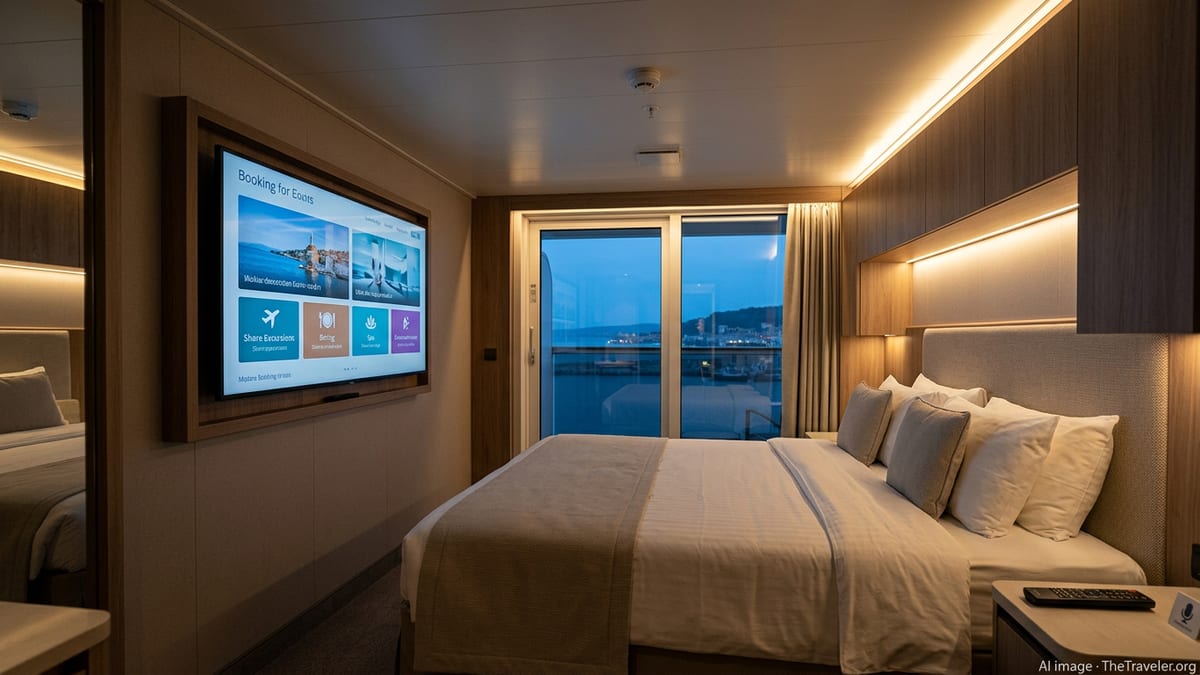
The SuitePad units installed across Celestyal’s cabins function as a digital hub for daily life at sea. According to publicly available information from the cruise line and its technology partner, the devices consolidate the daily program, dining options, shore excursion details, spa information, and entertainment schedules into an interactive interface that can be accessed at any time.
Guests can use the tablets to browse and book shore excursions, request room service, schedule specialty dining, and review onboard accounts without visiting guest services in person. The devices are also configured to push time‑sensitive updates, such as changes to port times, safety reminders, or promotional offers, directly into the stateroom environment.
In addition to transactional functions, the tablets are used as an information and messaging platform. Travelers can review port guides, learn about onboard activities, and check details of package inclusions from a single screen. For crew, the system is intended to streamline how information flows between departments and cabins, reducing the need for printed materials and repeated announcements.
Technology suppliers involved in the program position these devices as a step toward fully connected cabins, where guests engage with the ship’s services in a similar way to a modern hotel stay. In the cruise context, that means adapting to variable connectivity at sea while still offering an interface that feels familiar to smartphone and tablet users.
Environmental and Operational Drivers
The push to install tablets in every cabin is partly framed around efficiency. By digitizing daily newsletters, menus, and excursion brochures, Celestyal is able to reduce the volume of printed paper delivered to staterooms each day. Industry coverage highlights this shift toward “paper light” cruising as a response both to environmental expectations and to operational cost pressures.
Traditional cruise operations can require thousands of sheets of paper per sailing for printed programs, forms, and advertising leaflets. Moving these materials onto an in‑cabin tablet decreases waste and lessens the logistical work of printing, distributing, and then collecting outdated documents as itineraries progress.
From an operational standpoint, a centrally managed tablet system makes it easier to update information close to real time. If a port call changes due to weather or a tour sells out unexpectedly, schedules and availability can be revised once in the back‑end system and reflected in every cabin at once, instead of relying on ad hoc paper notices.
Observers also point out that digital channels provide more precise insight into guest behavior. Usage data can show which excursions are searched most often, which restaurants attract last‑minute bookings, and how passengers interact with onboard advertising. That level of detail is difficult to gather from printed leaflets alone, and it can inform future itinerary planning and onboard product decisions.
How Celestyal’s Rollout Fits Into Wider Cruise Tech Trends
The completion of Celestyal’s in‑cabin tablet rollout comes as cruise lines across segments experiment with different forms of digital personalization. Large operators have focused heavily on mobile apps, wearable devices, and AI‑enabled chat services, while smaller and regional brands have tended to prioritize targeted enhancements that can be implemented quickly across compact fleets.
In this context, Celestyal’s approach reflects a strategy of embedding technology directly in the cabin rather than relying solely on guests’ personal devices. For passengers who prefer to disconnect from their own phones while on vacation, a dedicated in‑room tablet offers access to digital convenience without requiring constant engagement with a personal screen.
At the same time, the rollout intersects with a growing emphasis on connectivity at sea, as ships add bandwidth and upgrade internal networks. Tablets that tap into onboard systems can operate independently of paid internet plans, giving guests an always‑on link to shipboard services even when external connectivity is limited or switched off.
Cruise industry trend reports suggest that future refurbishments and newbuilds are likely to integrate similar devices into staterooms, either through tablets, smart televisions, or wall‑mounted touchscreens. Celestyal’s early adoption of a dedicated tablet platform on all cabins positions it among the first wave of operators to treat this technology as a core part of the onboard product, rather than an optional extra.
Implications for Guests and the Competitive Landscape
For travelers considering Celestyal, the completed tablet rollout adds a clearly defined digital feature to a product otherwise known for destination‑focused itineraries and mid‑size ships. Prospective passengers comparing lines in the Eastern Mediterranean and Arabian Gulf may now weigh cabin technology alongside route, pricing, and inclusions.
The impact is likely to be felt most strongly among guests who value self‑service options. Being able to change dining times, explore excursions, or clarify account charges without queuing at a desk can reduce friction, particularly on days when ships are full and schedules are tight.
Analysts following cruise technology note that such projects can also shape expectations across the sector. Once a certain level of cabin technology becomes standard on one line, it can quickly become a reference point for travelers who then look for similar functionality elsewhere. That dynamic may encourage other operators, especially in the mid‑market, to accelerate their own digital cabin upgrades.
For now, Celestyal’s move underscores how cruise lines increasingly view in‑room technology as part of their brand identity. With the tablet rollout complete, the company has created a platform it can build on through software updates and new services, without needing to rework the physical cabins each time passenger expectations evolve.