


More news on this day
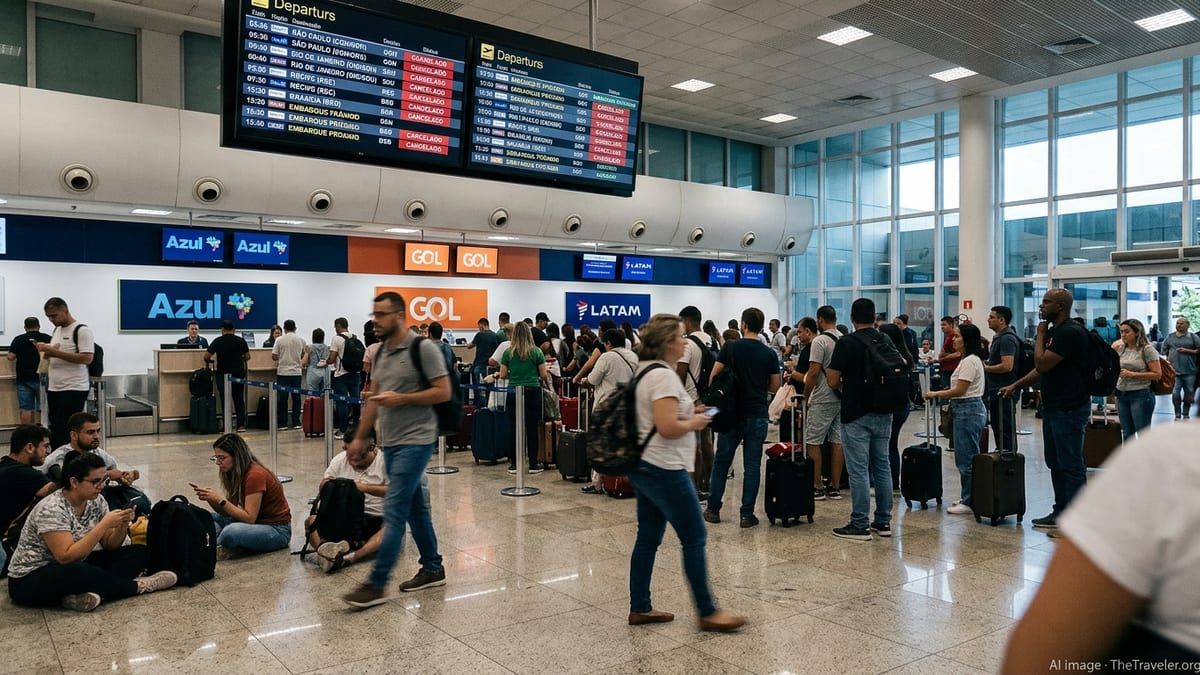
Travelers in Brazil faced fresh disruption this week as eight new flight cancellations involving Azul, LATAM, GOL, and United Airlines rippled across key domestic and international corridors, stranding hundreds of passengers at some of South America’s busiest hubs.
Get the latest news straight to your inbox!
New Cancellations Snarl Brazil’s Busiest Corridors
Operational data and real-time tracking platforms on Thursday, May 14, indicate that a new cluster of cancellations has emerged across Brazil’s dense air network, affecting services operated or marketed by Azul, LATAM, GOL, and United Airlines. The disruptions are concentrated on strategic routes linking São Paulo, Rio de Janeiro, Campinas, Recife, and long-haul destinations such as Chicago, underlining the vulnerability of key South American hubs when multiple carriers adjust schedules on the same day.
According to publicly available flight-status boards, at least eight flights involving these four airlines were marked as canceled over a short window, including both domestic legs within Brazil and international services to and from the United States. While some cancellations appear on codeshare services, the net impact for travelers is similar: fewer available seats, longer waits for rebooking, and mounting uncertainty for those with tight connections onward in Latin America, North America, and Europe.
Preliminary information suggests that the cancellations are not tied to a single root cause, but rather a mix of operational and network factors, from aircraft rotation issues on domestic shuttles to knock-on effects from earlier delays. In a market where Azul, LATAM, and GOL already run high-frequency schedules to feed massive hubs like São Paulo–Guarulhos and Campinas–Viracopos, even a modest cluster of cancellations can quickly expand into wider disruption.
Routes to Chicago, Campinas, Rio, and Recife Among the Worst Hit
Among the most notable changes flagged on Thursday are disruptions on Brazil–United States services involving United Airlines and its codeshare partners, affecting itineraries that rely on Chicago as a key North American gateway. Publicly available information shows select Brazil–Chicago connections appearing as canceled or unavailable in booking systems, forcing passengers to be re-routed via alternative hubs or pushed onto later departures.
Within Brazil, cancellations and irregular operations are particularly visible on trunk routes linking São Paulo with Rio de Janeiro, Campinas, and Recife. These corridors function as arterial links for Azul, LATAM, and GOL, which jointly control the majority of Brazil’s domestic market and depend on rapid aircraft turnarounds at Guarulhos, Congonhas, Galeão, and Viracopos to sustain their dense shuttle schedules.
Recent data from Brazilian aviation trackers and media monitoring has already highlighted elevated disruption levels at São Paulo–Guarulhos in April, with dozens of delays and several cancellations clustered within short time frames and affecting networks operated by Azul, LATAM, and GOL. The fresh wave of eight cancellations now reported across multiple hubs appears to extend that pattern, catching travelers off guard just as Brazil enters a busier midyear travel period.
Recife, an increasingly important gateway to Brazil’s northeast, has also seen irregularities on routes to and from São Paulo in recent weeks. Traffic statistics and route data indicate that Recife–São Paulo is one of the most heavily served domestic corridors, with Azul, LATAM, and GOL all operating regular services. When one or more carriers pull flights from such a saturated trunk route, remaining departures can quickly become oversubscribed.
Passengers Stranded and Rebooking Under Brazil’s Consumer Rules
For passengers on the ground, the immediate reality is long queues at service counters and tight competition for seats on alternative flights. Travel-rights organizations and consumer websites in Brazil advise that, under national civil aviation regulations, airlines are obligated to offer re-accommodation at no additional cost in cases of cancellation, as well as meal vouchers, lodging where necessary, and, in some circumstances, full refunds.
Publicly available guidance from Brazil’s National Civil Aviation Agency and consumer-protection bodies stresses the importance of documentation. Travelers are urged to keep boarding passes, receipts, and screenshots of flight-status changes when seeking compensation or reimbursement for additional expenses such as hotels and ground transport. Disruption records from earlier weather events and infrastructure failures in Brazil show that claims processes can stretch over weeks or months if paperwork is incomplete.
Industry observers note that Brazil’s long-haul passengers are particularly exposed when cancellations hit long-distance links to hub cities such as Chicago. Missed onward connections can reverberate across multi-leg itineraries, complicating the question of which airline is responsible for assistance and reimbursement when several carriers are involved on a single ticket or through codeshare arrangements.
Travel experts frequently recommend that passengers in Brazil monitor their flights not only through airline apps, but also via independent tracking tools that log delays and cancellations in near real time. As seen in previous disruption episodes at São Paulo–Guarulhos and Rio de Janeiro, the earliest warnings of mounting irregularities often appear first on these independent dashboards.
Airlines Under Pressure as Capacity Stretches and Demand Grows
The latest cancellations come at a moment of intense pressure for Brazil’s carriers. Market analyses and recent financial disclosures show that LATAM, GOL, and Azul are all competing aggressively for domestic share while simultaneously trying to rebuild and expand long-haul networks. Reports on Azul’s network strategy highlight Campinas–Viracopos as a fast-growing hub with relatively limited head-to-head competition on many routes, raising questions about how delicate that hub structure becomes when several rotations are lost in a single day.
Industry reports also point to constrained spare capacity across South American fleets as aircraft deliveries face delays and crews remain tightly scheduled. Recent coverage on Brazil’s aviation sector has emphasized that even short disruptions in ground handling or crew availability at central hubs can trigger a chain reaction of delays and cancellations stretching across multiple rotations in a day’s flying program.
United Airlines, which relies on code sharing and strategic partnerships to extend its reach into secondary Brazilian cities, is simultaneously managing its own transcontinental schedule pressures in North America. When long-haul aircraft assigned to routes such as Chicago–São Paulo experience unplanned maintenance or upstream delays, the knock-on impact can be immediately felt in South American connectivity.
Analysts tracking Latin American aviation caution that these dynamics are unfolding against a backdrop of rising regulatory scrutiny in Brazil. Recent proceedings by the country’s competition authority into possible pricing alignment on domestic routes underscore the sensitivity around capacity deployment, route concentration, and consumer impact when major carriers reconfigure or cut frequencies.
What Travelers Should Watch in the Coming Days
While Thursday’s tally of eight cancellations is modest compared with the hundreds of daily departures handled at Brazil’s main airports, recent disruption patterns suggest that travelers should remain vigilant over the next several days. Operational data from earlier episodes at Guarulhos, Congonhas, and Galeão indicates that small clusters of cancellations can foreshadow wider schedule reshuffles, particularly when tied to aircraft repositioning or weather systems affecting multiple regions.
Travel planners recommend that passengers with imminent trips involving Chicago, Campinas, Rio de Janeiro, Recife, or connections through São Paulo’s airports build extra buffer time into itineraries and avoid ultra-tight self-connections between separate tickets. Those relying on late-evening arrivals to connect onto early-morning domestic departures may be especially vulnerable if the disruption pattern widens.
Passengers are also being encouraged by travel advocates to proactively check whether their flights are part of a codeshare arrangement. When a ticket is sold under one airline’s code but operated by another, responsibility for assistance and rerouting can be complex, particularly in cross-border scenarios where both Brazilian and foreign consumer rules may apply.
With Brazil’s air traffic forecast to continue growing through the second half of 2026, analysts say that how Azul, LATAM, GOL, and United respond to this latest round of cancellations will be closely watched as an indicator of the region’s operational resilience. For now, stranded travelers at Brazil’s busiest terminals are feeling the immediate consequences of a fragile network stretched close to its limits.