


Few landmarks tell the story of Istanbul as vividly as Galata Tower. Rising over the modern Beyoğlu district, it has watched Crusaders and caravans, Ottoman fire brigades and steamships, and today’s café-hopping visitors drift along the Golden Horn. To understand the city’s layered history, it is worth climbing the tower not just for the view, but for the centuries of stories embedded in its stone.
Get the latest updates straight to your inbox!
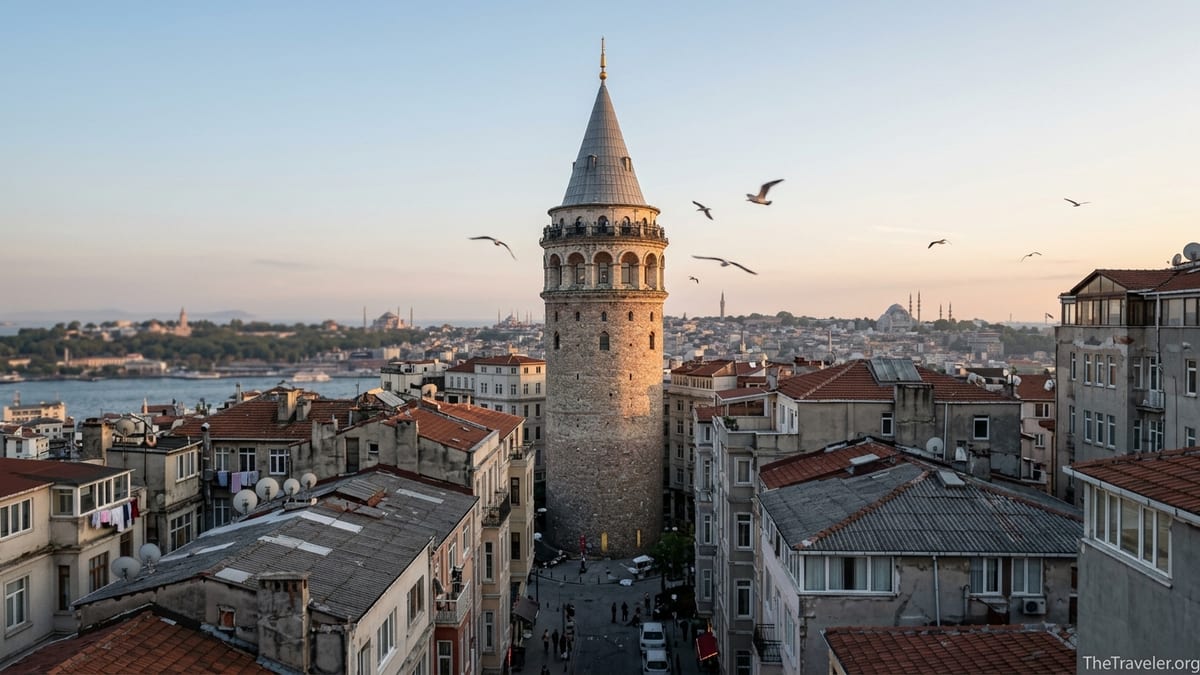
Genoese Galata: A Latin colony above the Golden Horn
Long before the tower became a postcard icon, Galata was a foreign quarter on the edge of Byzantine Constantinople. In the 13th century, Genoese merchants secured trading privileges north of the Golden Horn, building a fortified enclave known as Pera or Galata. Here, among warehouses, counting houses, and narrow lanes sloping toward the docks, they controlled grain, silk, and spice traffic that passed through the imperial capital.
The Genoese first built a defensive tower on this hilltop site in the Byzantine era, but the stone structure visitors see today dates to 1348. Known to its builders as the Christea Turris, or Tower of Christ, it rose at the highest point of the Genoese walls, part lookout, part symbol of the colony’s wealth. When you stand today in the small square at its base, it helps to imagine those walls running downhill toward Karaköy, enclosing an Italianate town of loggias, churches, and stone houses clustered around the harbor.
For modern travelers, traces of this Latin past survive in Galata’s urban fabric. Walking the streets between the tower and the Karaköy tram stop, you still pass facades with Latin inscriptions, fragments of former walls, and churches with Italian names. Many visitors stop for coffee in contemporary cafés that occupy what were once Genoese warehouses. Looking up from your table toward the tower’s conical roof, you are literally sitting in what used to be the commercial engine room of a medieval Mediterranean trading empire.
Because the tower was the highest point in the area, it functioned much like a medieval radar station. Guards scanned the mouth of the Bosphorus for hostile fleets and watched the harbor traffic that made or broke fortunes in Genoa and Constantinople alike. Today’s panoramic views over ferries, container ships, and cruise liners are a direct continuation of that maritime role, just with very different cargo.
From conquest to continuity: Galata Tower in the early Ottoman centuries
When Mehmed II conquered Constantinople in 1453, the Genoese in Galata negotiated relatively favorable terms, but their political autonomy soon faded. The walls were gradually diminished or demolished over later centuries, and the once Italian quarter became another neighborhood of a growing Ottoman capital. The tower, however, was too strategically useful to abandon. It was absorbed into the new regime’s infrastructure as a lookout over one of the busiest waterways in the world.
Ottoman authorities used Galata Tower for a variety of functions. At different times it served as a vantage point for spotting enemy ships, a lookout over the bustling shipyards and customs quays of the Golden Horn, and a place to monitor weather and sea conditions. In plans and engravings from the 16th and 17th centuries, the tower is a constant element in the skyline, just as it is in the countless photos taken by visitors from ferries shuttling between Karaköy and Eminönü today.
Beginning in the 16th century, the Ottomans developed increasingly organized fire brigades, and the tower’s height made it the ideal place to identify smoke early. Wooden houses and narrow lanes across Istanbul turned any spark into a potential citywide disaster, so a clear line of sight mattered. This is the period when Galata Tower’s identity began shifting from pure military watchpost toward the fire observation role that would define it for centuries.
For travelers trying to picture this transition, a simple exercise helps. From the tower balcony, look down toward the tightly packed streets of Cihangir and Fındıklı. Imagine those neighborhoods built almost entirely of timber, heated by charcoal braziers and oil lamps. An Ottoman fire watcher on duty at the tower would have scanned a landscape of flammable roofs stretching all the way to the city walls, fully aware that spotting a thin column of smoke a few minutes earlier could save entire districts.
Fire watchers on the skyline: Galata’s role in protecting a wooden city
By the 18th century, Galata Tower was firmly established as one of Istanbul’s primary fire watchtowers. Watchmen stationed at the top floor scanned the horizon day and night, particularly in dry, windy seasons when a single kitchen blaze could leap from roof to roof. They used lamps, flags, and sometimes cannon shots to signal the direction of a fire to brigades on the ground, who raced through the streets with leather buckets and hand pumps.
Several major fires scarred both the neighborhood and the tower itself. In 1794 a serious blaze damaged the upper sections, prompting a significant repair campaign. During this work, the Ottomans altered the structure, adding a new roof profile and creating a coffee house on the upper floor. Visitors in the early 19th century describe locals climbing the tower not only in search of views, but to sit over coffee or sherbet while watching the city they were charged with protecting.
The tower burned again in 1831, leading to more reconstruction and another rethinking of its top. Each fire left traces: charred beams replaced by new timbers, roof shapes subtly revised, internal wooden staircases patched or rebuilt. When you walk the museum route today and see the exposed masonry and modern concrete stairs, you are also looking at the accumulated scars of a building that spent centuries at direct risk from the very danger it monitored.
To appreciate how crucial this role was, consider the sheer frequency of urban fires in Ottoman Istanbul. Historical accounts speak of blazes that destroyed thousands of houses at a time, sometimes on both sides of the Golden Horn. A watcher on Galata Tower might see flames in Fatih, then hours later another plume rising in Üsküdar. For modern visitors arriving by metro to Şişhane or Karaköy, it is easy to forget that these dense, now largely stone neighborhoods were once tinderboxes, and that the tower’s vigilance could mean the difference between a contained incident and the loss of an entire quarter.
Legends, lore, and the human stories of the tower
Beyond its practical functions, Galata Tower attracted myths that still shape how visitors experience it. The most famous is the tale of Hezarfen Ahmed Çelebi, the 17th century figure said to have strapped on wooden wings and leapt from the tower, gliding across the Bosphorus to Doğancılar Square in Üsküdar. The only detailed account of this feat comes from the Ottoman traveler Evliya Çelebi, so historians treat it as legend rather than documented fact, but the story has become part of Istanbul’s identity.
Inside the museum today, you will find exhibits and models that present Hezarfen’s flight as folklore linked to the city’s fascination with the skies. Turkish children’s books, television programs, and even the name of a small general aviation airfield west of Istanbul keep his memory alive. As a visitor, you might buy a souvenir magnet showing a tiny winged figure soaring away from the tower, a reminder that this solid stone structure has also been a launchpad for imagination.
Another enduring piece of lore concerns romance. A popular modern belief claims that if two people who are destined for each other climb Galata Tower together for the first time, they will eventually marry. If they have been up before with different partners, the spell is supposedly broken. While this is not a historical Ottoman story, it has become embedded in local pop culture. In the evenings, you can still see couples queuing together in the small square, sometimes timing their visit to sunset, hoping perhaps that the combination of history and skyline will nudge fate in their favor.
These human stories are woven into the practicalities of a modern visit. A typical ticket, paid in Turkish lira at the booth or a museum pass kiosk, brings you into a space that combines serious historical interpretation with light touches for families: interactive displays of the old fire signaling system, scale models of the Genoese citadel, and photo spots that inevitably echo centuries of travelers who came simply to look at the view. The tower has always been about watching, but who is doing the watching has changed over time.
Restorations, controversies, and safeguarding a seismic city
Galata Tower has undergone repeated restorations that reflect both changing architectural tastes and rising concerns about conservation. Major work in the 1960s replaced earlier wooden floors with reinforced concrete and restored the pointed conical roof that many visitors now assume is original. In the late 20th century it functioned as a tourist venue with a restaurant and small stage, a far cry from its days as a sober fire watchtower.
More recent interventions have focused on structural integrity, especially in light of Turkey’s seismic risks. After the devastating 2023 earthquakes in the country’s south, attention sharpened on historic masonry structures in Istanbul. Authorities have undertaken gradual strengthening of Galata Tower’s core and exterior, including crack repair and reinforcement intended to help it better withstand potential shaking. Short-term closures in recent years for exterior repairs and earthquake-proofing have occasionally surprised travelers, a reminder to check local guidance when planning a visit.
Some restoration phases have attracted criticism from conservationists and local residents, particularly when heavy machinery was used near the historic masonry or when modern materials appeared too visually intrusive. These debates mirror broader conversations in Istanbul about how to balance visitor access, heritage preservation, and the need to modernize infrastructure in an active, densely populated district.
For visitors, the practical impact of these projects is most visible in the entrance sequence and the interior circulation. You now pass through security checks, modern ticket turnstiles, and a compact lift that takes you most of the way up before you climb the final flights of stairs. Interpretive panels introduce the tower’s fire-watching history, Genoese origins, and Ottoman-era uses, contextualizing the metal braces and fresh mortar lines that you might notice in the walls as the visible side of a deeper structural effort.
From restaurant and viewpoint to dedicated museum
The tower’s most recent transformation has been conceptual as much as physical. In 2020, Turkey’s Ministry of Culture and Tourism announced that Galata Tower would be formally reorganized as a museum. The restaurant and nightclub that once occupied the upper levels were removed, interior floors were reconfigured, and new exhibitions were installed. On 6 October 2020, the tower reopened in its new role, timed to coincide with the anniversary of Istanbul’s liberation in the early 20th century.
Today, each level focuses on a different aspect of the structure’s past and its city. Lower floors introduce the Genoese colony of Pera with maps and replicas of trade documents. As you climb, you encounter sections on Ottoman Istanbul’s wooden housing and fire risks, displays about the tower’s use as a fire watchpoint, and multimedia presentations that reconstruct historical skylines. One floor is typically dedicated to the legends of Hezarfen Ahmed Çelebi and other early flight tales, framed carefully as part of cultural memory rather than verified aviation history.
The observation deck, still the main draw for many visitors, is now explicitly integrated into the museum narrative. Panels around the balcony point out landmarks such as the Golden Horn, the Bosphorus, the Princes’ Islands on clear days, and major mosques like Süleymaniye and Sultanahmet. This transforms a simple photo stop into a lesson in how the tower’s vantage point has served merchants, soldiers, fire watchers, and storytellers in turn.
In practice, a typical visit today is significantly more structured than it was a decade ago. Visitors move along a defined route with explanatory material in multiple languages, and staff keep numbers controlled on the balcony for safety and comfort. Ticket prices are updated periodically in line with local economic conditions, but for most international travelers the cost remains within the range of a mid-priced attraction in Istanbul, comparable to entry at other major museums in the city. Many combine the tower with nearby sites such as the Galata Mevlevi Lodge Museum or a walk up İstiklal Avenue to Taksim.
A story-led way to visit: walking through Galata’s layers
Approaching the tower with its history in mind changes the texture of a visit. One narrative-friendly route begins down by the water in Karaköy. From the tram stop, you can walk along the old quay area where Genoese and later Ottoman ships once unloaded goods, then turn uphill on one of the steep cobblestone streets that weave past small hardware shops, cafes, and bakeries. The climb dramatizes the tower’s strategic position: as you ascend, the Golden Horn drops out of view and the stone cylinder of Galata Tower gradually dominates the skyline.
Reaching the small square at the base, imagine this space packed with carts, porters, and sailors in the 14th century. Then shift your mental picture forward to an 18th century evening, when coffee drinkers gathered on the upper floors while fire watchers scanned the city below. As you buy your ticket at the modern booth, you are stepping into a place that has been commercial, strategic, and social in turn.
Inside, follow the museum route slowly rather than racing to the top. On the levels that cover Genoese Galata, notice the stonework details that differ from typical Ottoman style: the proportions of narrow windows, the texture of the masonry. When you pass exhibits about the great fires, look down the central void of the tower and imagine smoke rising through those same vertical spaces. The physical form of the building becomes a three-dimensional storyteller.
Once on the balcony, take a moment before reaching for your camera. Face southeast toward the Historical Peninsula. From this angle you see why the tower mattered to so many regimes: it commands the junction between the Bosphorus and the Golden Horn, the route to the Black Sea, and the approach to the old city. Turn left toward the Bosphorus bridges and the Asian shore, and you are looking across the path of Hezarfen’s legendary flight. Turn around to see the modern towers in Levent and Maslak, a reminder that the city’s vertical skyline is still rising, with Galata Tower as one of its oldest peaks.
The Takeaway
Galata Tower’s story is not a straight line from medieval fortress to tourist attraction. It is a layered narrative in which a Genoese watchtower became an Ottoman fire post, a coffee house with a view, a symbol of Istanbul’s skyline, and, most recently, a museum that interprets all of those roles. Standing on its balcony, you are not just looking at the city; you are looking from a place that has shaped how the city has been watched and imagined for seven centuries.
For travelers, understanding that history deepens the experience. The ticket you buy supports ongoing conservation in a seismic region. The exhibits you pass through translate dense scholarship into accessible stories about trade, disaster, legend, and daily life. The view you photograph is the same one that once determined ship movements, informed fire brigade plans, and inspired tales of human flight.
In a city rich with monumental sights, Galata Tower offers something distinctive: a compact, walkable route through Istanbul’s relationship with height, risk, and opportunity. Climb it not just for the panorama, but to follow the footsteps of Genoese merchants, Ottoman fire watchers, and modern conservators, all of whom have helped keep this stone sentinel standing above the Golden Horn.
FAQ
Q1. When was Galata Tower built and by whom?
Galata Tower in its current stone form was built in 1348 by the Genoese colony of Pera as part of their fortified citadel north of the Golden Horn.
Q2. What was Galata Tower’s original purpose?
Originally the tower served as a defensive watchtower called the Tower of Christ, allowing Genoese guards to monitor maritime traffic and potential threats approaching the harbor.
Q3. How did the Ottomans use Galata Tower after 1453?
After the Ottoman conquest, the tower continued as a lookout over the Golden Horn and evolved into a key fire watchtower, where guards scanned the mostly wooden city for early signs of smoke.
Q4. Is the legend of Hezarfen Ahmed Çelebi’s flight from the tower true?
The story of Hezarfen’s flight appears mainly in one 17th century Ottoman chronicle and is treated by historians as a famous legend rather than a fully verified historical fact.
Q5. Has Galata Tower been damaged by fires?
Yes, the tower was significantly damaged by fires, notably in 1794 and 1831, which led to major repairs and changes to its upper structure and roof profile.
Q6. When did Galata Tower become a museum?
The tower was reorganized as a dedicated museum and cultural site in 2020, with exhibitions installed on multiple floors, and reopened to visitors in October that year.
Q7. Can visitors still go up to the observation deck?
Yes, visitors can take an elevator most of the way and then stairs to reach the outdoor observation balcony, which offers panoramic views over the Golden Horn, Bosphorus, and Historical Peninsula.
Q8. How long should I plan for a visit to Galata Tower?
Most visitors spend about one to one and a half hours, allowing time for the museum exhibits, elevator and stair access, and unhurried views from the balcony.
Q9. Is Galata Tower included in museum passes?
Galata Tower is managed by the Ministry of Culture and Tourism, and at times has been included in national or Istanbul-focused museum passes, so it is worth checking current pass details before visiting.
Q10. What is the best time of day to visit Galata Tower?
Late afternoon leading into sunset is especially popular for photography, but early morning visits can be quieter, with shorter queues and softer light over the city.