


The walk from Galata Tower down to Karaköy is one of Istanbul’s most rewarding short walks: a winding descent from medieval stone tower to sparkling waterfront, past café-filled lanes, historic staircases, street art, mosques and ferry piers. It takes as little as 15 to 25 minutes if you walk directly, but most travelers stretch it into a half day of photo stops and coffee breaks. This guide explains the best downhill routes, how to avoid the steepest stretches, and where to pause for standout views of the Golden Horn, Galata Bridge and the Bosphorus.
Get the latest updates straight to your inbox!
Understanding the Hill: How Steep Is Galata to Karaköy Really?
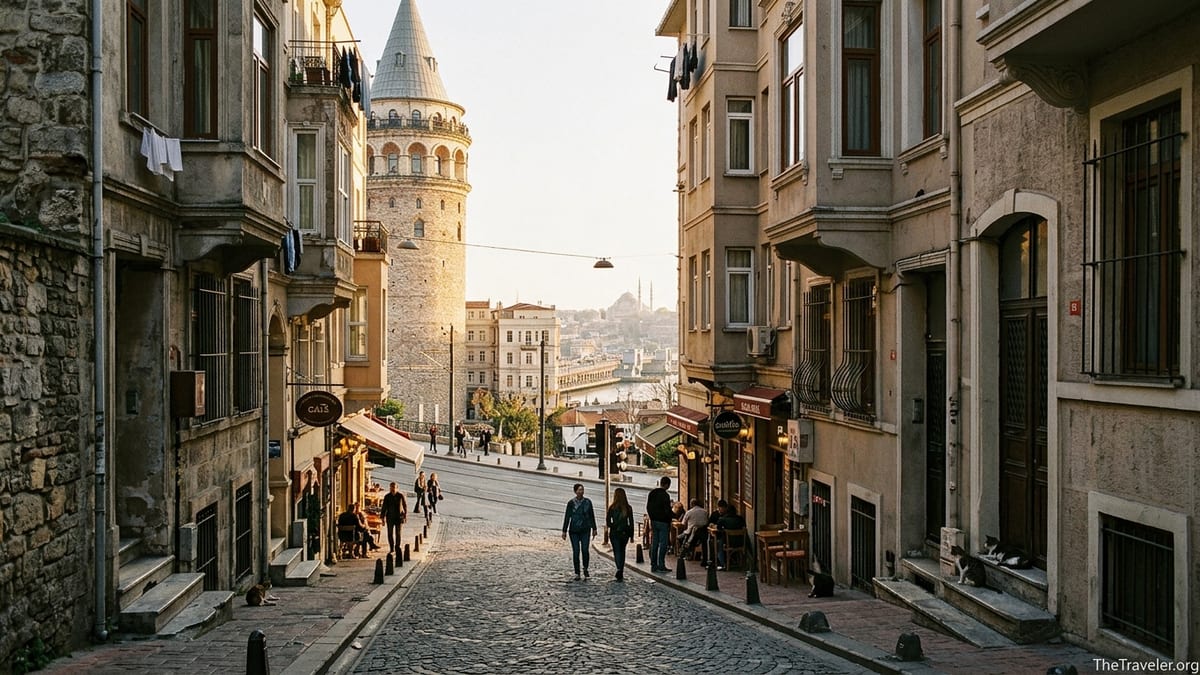
Galata Tower sits on top of Galata Hill in the Beyoğlu district, above the old Genoese quarter. Official visitor information notes that the streets immediately around the tower are steep and cobbled, which is exactly what gives the neighborhood its atmosphere but also what makes it tricky for some travelers. From the base of the tower down to the waterfront is only about 600 to 800 meters as the crow flies, yet the elevation drop is enough that you will feel it in your knees on the steeper lanes.
The good news is that you are walking downhill, not up. Even with photo stops, most reasonably fit visitors can manage the descent comfortably, especially if they choose gentler zigzagging streets instead of heading straight down the fall line. The main thing to remember is that narrow side alleys tend to be steeper, while slightly wider streets that carry taxis or small delivery vans usually follow a more manageable gradient.
If mobility is a concern, you can also “cheat” with public transport. The historic Tünel funicular links the bottom of the hill at Karaköy with the top of Beyoğlu; many travelers ride up with Tünel or take the T1 tram to Karaköy, then only walk the easier, mostly flat sections at the bottom such as the Karaköy waterfront, ferry piers and Galataport promenade, saving the hilltop area for short, targeted strolls.
Footwear matters more than distance. You will be walking on a mix of flat pavement, irregular stone and older cobbles. Closed shoes with decent grip are far better than smooth-soled sandals, especially if it has rained and the stones are slick. Even locals slow down on certain corners after a summer shower.
Classic Route: From Galata Tower to Karaköy via Kamondo Stairs
The classic downhill route begins on the small square at the base of Galata Tower, where cafés like the long-running Guney Restaurant provide an easy landmark. From here, one of the most popular ways down is to aim for the 19th-century Kamondo Stairs, a photogenic set of Art Nouveau stone steps built by the banking family whose name they carry. Contemporary descriptions of the area place these stairs on Bankalar Caddesi, the historic “Banks Street,” which gives you a sense of how this used to be the city’s financial district.
To follow this route, walk east from the tower on Büyük Hendek or Galata Kulesi Street, then descend gradually toward Bankalar Caddesi using side streets like Bereketzade Medresesi. This combination keeps the gradient moderate until you reach the top of the Kamondo Stairs themselves. Many guidebooks and city walking tours use exactly this sequence, because it threads together heritage buildings, glimpses of the Golden Horn between alleys and a satisfying finale at the sculptural staircase.
The Kamondo Stairs are wide and relatively short, so most visitors can manage them easily. They are also one of the most photographed staircases in Istanbul, which means you will likely see small groups queuing for a quick picture. If you visit early in the morning, you may have them largely to yourself and can take time to notice the worn stone treads, plantings in niches and the way the staircase curves like an interlocking double helix.
At the bottom of the stairs, you emerge onto Bankalar Caddesi. Turn left for a short walk to the northern end of Galata Bridge, or continue downhill and angle right to reach central Karaköy with its tram line, ferry piers and café streets. This route gives you a classic mix of old financial institutions, street art and neighborhood life before delivering you to the waterfront.
An Easier Descent: Gentle Streets and How to Avoid the Steepest Lanes
While the Kamondo route is iconic, it is not the only option. If you prefer a gentler gradient, a practical strategy is to avoid the narrower stone alleys directly east of the tower and instead walk out in a wider arc to meet the traffic-bearing streets that contour the hill. Locals often recommend heading first toward Şahkulu or Serdar-ı Ekrem Street, both of which are slightly uphill from the tower but quickly level out and then descend gradually toward Karaköy.
From Galata Tower, walk a minute or two in the direction of İstiklal Caddesi, then turn down one of the broader streets where you see taxis moving. A common choice is to descend via Şahkulu and then cut down toward Karaköy after you have passed most of the steepest section. This zigzag adds five or ten minutes but trades harsh slopes for a more even, rolling downhill with better sidewalk surfaces and fewer abrupt steps.
Travelers with knee issues or strollers may want to avoid the tight staircases that connect directly to the lower end of Galata Bridge. Some of these shortcuts, while tempting on a map, consist of uneven, narrow steps without handrails. A safer option is to aim for the main roads leading to the bridge, which typically have wider pavements, guardrails and occasional benches or walls where you can pause.
Another way to minimize climbing is to invert the problem: use public transport to go up, then walk down. For instance, you can ride the Tünel funicular up from Karaköy to Beyoğlu, wander the relatively flat spine of İstiklal Caddesi, then return to Galata Tower and make only the downhill section on foot. This is especially useful on hot July and August afternoons when even locals try to avoid grinding uphill in the sun.
Café Stops, Street Life and Photo Angles on the Way Down
One of the chief pleasures of walking from Galata Tower to Karaköy is how much everyday Istanbul life you see in a short distance. Streets close to the tower have long drawn independent cafés and bakeries. Travelers frequently mention spots like Café Privato for breakfast or Mandabatmaz for thick Turkish coffee in the wider Galata area. A simple breakfast of eggs, olives, cheese and bread at one of these cafés, plus coffee, often comes to a mid-range price that still feels reasonable by Western European standards in 2026.
As you descend toward Karaköy, the character of the streets shifts. You will pass small hardware stores, design boutiques, tattoo studios, and simple pide or döner shops where office workers queue at lunch. Places like Dönerci Engin Usta, often recommended by Istanbul residents, serve classic meat sandwiches that make an ideal refueling stop between the tower and the bridge. Expect to pay a modest amount for a generous portion compared with tourist-heavy districts.
Photo opportunities are constant. One classic frame captures Galata Tower peeking between tall residential buildings when you look back uphill from a side street; another uses the tram tracks near Karaköy to lead the eye up toward the tower’s conical roof. In the morning, the light often comes from the east, casting soft shadows across cobbles and highlighting the colors of shopfronts and bay windows. In late afternoon, warm light can catch laundry lines and satellite dishes, making for more textured, atmospheric street scenes.
Keep an eye out for street art on shuttered shopfronts and side walls, especially closer to the lower slopes where artists have more space. Many visitors find that some of their favorite images from Istanbul are not of big monuments but of a specific stairway painted in bright colors, an elderly resident watching from a balcony, or a cat sunning itself in a doorway. The Galata to Karaköy descent is rich in exactly this kind of detail.
Reaching the Waterfront: Karaköy Square, Galata Bridge and the Ferry Piers
The hill effectively ends where the tram line and main road meet at Karaköy Square, a busy junction beside the northern end of Galata Bridge. Official descriptions of the bridge emphasize its wide, flat pedestrian walkway and panoramic views of the Golden Horn and the historic peninsula, and this is where your downhill walk can transition into a scenic, almost level stroll. Many travelers continue across the bridge on foot to Eminönü and the Spice Bazaar, timing the walk for sunset to watch fishermen silhouetted against the skyline.
At water level around Karaköy, you will find multiple ferry piers. The main municipal pier, operated by the city ferry company, sends boats across to Kadıköy and Üsküdar on the Asian side, as well as up the Golden Horn to neighborhoods like Eyüp. These ferries are part of the regular public transport system, so fares are paid with the standard transit card and are generally inexpensive by international standards. Private operators run additional routes from nearby Turyol pier, particularly to Kadıköy, which can be handy if you just missed a municipal boat.
If you prefer to stay on the European side, it is easy to combine your downhill walk with a coffee stop under or beside Galata Bridge. The lower deck of the bridge has long housed simple fish restaurants and teahouses, where you can sit at plastic or metal chairs, order a glass of Turkish tea or a grilled fish sandwich and watch ferries pass under your feet. Prices here vary, and many waiters will approach you, so it is wise to confirm the menu before sitting down if you are on a budget.
For photographers, the corner where the bridge meets Karaköy offers strong compositions. Looking north, you can capture Galata Tower rising behind the waterfront; looking south, you see the domes and minarets of mosques on the historic peninsula. The light here changes throughout the day, but early evening often brings golden tones on the stone facades and a glow in the sky that reflects off the water.
Extending the Walk: Galataport Promenade, Museums and Seafront Cafés
From Karaköy Square, it is only a short, flat walk along the waterfront to Galataport, the large mixed-use district created by redeveloping the old port area. Official descriptions note that Galataport now covers hundreds of thousands of square meters and combines an underground cruise terminal with an open-air promenade atop it, lined with more than two hundred shops, cafés and restaurants. Crucially for walkers, the seafront path from Karaköy to the Tophane tram stop is almost entirely level and step-free.
This makes Galataport an excellent extension of your downhill route if you still have energy. You can stroll past international fashion brands and Turkish design stores, pause at a café terrace for a coffee or fresh juice, or sit on one of the benches facing the Bosphorus to watch container ships, ferries and private boats pass between Europe and Asia. A simple coffee in one of the mid-range cafés here typically costs more than in backstreet Galata, reflecting the waterfront location and modern development, but many visitors find the views worth the markup.
Galataport is also home to major cultural institutions such as Istanbul Modern, the city’s flagship modern and contemporary art museum. If you time your downhill walk from Galata Tower to arrive here in the late morning or afternoon, you can combine street photography with a museum visit and a leisurely lunch. Restaurant options range from casual Turkish chains to destination dining at hotels like The Peninsula, so you can choose according to your budget and mood.
If your ship is docked at Galataport, you can essentially invert the walk: step off the cruise terminal, follow the flat promenade to Karaköy, then climb gently toward Galata Tower or take Tünel up to Beyoğlu and stroll back down through the lanes later in the day. For many cruise passengers with limited time in port, this combination of level waterfront and one concentrated hill section provides a good taste of the area without excessive exertion.
When to Walk, Safety Tips and Practical Details
The Galata to Karaköy descent is enjoyable in most seasons, but certain times of day enhance the experience. Mornings are generally quieter on the streets immediately below Galata Tower, making it easier to photograph alleys without crowds and to find seats at popular cafés. Late afternoon and early evening bring softer light, more locals out and about, and the chance to finish your walk by watching sunset from Galata Bridge or the Galataport promenade.
In summer, midday heat can be intense on the exposed sections near the bridge and along the waterfront. If you must walk then, carry water and wear a hat, and consider taking shaded backstreets where possible. Winters in Istanbul are milder than in many northern cities but still cool and wet at times; rain makes smooth stones slippery, so use extra care on staircases like Kamondo and avoid rushing downhill.
In terms of safety, this is a busy central area that sees a mix of tourists, local workers and residents throughout the day. Petty theft can happen, as in any major city, so keep phones and wallets secure, especially when stopping to take photos on crowded corners or on the bridge. Be cautious when stepping into the street for a better angle; small delivery vans and scooters often move quickly on narrow roads. At night, main routes such as the streets leading to Galata Bridge and Karaköy Square remain active and generally feel safe, but less-lit side alleys can feel isolated, so many visitors prefer to stick to better-lit paths late in the evening.
Public toilets are not abundant directly on the hill, but you can usually find facilities in cafés if you purchase something, and there are more options around Karaköy Square, ferry terminals and Galataport. Transit access is excellent at the bottom: the T1 tram runs along the waterfront, the Tünel funicular climbs back up the hill, and multiple bus and ferry lines fan out to other parts of the city, giving you many choices for your onward journey.
The Takeaway
Walking downhill from Galata Tower to Karaköy is one of Istanbul’s most compact yet varied urban experiences. In less than a couple of kilometers, you pass from medieval fortification to 19th-century banks, from sculptural staircases to graffiti-splashed walls, from neighborhood döner shops to contemporary waterfront cafés. It is a walk that rewards looking up at carved stone balconies and looking down at worn steps, lingering in side streets as well as on famous viewpoints like Galata Bridge.
By choosing your route carefully, you can tailor the experience to your comfort level. Those who enjoy a bit of drama can head straight for the Kamondo Stairs and the steeper lanes; those who prefer gentler gradients can zigzag via broader streets and focus on the mostly flat sections along the Golden Horn and Bosphorus. In all cases, comfortable shoes, unhurried time and a willingness to pause for coffee or tea will transform the descent from a simple A to B into a highlight of your visit.
Combine the hill with a ferry ride from Karaköy to the Asian side, or with a museum visit and seafront walk at Galataport, and this short downhill route becomes the backbone of a full day in the city. Whether you are staying near the tower, arriving by cruise ship, or crossing from the Old City for an afternoon, the path from Galata to Karaköy offers a dense, walkable slice of Istanbul’s past and present in just a few hundred vertical meters.
FAQ
Q1. How long does it take to walk from Galata Tower to Karaköy?
The direct downhill walk can be done in about 15 to 25 minutes, but most travelers spend at least an hour with photo stops and a café break.
Q2. Is the walk from Galata Tower to Karaköy suitable for people with limited mobility?
Parts of the hill are steep and cobbled, which can be challenging. Choosing gentler streets, moving slowly, and using public transport for the uphill sections can make it more manageable, but it is not fully step-free.
Q3. What is the easiest route down from Galata Tower to avoid the steepest streets?
Instead of heading straight down narrow alleys, walk first toward broader streets like Şahkulu or Serdar-ı Ekrem, then descend in a zigzag toward Karaköy and Galata Bridge, which spreads the slope over a longer distance.
Q4. Where are the best photo spots between Galata Tower and Karaköy?
Favorite spots include the Kamondo Stairs on Bankalar Caddesi, side streets that frame Galata Tower between tall buildings, the northern end of Galata Bridge, and the Galataport promenade facing the Bosphorus.
Q5. Are there good cafés and restaurants along the way?
Yes, you will find popular breakfast and coffee places near the tower, simple döner shops and bakeries on the descent, and a wide range of cafés and restaurants around Karaköy Square and along the Galataport waterfront.
Q6. Is it better to walk this route in the morning or evening?
Mornings are quieter and cooler on the hill, making it ideal for exploring side streets and cafés, while late afternoon and evening offer softer light and lively scenes on Galata Bridge and the waterfront.
Q7. Can I combine the walk with a ferry trip?
Yes. At the bottom of the hill, Karaköy’s ferry piers offer regular boats to Kadıköy, Üsküdar and up the Golden Horn, so many visitors walk downhill, then cross to the Asian side by ferry.
Q8. How do I reach Galataport from Karaköy after walking down?
From Karaköy Square, simply follow the flat waterfront promenade in the direction of Tophane. In a short, level walk you will enter the Galataport district with its shops, museums and cafés.
Q9. Is the route safe to walk after dark?
Main streets between Galata Tower, Karaköy Square and Galata Bridge remain active in the evening and generally feel safe, though it is sensible to avoid poorly lit alleys, keep valuables secure and stay aware of traffic.
Q10. What kind of shoes and clothing should I wear for this walk?
Closed, comfortable shoes with good grip are best for cobbled and uneven surfaces, and in summer light, breathable clothing plus a hat and water are recommended for the sunny sections near the bridge and waterfront.